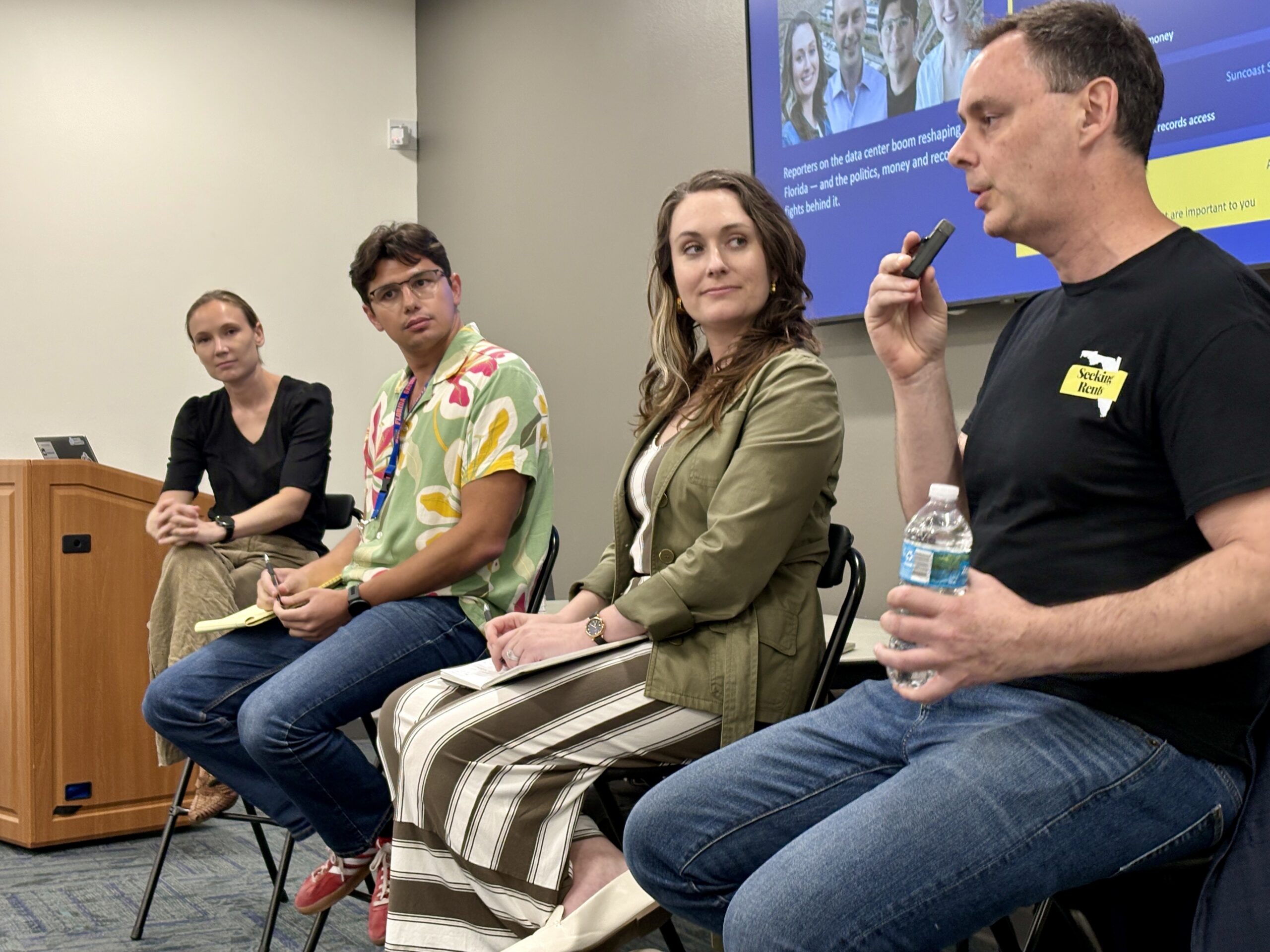
Reporters (from left to right) Alice Herman and Christian Casale of Suncoast Searchlight, Emily Mahoney, of the Tampa Bay Times, and Jason Garcia, of Seeking Rents, discussed data centers in a panel hosted by Seeking Rents and Suncoast Searchlight Tuesday evening | Emily Le Coz, Suncoast Searchlight
At Venice data center forum, journalists highlight power of community pushback
Proposals for hyperscale data centers are surging in Florida and across the country, but community voices have become a powerful force to slow, and in some cases stop, those proposals.
That was the message shared Tuesday by a panel of journalists in an event hosted by Suncoast Searchlight and Seeking Rents.
“The more engaged folks are with this, the more responsive policy makers will be,” Jason Garcia, the founder, publisher and accountability reporter for Seeking Rents, said during the discussion.
The event, called “Powering the Future? Data Centers on the Suncoast,” drew nearly a hundred attendees to the Frances T. Bourne Jacaranda Library in Venice and featured a panel of four reporters. They included: Garcia, whose independent publication produces accountability journalism about Florida politics and the influence of business and special interests on public policy; Alice Herman and Christian Casale, investigative and government reporters for Suncoast Searchlight; and Emily Mahoney, who reports on energy for the Tampa Bay Times.
The discussion focused on the power of community engagement in influencing local government responses to proposed data centers, and the financial influence that data companies have on statewide and local leaders.
Data center proposals are growing, and statewide legislation to regulate them has been weak
All four journalists have been covering the recent wave of proposed data centers across the state, including one in Fort Meade that Mahoney said could become Florida’s first large-scale data center — if the project can get a water permit approved — and one in DeSoto County that can continue moving forward because it was already under consideration when county commissioners passed a moratorium on new proposals.
Data centers aren’t a new invention, but they have historically been much smaller and less prolific than the hyperscale, AI-driven projects being proposed now, according to Mahoney, who has been active in covering the proposals across the state.
“As soon as one disappears, there are three more that have popped up that I hadn’t heard about before,” she said during the discussion.
Part of the reason the proposals seem to pop out so quickly is because local governments are allowed to sign non-disclosure agreements with the companies proposing the facilities, meaning in many cases, the public won’t hear about a proposal until planning is well underway.
The reporters discussed Senate Bill 484, a new law that passed earlier this year in Florida that was advertised as a way to prevent utility cost increases related to data centers and to give local governments power to block data center proposals. But the law was not as forceful as it could have been.
Earlier drafts of the law included a ban on non-disclosure agreements, something that data companies like DCIP group — the company behind the proposed data center in DeSoto County — lobbied lawmakers to remove before the bill passed.
“That legislation … is far weaker than what they initially pitched,” Garcia said. “There is some good stuff in this bill, but it could have been so much better.”
Herman, who has been covering the DeSoto County proposal, said documents she received through public records requests were vital in providing community members with all the details of the proposal and what it could mean for them — something that helped residents in their ongoing efforts to stop the proposal.
“We might not have gotten all those records if they had signed an NDA,” Herman said. “I think that there’s a strong possibility that the commissioners will actually say no to those developments.”
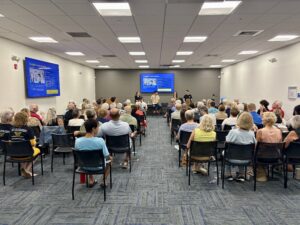
Nearly a hundred community members attended a panel discussion Tuesday about data centers and their impact in Florida. | Emily Le Coz, Suncoast Searchlight
Communities are uniting in opposition to proposed data centers
DeSoto County is one of several communities across Florida where residents from all sides of the political aisles have united in opposition to proposed data centers, the reporters said.
“Something we’re seeing right now across the state and across the country are people really rebelling against data centers,” Casale said during the discussion.
Senate Bill 484 ensured local governments have the power to reject proposals for new data centers, and the reporters emphasized that individual community members can have a lot more sway with their local leaders than with state legislators.
“The more engaged folks are with this, the more responsive policy makers will be,” Garcia said.
Mahoney added that she has seen a number of local governments hit pause or take a step back on proposed data centers after community members rallied in local city and county meetings.
Many of the same concerns that people are bringing to local government meetings were expressed by attendees at the panel discussion, who asked the journalists questions about what, if any, benefit the data centers may have, and how data companies are working to get lawmakers on their side.
Mahoney said community members on all sides of the political aisles are bringing similar concerns to their local officials. People are worried about water availability during the ongoing drought, electric bills increasing, air and noise pollution, and even cultural concerns like the possibility that a large-scale industrial project will change the character of rural areas.
“This issue is top of mind,” she said. “No matter where people fall on the political spectrum, this industry and the way it’s coming into where we live has felt exploitative to them.”
Emily Anderson is a watchdog/investigative reporter for Suncoast Searchlight. Email her at eanadersen@suncoastsearchlight.org.