
Cast members from the Westcoast Black Theatre’s world premiere of “Lies, Spells & Old Wives’ Tales” create a quilt. | Photo by Sorcha Augustine provided by WBTT
Florida’s new anti-DEI law threatens funding for Sarasota arts groups
Sarasota County arts organizations seeking a share of $2.1 million in public grant funding this year are facing a new requirement tied to recently approved Florida restrictions on diversity, equity and inclusion initiatives.
Some have signed a county acknowledgment of the law despite deep reservations. One has refused, forfeiting funding it can scarcely afford to lose.
The acknowledgment, added this year to Sarasota County’s cultural grant agreements, cites a state law — Senate Bill 1134 — signed by Gov. Ron DeSantis in April and going into effect on Jan. 1 that prohibits counties from using public money to support DEI initiatives.
DEI is defined in the bill as any effort to use race, color, sex, ethnicity, gender identity, or sexual orientation to influence hiring, provide preferential treatment, or promote programming and activities.
The acknowledgment requirement applies to any organization receiving a county grant, Sarasota County spokesperson Josh Taylor said in an email statement to Suncoast Searchlight.
Sarasota’s arts community offers an early test of how the law could affect organizations whose missions and programming center on the communities or identities referenced in the law. Arts leaders say they are left questioning how the law will be interpreted, how it will be enforced, whether organizations built around serving particular communities could become targets and what, if anything, would constitute a violation.
The mission statement for Sarasota’s Urbanite Theatre includes a commitment to “inclusive, artist-first storytelling.”
“Inclusive” making the “I” in DEI.
One of Urbanite’s plays next season is called “Black Bastard,” which, as the name may imply, touches on race. Another play, “1999,” is about gender and the #MeToo movement.

Jon Joseph Gentry, left, and Tyler Gevas in a scene from the Urbanite Theatre production of “Monsters of the American Cinema.” Gentry will return to the theater in the 2026-27 season with his original play “Black Bastard.” | Photo by Sorcha Augustine provided by Urbanite Theatre
Summer Wallace, the co-founder and producing artistic director of Urbanite, did not sign the county’s acknowledgment, forfeiting $40,230 for its 2026-27 Main Stage Season.
“As an arts leader and theater maker, what I’m reckoning with is that it does not feel good taking grants that can’t be utilized for those programs,” Wallace said. “Technically, I think we could be fine, but it goes into the matter of ethical theater making.”

Summer Wallace, Producing Artistic Director of Urbanite Theatre. | Photo by Sorcha Augustine
Still, it was not an easy decision. Any rejection of funding is nerve-wracking for a small theater like Urbanite. Wallace is already projecting a financial loss for next year and scrambling for donations.
The grants are funded by the county’s Tourist Development Cultural/Arts (TDC/A) program, which uses tourism tax dollars to support cultural events, exhibitions and performances that draw visitors to the area. The Arts and Cultural Alliance of Sarasota County administers the program.
The current fund cycle has been in motion since January, when applications opened for organizations to apply.
An Alliance review panel has already scored this year’s proposals and recommended awarding $2.1 million to 34 organizations. The recommendations range from $9,387 for La Musica’s 2026-27 Season to $111,749 for several programs, including Marie Selby Botanical Gardens’ Jean & Alfred Goldstein Exhibition.
The Alliance will present its recommendations to the county commission for final review at the board’s Aug. 26 meeting, according to Brian Hersh, the organization’s CEO. The review was initially scheduled to appear before the commission in July, before it was postponed.
“As part of administering the grant program, the Alliance shared an acknowledgment form with applicants to ensure they were informed of the new language being added to the grant contracts this funding cycle,” Hersh said in an email.
Arts groups could lose reimbursements if found to violate DEI law
The TDC/A contracts are overseen by the county’s Parks and Recreation Department. As the grants come in the form of reimbursements, the department would determine whether arts groups violated the state DEI law, and thus forfeit their funds.
Taylor said the county will comply with the new state law.
“These grants are reimbursement-based,” the spokesman wrote in an email. “Any violation of the grant agreement or applicable law will be addressed pursuant to the agreement terms and county policy. The Office of the County Attorney does not oversee day-to-day contract compliance.”
Since 1999, the Westcoast Black Theatre Troupe has put on performances that celebrate African-American entertainment and culture. At its theater just south of the train tracks that intersect Orange Avenue, the group’s 2026-27 season is called “Rhapsodies of Rhythm.”
The group said the year’s shows, which will include “A Midsummer Night’s Dream,” “Stevie: A Stevie Wonder Revue,” and “A Motown Christmas,” will celebrate “a musically poetic changing of beats and the diverse sounds of jazz, pop, R&B and the blues.”
WBTT was recommended to receive more than $100,000 from the county for “Rhapsodies of Rhythm.” However, the new state guidelines have suddenly cast doubt on what could be critical funding for a cornerstone of Sarasota’s cultural community. With a stated mission to promote Black history and entertainment, could the theater run afoul of a state law that forbids public funds for programming that references race and color?
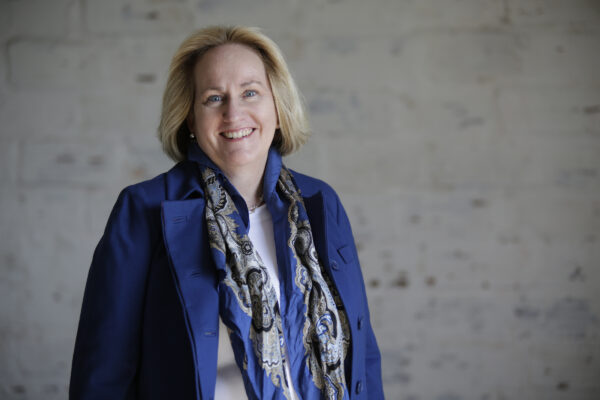
Julie Leach, the executive director of the Westcoast Black Theatre Troupe. | Provided by WBTT.
Julie Leach, the company’s executive director for more than a decade, said she originally was not going to sign the agreement, but eventually decided to after some deliberation. Ultimately, WBTT was reluctant to turn away the money.
“It’s just really, really vague and the remedy is someone could sue the county if they feel they’re supporting something that’s preferential,” Leach said. “But that may happen because we have Black in our name and all our programming is about the Black experience in America, which is real. This is a perfect example of state overreach, and I feel like the county’s in the middle and they have to decide what they need to do.”
Leach was struck by the part of the law that said grantees’ programs could not be designed to reference race, gender identity, ethnicity, or sexual orientation. The vagueness of the law has sowed discord and confusion among arts groups such as WBTT, whose entire essence is defined by race.
“We are not changing our programming or our purpose, and we’re a vital part of the tourist economy here,” Leach said. “If (the county is) not comfortable with that, they’ll have to knock us off.”
DEI law follows DeSantis’ culture war, growing state pressure on local governments
DEI has for years been a front in Gov. Ron DeSantis’ wide-ranging culture war, which escalated as he geared up for the 2024 presidential election. In 2023, he signed a bill at Sarasota’s New College of Florida that banned the state’s public colleges and universities from spending money on DEI programs.
When he signed SB 1134 into law in April, DeSantis said, “Floridians should not be forced to pay for radical climate agendas or identity politics with their hard-earned tax dollars.”
State Sen. Clay Yarborough, R-Jacksonville, the bill’s sponsor, did not respond to Suncoast Searchlight requests for comment to his office, email and personal cell phone.
The governor’s office also did not respond to voicemail and email requests for comment.
The mandate comes amid a wider wresting of control over local government by Tallahassee. Sarasota County commissioners are being sued personally by a developer for blocking an apartment project proposed under Florida’s Live Local Act. Local elected officials have also blasted the proposed property tax amendment as potentially disastrous to their budgets and a power grab by Tallahassee politicians.
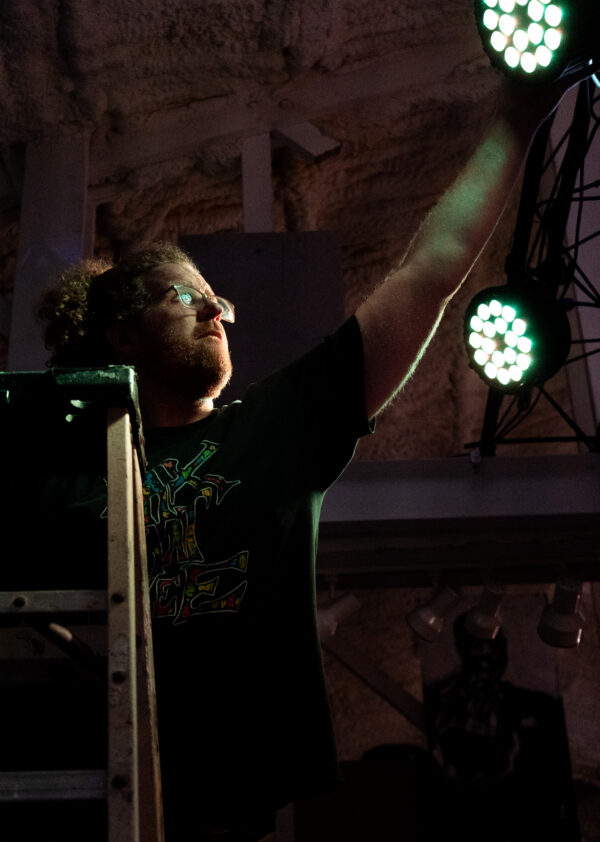
WSLR+Fogartyville General Manager Jesse Coleman install new lighting at his station’s performance venue. | Photo by Gabriela Szymanowska.
The penalties for violating Florida’s law on DEI have been vague. SB 1134 stipulates that any resident could sue their county for relief and damages if the court finds that public funds went toward DEI.
Much of Sarasota’s tourism appeal comes from its branding as Florida’s “Cultural Coast”; city roundabouts swirl around vibrant, abstract sculptures as part of public arts projects. Many of downtown’s architectural landmarks house a theater, art gallery, or performing arts center.
WSLR+Fogartyville is a public radio station and events space in the Rosemary District. Jesse Coleman, the station’s general manager and executive director, signed the agreement for a grant to fund the upcoming Fogartyville concert series. He emphasized that the grant funding is narrow in scope.
“Our values are funded by our community, not a single grant,” Coleman said.
The station has been spurned by Sarasota County in the past. In 2024, a commission more in touch with conservative culture politics unanimously declined to award WSLR nearly $28,000 in funds for its Fogartyville concert series. It came at a time when the commission also cut ties with the nonprofit organization United Way because its 211 helpline included referrals to abortion services.
Coleman blasted SB 1134 as hurtful to local tourism and another attack on the arts community by DeSantis.
“You don’t grow tourism by telling a community arts center to be less open. It’s small-minded, and it’s a self-defeating move by the state,” Coleman said.
Christian Casale covers government and politics for Suncoast Searchlight. Email him at christian@suncoastsearchlight.org. Jay Handelman and Carrie Seidman are the founders and editors of ArtsBeat, a nonprofit news organization that covers arts and culture in Sarasota.
Editor’s Note: This story was updated to correct the range of recommended grant amounts to reflect the newest figures.