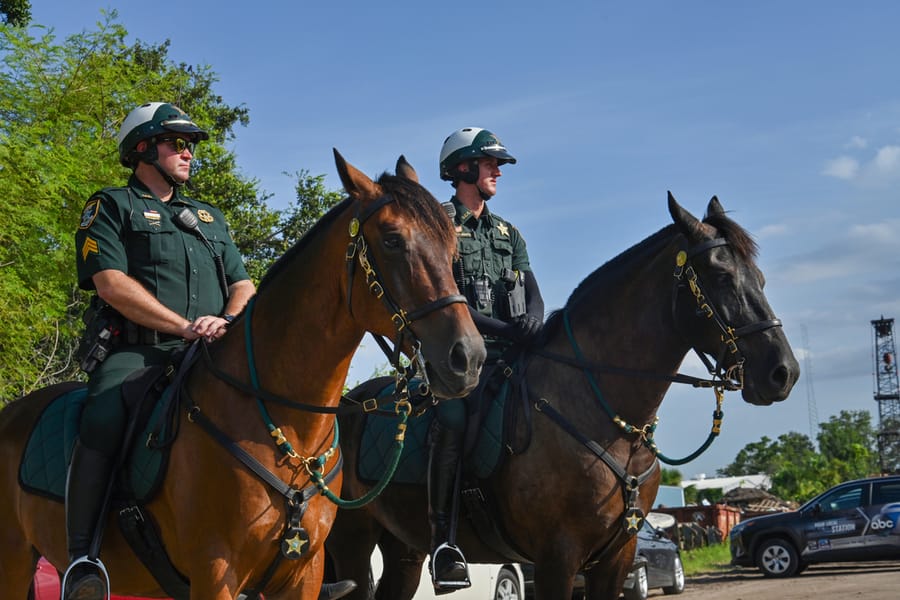
Two Sarasota County Sheriff's deputies on horseback. | Photo courtesy of Sarasota County
DeSantis railed against ‘Defund the police.’ Amendment 3 could do just that
For years, Gov. Ron DeSantis has made support for law enforcement a key pillar of his political identity.
He has held press conferences in front of lecterns emblazoned with “Florida Supports Law Enforcement,” signed legislation aimed at recruiting and retaining police officers, castigated the “defund the police” movement and accused political opponents of jeopardizing public safety.
In 2022, 59 Florida sheriffs endorsed his reelection.
Now, a property tax measure championed by DeSantis is forcing some Florida law enforcement agencies to contemplate something they have largely avoided for years — substantial budget cuts.
Amendment 3, which will appear on Florida’s November ballot and requires 60% voter approval to pass, would sharply expand the state’s homestead exemption and reduce the property tax revenue that counties and cities use to pay for police, fire rescue, roads, parks and other services.
The savings for homeowners could be significant. So could the consequences for their local law enforcement.
“The overall feeling is that this is going to hurt law enforcement. This is going to hurt our communities. This is going to hurt our public safety,” said Marion County Sheriff Billy Woods, a fifth-generation county resident and 37-year law enforcement veteran who has led the Florida Sheriffs Association since July.
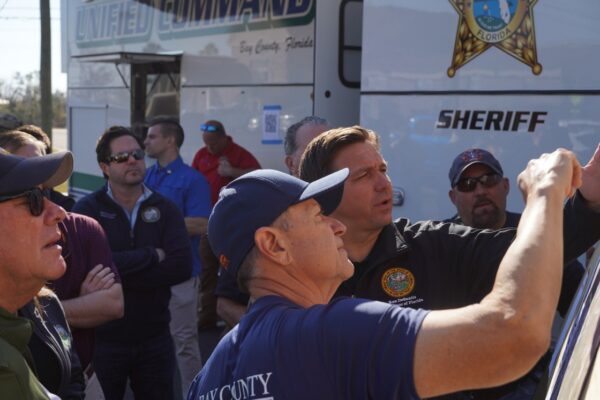
For years, Gov. Ron DeSantis has made support for law enforcement a key pillar of his political identity. | Photo courtesy of the Governor’s Office
Woods said Amendment 3 could be interpreted as “a hidden way of defunding the police.”
On the Suncoast, the potential consequences are already coming into focus.
In Sarasota and Manatee counties, where law enforcement consumes the lion’s share of general fund spending, sheriffs say losses of the magnitude being projected could force them to reconsider services that extend beyond patrol and criminal investigations. Smaller police departments have even less room to maneuver.
Sarasota County projects it would lose $134 million in property tax revenue over the first two years if Amendment 3 passes. Based on how the county currently divides its general fund, about $54.2 million of that would fall on the Sheriff’s Office — more than one-tenth of its current budget each year.
Sheriff Kurt Hoffman said his office has begun examining potential cuts, including services it is not legally required to provide. Manatee County Sheriff Rick Wells said he expects to freeze positions if the amendment passes and his budget falls by about 20%. And in Venice, Police Chief Andy Leisenring is preparing for the possibility of cuts he said could rival those his department endured during the Great Recession.
They are hardly alone.
Law enforcement representatives across Florida have warned that Amendment 3 could threaten public safety funding. Woods, whose association represents the state’s 67 sheriffs, remains a DeSantis supporter and praised the governor’s record on law enforcement. He also favors easing the burden on taxpayers; but Amendment 3, he emphasized, was the wrong way to go about it.
“I don’t care how pretty they make it sound,” Woods said. “How great they can put the words in there. The fact is: it is going to hurt public safety, no matter how you equate it.”
The Florida Sheriffs Association has taken that message directly to voters, releasing a video recently with some of its highest-profile sheriffs — Grady Judd of Polk County, Pinellas County’s Bob Gualtieri and John Mina of Orange County — warning that cutting property taxes could ultimately mean cuts to public safety.
“Amendment 3 sounded too good to be true,” the video said, “and now you know it is.”
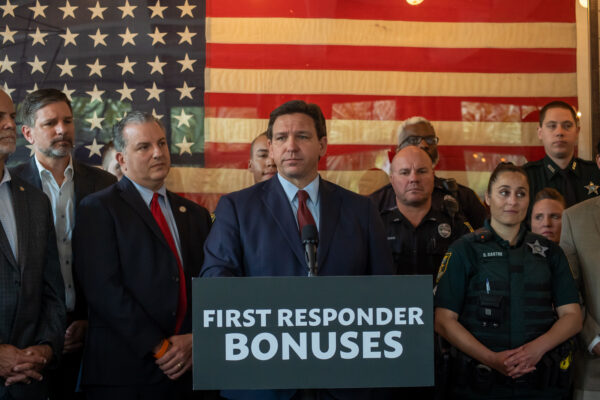
Florida Gov. Ron DeSantis announced $1,000 bonuses for first responders in 2022. | Photo courtesy of the Governor’s Office
The Florida Fraternal Order of Police raised similar concerns in July, saying that the amendment “creates far too much uncertainty about how local governments would continue to fund law enforcement, fire rescue, emergency medical services, and other critical public safety functions.”
DeSantis has dismissed those warnings as “fear-mongering.”
His press secretary, Molly Best, referred Suncoast Searchlight to comments DeSantis made during Tuesday’s Florida Cabinet meeting. The governor said state grants could be used to fill in some law enforcement gaps.
“If there is a local police department that needs an officer or two, we’ve got great money,” DeSantis said. “I’m happy to help through a transitional phase.”
Amendment 3: Savings for homeowners, cuts for their police
Florida homeowners already receive a homestead exemption that shields a portion of their primary residence’s assessed value from property taxes. Amendment 3 would dramatically expand that break.
For taxes levied by counties, cities and other local governments — but not school districts — the amendment would triple the exemption from its current amount of about $50,000 to $150,000 in 2027 and to $250,000 in 2028. For non-homestead properties, including many second homes, it would lower the cap on annual increases in assessed value from 10% to 5%.
The constitutional amendment would place new restrictions on how counties and municipalities could spend the property tax revenue they collect, limiting it to specified purposes like public safety, debt payments and employee retirement benefits.
For local governments, though, the provision with the most immediate financial consequence is the larger homestead exemption. The more property value that is exempt from taxation, the smaller the tax base available to fund local services.
Over five years, Sarasota County is projected to lose $386.56 million in revenue and Manatee County $498.65 million as a result of the amendment’s exemptions, according to the Florida Association of Counties.
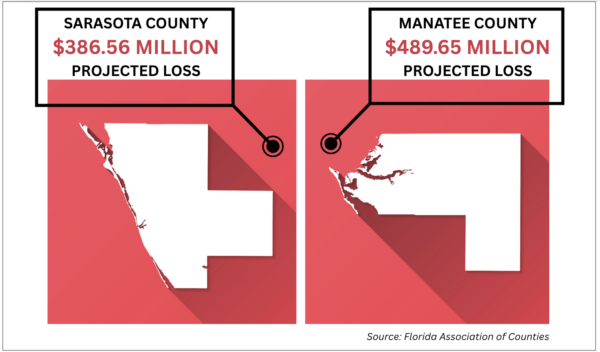
Suncoast Searchlight graphic
The effects wouldn’t be limited to general funds. Some counties, including Charlotte and DeSoto, levy additional property taxes through Municipal Service Taxing Units, or MSTUs, to help pay for law enforcement. Those revenues also would be affected by Amendment 3. All told, law enforcement MSTUs in 13 counties are projected to lose over $422 million over two years if the amendment passes, according to a projection by the Florida Policy Institute.
The potential impact on law enforcement stands in contrast to DeSantis’ own recent rhetoric.
Just last month, at an event where he was awarding recruitment bonuses to new officers in Pasco County, DeSantis cast himself as a defender of law enforcement.
“In 2022, while some cities were reaping the disastrous results of ‘defund the police’ experiments, I signed landmark legislation to strengthen law enforcement recruitment and retention in Florida,” the governor said.
The “defund the police” movement gained national prominence during the racial justice protests that followed George Floyd’s murder by a Minneapolis police officer in 2020. While the movement encompassed a range of ideas, many advocates called for shifting some money from police departments to social services and other programs intended to address the underlying causes of crime.
Some sherifs, including Woods, now say those kinds of programs — including homeless outreach and mental health services that their agencies have taken on — could themselves be vulnerable under the proposed tax cuts.
Amendment 3 is a very different policy born of a very different political movement. But for law enforcement agencies that depend heavily on property taxes, its passage could produce a similar result, one that DeSantis has spent years railing against — less money for police.
Sarasota, Manatee sheriffs warn of potential service pullbacks
Like many Florida homeowners, Kurt Hoffman the citizen stands to benefit personally from Amendment 3’s property tax cut.
“My wife is very in favor of it,” Hoffman said. “You know, we have that debate inside our house, as I’m sure lots of folks do about it.”
But Hoffman the Sarasota County Sheriff sees the other side of the equation. His agency could lose an estimated $54.2 million over two years if the amendment passes.
The Sheriff’s Office is by far the largest draw on Sarasota County’s general fund, accounting for 44% of its spending.
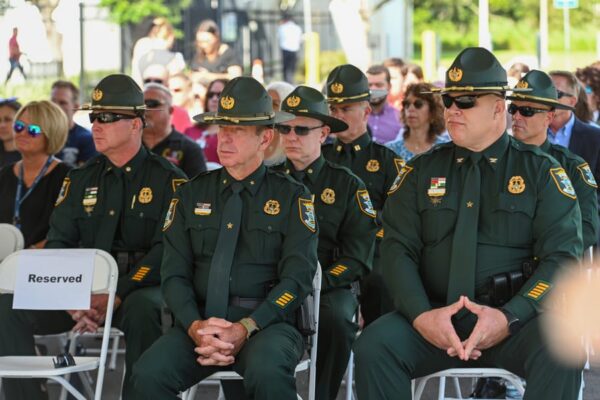
Sarasota County Sheriff Kurt Hoffman (center) at a 9/11 commemoration event in 2025. | Photo courtesy of Sarasota County
Hoffman said there has been some formal planning so far for how his agency would absorb a cut of that magnitude. But he and his staff have begun looking at what the Sheriff’s Office does that isn’t legally required to do.
“What are some of the things that we’re doing that we’re not mandated to do?” Hoffman said. “Not only vis-à-vis our relationship with the county, but also our relationship with other law enforcement agencies.”
The list extends beyond traditional patrol and criminal investigations. The agency operates two homeless outreach teams. Its deputies assist the Florida Highway Patrol at traffic crashes and support municipal police departments and other law enforcement agencies — services Hoffman said could come under scrutiny if his budget shrinks.
“I’m not saying by any means that those would go away, but those are things that you at least have to have the conversation about when you’ve asked the sheriff to do above and beyond what the responsibilities are under Chapter 30,” Hoffman said, referring to the section of Florida law that defines sheriffs’ duties.
Hoffman said the county may also have to examine how it pays for the Sheriff’s Office to operate the jail and provide animal services.
The prospect of cuts comes after years of substantial growth in the Sheriff’s Office budget. The agency received $88.5 million in 2009 and $224.4 million in the most recent budget, an increase of about 154%.
Over the same period, reported serious crime moved sharply in the other direction. “Part I” crimes in Sarasota County — murder, rape, robbery, aggravated assault, burglary, larceny and motor vehicle theft — fell 67%, from 9,131 in 2009 to 2,986 in 2025, according to the Sheriff’s Office’s.
Violent crime state-wide also dropped over that timespan, but not to the level seen in Sarasota County.
Hoffman’s colleague to the north, Manatee County Sheriff Rick Wells, is already thinking about how a 20% budget cut could ripple beyond his own agency.
Wells warned that his office may have fewer resources to assist the much smaller police departments in communities such as Bradenton Beach and Holmes Beach.
For smaller departments, that could mean losing some of the backup they receive from county sheriffs while confronting their own budget pressures.
Small-town police departments could feel the heat
Venice Police Chief Andy Leisenring remembers what that kind of budget pressure looks like.
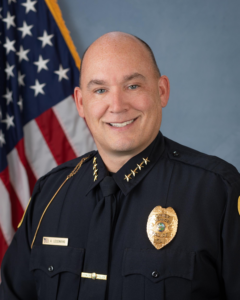
Venice Police Chief Andy Leisenring | Photo courtesy of the City of Venice
The last time his department faced significant cuts was during the Great Recession. Leisenring had just joined VPD, he recalled, when then-Chief Julie Williams was told to find $1 million to cut.
“That was a big hit in the gut, and anything other than that we had in our operation side was basically cut to bare bones, and our pay was frozen,” Leisenring said.
Now, about 20 years later, at the helm of the department where he made his career, Leisenring may face a similar dilemma. Venice is projected to lose $5.4 million if Amendment 3 passes; 39% of the city’s general fund goes to the police department.
Leisenring said he would prioritize cutting “things over people,” leaving little flexibility. About 83% of VPD’s budget goes toward personnel.
But those “things” include some of the tools and services that residents have come to expect.
Venice is a city of about 30,000 residents with relatively little violent crime. Its police officers spend much of their time at community events and providing what Leisenring called a “concierge-level service” — the kind of small-town policing in which residents call the department with problems that might fall outside traditional law enforcement.
“We really have that personal small-town touch, but that does create additional work,” Leisenring said. “We have a lot of things that may pull us in a lot of different directions as we try to provide the service that the community wants and expects from us.”
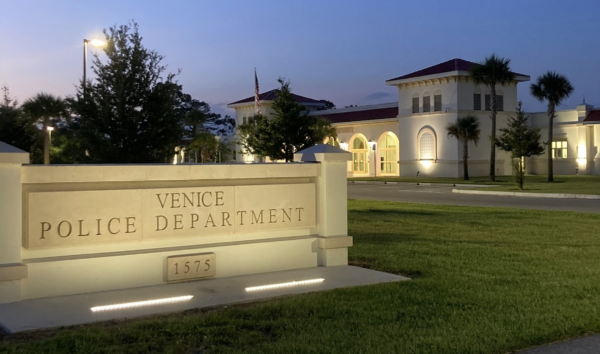
Venice is a city of about 30,000 residents with relatively little violent crime. Its police officers spend much of their time at community events and providing what the chief called a “concierge-level service.” | Photo courtesy of the Venice Police Department
Technology is another major expense. The department recently added body cameras, which Leisenring said cost hundreds of thousands of dollars to maintain.
“They want that transparency, and that comes with a price tag,” he said.
Woods said the same calculation is playing out in Marion County, where his agency is staring down $61 million in cuts — more than a quarter of the budget. Rather than lay off personnel and risk longer emergency response times, he said he would likely look at cutting costly technology, including body and car cameras.
In Venice, Leisenring isn’t yet ready to say what would make the cut. He said the department has contingency plans, depending on whether the amendment passes and how the City Council handles any shortfall, but they aren’t far enough along to share.
Venice Mayor Nick Pachota did not respond to a request for comment. A city fact sheet highlighted that “the amendment could impact public safety funding.”
Christian Casale covers government and politics for Suncoast Searchlight. Email him at christian@suncoastsearchlight.org.