
Owen Vaughan, 1, plays on an outdoor playset at Children First in Sarasota on Sept. 9, 2026. Owen and his older brother, Donovan, both attend Children First for early childhood education. | Emily Andersen, Suncoast Searchlight
Head Start overhaul could reshape services for Sarasota families
Each morning on the way to preschool, Savannah Vaughan has the same conversation with her oldest son.
“We’re going to have a good…” She starts the sentence.
“A good day!” Her son, Donovan, finishes it.
They go back and forth, with Vaughan prompting and Donovan finishing more phrases: “We’re going to be nice…” “to our friends!” “And we’re going to listen…” “to our teachers!”
It’s a routine the soon-to-be mother of three started earlier this year to help her 3-year-old prepare for the day and remember to be kind — and not to hit other kids, something he struggled with when he started attending Children First programs last year.
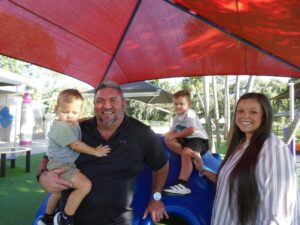
Savannah Vaughan poses for a photo with her father, Robert Strohschein, and her two sons, Donovan and Owen Vaughan, at Children First in Sarasota on Sept. 9, 2026. | Emily Andersen, Suncoast Searchlight
Savannah credits the patience and care Donovan has received through Children First, a nonprofit that administers the federal Head Start program in Sarasota County, with helping him address behavioral problems during a difficult adjustment period.
But the programming that helped Donovan and thousands of other children and families could now be under threat if a new proposal by the U.S. Department of Health and Human Services is approved after a public comment period that ends next month.
Announced in August, the proposal wouldn’t directly cut funding to Head Start — a federal program that provides free childcare and preschool services to low-income families — but it would eliminate many of its federal regulations. Sarasota County providers worry the change could ultimately reduce funding and make it more difficult to maintain support for families.
Head Start began in 1965 and is administered across the country by local organizations, like nonprofits and school districts. Its focus is on providing early childhood education to families in poverty, including those experiencing homelessness and children in foster care.
Head Start also provides disability and other health services for students, works with parents to improve job and financial stability, and refers families who need additional support to other social service agencies.

A child plays on outdoor playground equipment at Children First in Sarasota on Sept. 9, 2026. | Emily Andersen, Suncoast Searchlight
Many of those services would no longer be federally required under the proposal, which would cut Head Start’s current list of 220 federal regulations down to only 28. Requirements for regular student health screenings, regular criminal background checks for staff after hiring, and some staff training and credentials would be eliminated.
The proposal would also add new regulations, like requiring teaching to be conducted only in English rather than the current standard of teaching dual-language students in both English and their at-home language. Another new standard would require that all enrolling families provide formal documentation to prove their income matches eligibility requirements — something that Children First leadership said could make it difficult to provide services for children living in homelessness or with unemployed parents.
HHS says eliminating regulations would reduce bureaucracy, give local providers more flexibility and save the federal government up to $2.2 billion.
Local Head Start providers could choose to maintain services and standards that are no longer federally required, but they worry that cutting requirements could lead to lost funds — which would make it difficult to maintain the same level of care.

A child plays on the swings in the outdoor playground at Children First in Sarasota on Sept. 9, 2026. | Emily Andersen, Suncoast Searchlight
Despite this, Children First CEO Philip Tavill said he believes the Sarasota County organization can work within the boundaries of the new proposal to continue its mission of strengthening children and families.
“It’s absolutely our goal that adhering to a regulation will not become a barrier to a family that is high risk,” Tavill said. “What I’m saying in a nutshell is we’ll figure it out. We’re pretty good at that.”
Wanda Minick, the executive director of the Florida Head Start Association, said she understands the change is an attempt to reduce the federal government’s financial burden and ensure tax dollars are being used responsibly.
But she feels the proposal goes too far and puts vulnerable children at risk.
“I believe that this proposal, as it stands, would dismantle the very standards that ensure children are safe and supported and ready to succeed,” Minick said. “I just want to make sure that this program is around for future generations.”

A child ties her shoes while playing outside at Children First in Sarasota on Sept. 9, 2026 | Emily Andersen, Suncoast Searchlight
For families like Vaughan’s, this matters because Head Start has provided more than just a place for Donovan to spend the day.
He had been in the middle of an adjustment period when his family moved to Florida to be closer to Vaughan’s parents while her husband, Donovan’s dad, was away in the military. The transition caused some behavioral problems, including hitting other children.
Now, Donovan and his younger brother both receive early childhood education through Children First — something Vaughan said their family would never have been able to afford at a private preschool or daycare.
At the end of each day, Donovan reports back to his mom, telling her, “Mommy, I had a good day!” or “Mommy, I had a bad day,” or sometimes just, “Mommy, I didn’t hit anybody!”
Reduced regulations could make it harder for families to get support
Heriberto Enriquez Alfaro has had five children participate in Head Start programs through Children First, and his youngest two are still attending the school.
A lot has changed for his family during the eight years since he enrolled his oldest daughter — who is now 11 — in the program, including new job opportunities that Enriquez Alfaro said wouldn’t have been possible without Children First.
The program helped connect Enriquez Alfaro’s family with support during financial hardship, provided him with classes about parenting and finances, and helped him with resume building and job applications.

Heriberto Enriquez Alfaro and Natashlie Enriquez Ortiz pose with their two youngest children — Joaquin Enriquez-Ortiz and Kaylani Enriquez-Ortiz — at Children First in Sarasota on Sept. 9, 2026. The couple has five children who have all attended Children First programs. | Emily Andersen, Suncoast Searchlight
He now works two jobs, as a certified nursing assistant at Pines of Sarasota Healthcare and as a patient care technician at Sarasota Memorial Hospital.
Regulations for staff qualifications and hours of availability would be removed under the new proposal for many of the programs that Enriquez Alfaro has relied upon, which could reduce the impact of Head Start on families like his.
“It’s not just a program where you come and you drop off your kids,” Enriquez Alfaro said. “It’s a resource. It’s almost even, like, a family.”
Enriquez Alfaro has been an active part of that family. For four of his eight years with the program, he has been a member of Children First’s parent advisory committee — another national requirement that will be removed by the new proposal.
The committee’s role is to provide a parent perspective for decision-making at Children First, including raising concerns about things that staff and board members may not notice. Enriquez Alfaro, for example, encouraged the board to add dedicated parking spaces for pregnant women in the school’s parking lot after noticing pregnant mothers struggling to get out of their cars with children in car seats during drop-off.
“If I see something going on in the facility, we definitely feel like … ‘Hey, we have a say in it,’” Enriquez Alfaro said.
Teacher/student ratios could more than double for older children
Connie Vermette has worked as a teacher with Children First for almost 24 years. The work has changed a lot in that time, she said, but her mission to be a mentor for the rising generation has not.
She said she’s worried about how her students could be impacted by the proposed federal changes — especially the elimination of the student-to-teacher ratios. Currently, Head Start requires one teacher for every four children younger than 3, one for every eight 3-year-olds, or a teacher for every 10 children aged 4 and 5.

Connie Vermette, a teacher at Children First in Sarasota, plays outside with her students on Sept. 9, 2026. | Emily Andersen, Suncoast Searchlight
That federal requirement would be eliminated under the new proposal, instead defaulting to the general preschool and daycare requirements in each state.
Florida has some of the highest teacher-to-student ratios in the nation. For example, 5-year-olds require only one teacher for every 25 students.
Many of the children who attend Head Start programs have disabilities, unstable home lives, language barriers, and other difficulties that may cause behavioral concerns. According to data from the Florida Head Start Association, more than one in three children served by Head Start in Sarasota County are living below the federal poverty line, living in foster care or experiencing homelessness, and about one in 10 have a disability.
Small class sizes are helpful in making sure all students get the attention from teachers that they need, Vermette said.
“The quality of the teachers with the low ratios is better for the children,” Vermette said. “I just don’t think it’s right, and it’s not safe.”
Leaders at Children First said they intend to keep their child-to-teacher ratios the same, even if the federal requirement is removed, and they aren’t alone.

A teacher blows bubbles for toddlers at Children First in Sarasota on Sept. 9, 2026. | Emily Andersen, Suncoast Searchlight
Minick, the executive director of the Florida Head Start Association, said she has met with Head Start agencies across the state to talk about the new proposal, and not a single agency plans to match Florida ratio standards.
But providers worry that maintaining staff levels will become more difficult if future federal funding is based on the higher ratios. At Children First, federal funding makes up about 60% of its budget, and some agencies rely even more heavily on federal funds.
“Programs like ours are just going to need to be super nimble if all of this goes through,” said Kathleen Sullivan, the vice president of programs and Head Start director for Children First.
Despite concerns about the long-term impact of the proposed changes, leaders at Children First said they are confident that the organization will find ways to continue providing the same level of services that it always has.
“I just don’t think you drastically change programming because administrations change,” said Michael Suarez, the chair of Children First’s board of directors. “I think this organization, they’ve put together so many things that make sense and they work, and so they’ll just have to adapt to whatever changes come our way.”
Emily Andersen is a watchdog/investigative reporter for Suncoast Searchlight. Email her at eandersen@suncoastsearchlight.org.