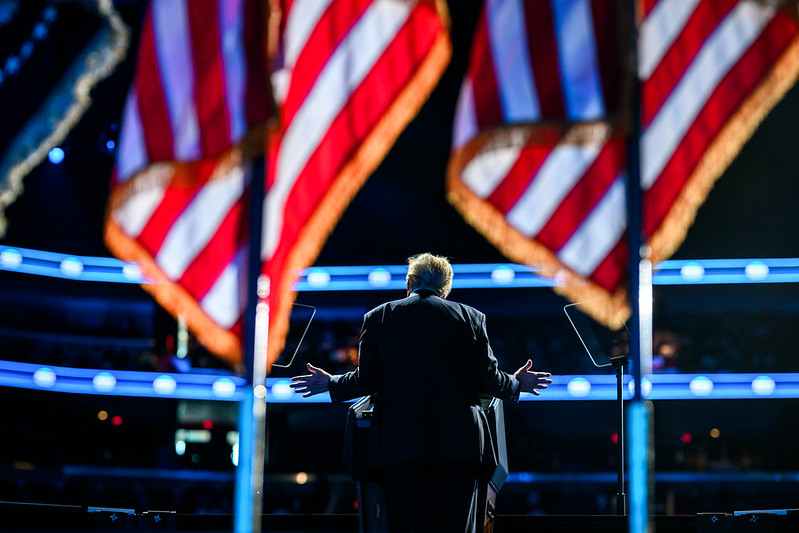
President Donald Trump delivers remarks at the America Business Forum Miami at the Kaseya Center in Miami on Nov. 5, 2025. Since Trump took office in January 2025, shifting federal funding policies tied to political and cultural debates have created uncertainty for nonprofits that rely on government support. | Official White House photo by Molly Riley, via Flickr
Suncoast nonprofits strained as political polarization impacts federal funding
Cultural and political division in Florida and across the country has spread beyond heated arguments on social media and around Thanksgiving tables.
Since Donald Trump took office in January 2025, federal funding policies based on culture-war debates have created uncertainty around grants, contracts and other kinds of government support that charitable organizations rely on to provide food, housing, and other critical services.
In November, an extended federal shutdown caused by partisan debates about how funding should be used led to millions of people losing food stamp benefits, and turning to an already overwhelmed nonprofit food system for support.
Earlier this year, federal housing officials introduced a divisive new funding approach that included stipulations on diversity, equity and inclusion policies, inspiring a lawsuit from national advocacy groups and delaying the distribution of billions of dollars usually dispersed to nonprofits fighting homelessness around the country.
Closer to home, Manatee County officials in April considered — and ultimately dismissed — a proposal that would have prevented nonprofits from receiving county funding unless they were able to verify their clients were not undocumented immigrants. Officials said the proposal was an attempt to align the county with a federal law, but critics warned it could discourage vulnerable individuals from seeking help and place an unnecessary strain on charitable organizations.
These federal changes have compounded with inflation and a rising demand for services to create a new financial strain for nonprofits. Many organizations are now left wondering how much longer they can keep the lights on.
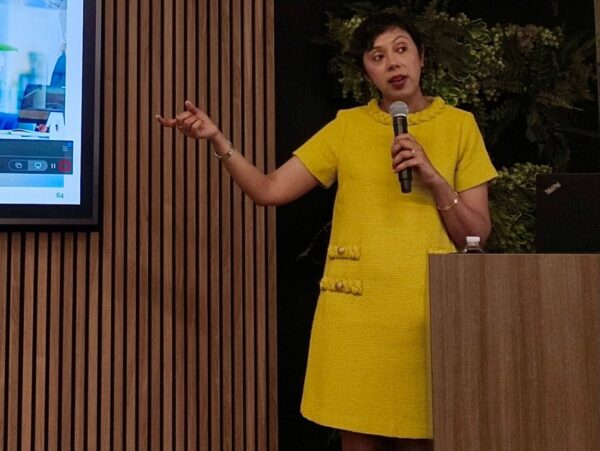
Sabeen Perwaiz, the President and CEO of the Florida Nonprofit Alliance, presents the results of the alliance’s annual statewide nonprofit survey to nonprofit leaders from Sarasota and Manatee counties on May 14. | Photo by Emily Andersen, Suncoast Searchlight
“The politicization of nonprofit work has accelerated at a rate we just were not expecting or anticipating,” Sabeen Perwaiz, the president and CEO of the Florida Nonprofit Alliance, said during a presentation to local nonprofit leaders earlier this month. “We’re getting pulled into a fight that’s not ours.”
Perwaiz spoke calmly and matter-of-factly during the presentation, sharing data from the alliance’s annual survey of nonprofits around the state.
But the numbers weren’t encouraging.
“Regardless of barriers, nonprofits are getting it done,” Perwaiz said during the presentation. “This is a strength, but an unsustainable one.”
In Florida’s Central West Region — which includes Sarasota and Manatee counties, as well as Polk, Hillsborough, Pinellas, Pasco, Hernando and Citrus — just over half of the nonprofits surveyed said they served more clients last year than in 2024.
In some cases, the increase in clients was huge — as more and more individuals are impacted by changing federal funding priorities.
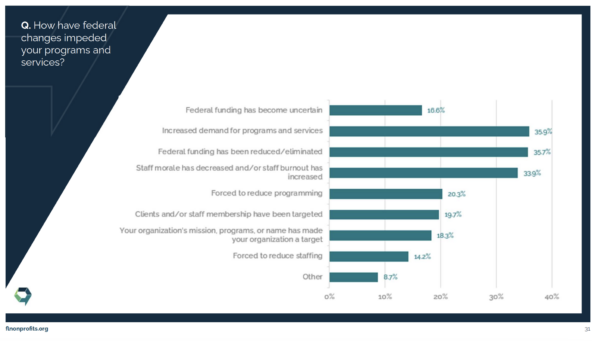
A slide from the Florida Nonprofit Alliance’s 2025 survey showing how political changes have impacted nonprofit organizations. | Photo courtesy of the Florida Nonprofit Alliance
Dan Minor is the president and CEO of Harvest House, a Sarasota nonprofit that focuses on providing housing and runs a weekly drive-through food pantry. Minor said for one week during the government shutdown in November — which delayed food stamp benefits — they served 700 families. That was more than double the pantry’s predicted weekly clientele, based on previous service data.
“A lot of the people coming in were people who had never even been to a food bank before, so these are not people that are used to the system,” Minor said. “One quick decision or delay … has an immediate local impact.”
This increase in demand has not corresponded with an increase in funding. About a third of nonprofits in the region raised less money last year than in 2024, according to the alliance’s survey.
This is partially due to federal funding changes, as 29% of nonprofits said their programs and services were impacted by federal policies.
“It does have ripple effects,” Perwaiz said. “We can’t just keep our heads down.”
Federal decisions leave local organizations in limbo
Taylor Neighbors, the CEO of the nonprofit Suncoast Partnership to End Homelessness, has seen the impact of federal funding changes firsthand.
Suncoast Partnership is a continuum of care organization that coordinates the homelessness-focused nonprofits across Sarasota and Manatee counties. Every year, Suncoast Partnership organizes the sector’s federal funding applications through the U.S. Department of Housing and Urban Development
In 2025, HUD released its notification of funding opportunities in November, several months later than normal, and stated funds wouldn’t be made available until May 2026, leaving a funding gap of about four months.
The notice went back on funds that had already been promised under a two-year application cycle set up under former President Joe Biden in 2024, and was riddled with restrictions that Neighbors said went against accepted best practice for reducing homelessness. Rather than focusing on permanent supportive housing, it encouraged organizations to focus primarily on transitional housing, like shelters. It also threatened to take funding from any organizations using language related to diversity, equity and inclusion.
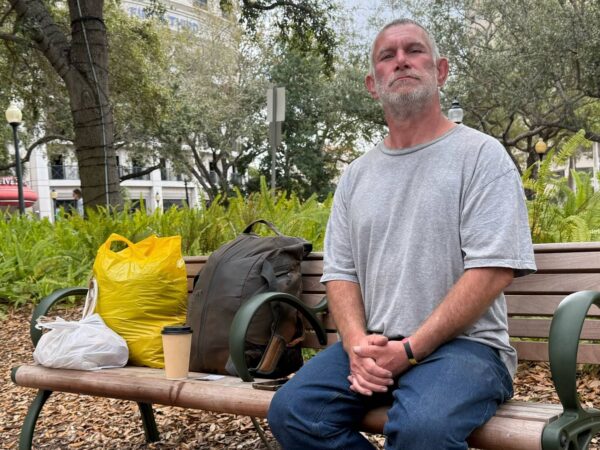
Joel T. Lanfair Jr. has been homeless in Sarasota for more than two years and said he still struggles with substance abuse and does not have access to services. During freezing temperatures, Lanfair said he sheltered in a downtown parking garage. | Photo by Derek Gilliam, Suncoast Searchlight
The National Alliance to End Homelessness filed a lawsuit against HUD and the funding notice, which led to the federal agency issuing a second one that still kept many of the same restrictions. The national nonprofit also challenged that notice in court, and the case is ongoing.
Within the last few months, some organizations have started to receive funding. The federal government is beginning to issue the amounts promised under the Biden administration’s initial two-year funding plan, since the new plan can’t be used while the court case is still pending.
But Neighbors said trust is low that the funding will continue with any consistency.
“We just got a letter the other day … that we should be receiving the funding, which is great,” Neighbors said. “When we get the contract, and we actually have the executed contract, we’ll feel a little bit better.”
Local philanthropy cannot fill the gaps
It’s not the first time the local housing support sector has had to get by without federal funding.
Neighbors said a few years ago, the Suncoast Partnership’s combined grant application was rejected because of a filling error, so the entire sector had to band together with philanthropic organizations and local governments to make it through the year.
“That’s what we’re used to in the nonprofit realm, being able to quickly adapt to situations,” Neighbors said. “We all just do the best that we can … It’s a lot of problem solving, being creative and collaboration.”
That’s what organizations around the state are attempting to do now.
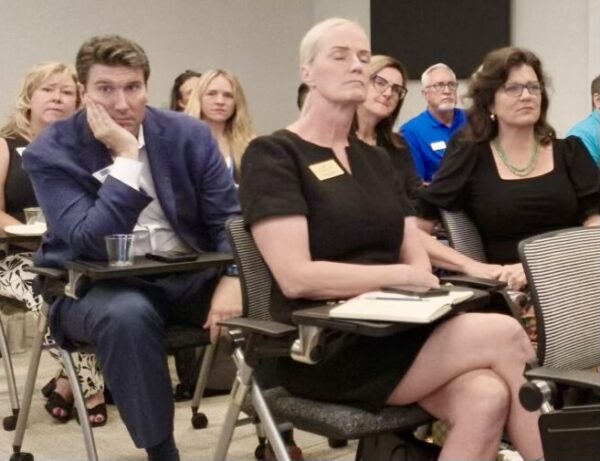
Nonprofit leaders from Sarasota and Manatee counties sit for a data presentation by the Florida Nonprofit Alliance at the Community Foundation of Sarasota County on May 14. | Photo by Emily Andersen, Suncoast Searchlight
The difference this time is that the funding difficulties are spread across every facet of the nonprofit sector. All kinds of organizations — from those providing food and shelter to those helping with mental and physical healthcare — are facing federal cuts. Even those that aren’t now face greater competition for donors, who are already stretched thin.
“Is this something that philanthropy can make up? No, there is absolutely no way,” said Wendy Deming, the CEO of the Bishop-Parker Foundation, a nonprofit funding organization in Manatee County.
“It comes down to a reckoning of what kind of country do we want to be?” she said. “Are we willing to take care of people who, many, through no fault of their own, find themselves in difficult situations? It comes down to an ethical decision, in my mind, and everybody, individually, needs to ask themselves that question.”
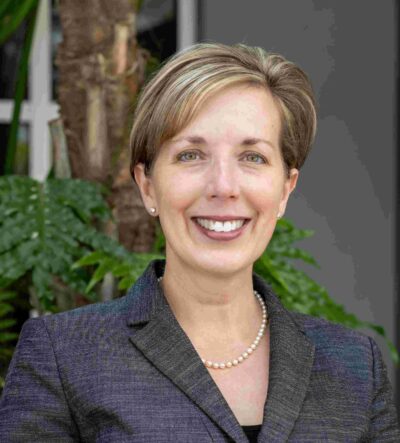
Wendy Deming, CEO of the Bishop-Parker Foundation. | Photo courtesy the Bishop-Parker Foundation
Deming said the number of funding requests the Bishop-Parker Foundation has received over the last couple years has stayed about the same, but types of requests are changing.
Instead of asking for funds to support new or ongoing programs, many organizations — especially those focused on health and human services — have been asking for operational funds, or money for things like building costs, electricity and staff salaries. In other words, they’re doing what they can to stay afloat.
“They’re looking for core support, rather than expanding what they’re able to do,” Deming said.
Unrestricted revenue, or funding that can be used for ongoing operations, can be hard for nonprofits to come by, since many funders want their dollars to go toward specific programs. Almost a third of nonprofits in the Central West Region saw a decrease in unrestricted revenue in 2025 compared to the year before, according to the Florida Nonprofit Alliance’s nonprofit survey.
“Once budgets start shrinking, then you’re looking at mostly laying off people,” said Leah McDermott, the program director for the Florida Nonprofit Alliance. “Oftentimes, it is your development staff who are raising the money, but you can’t afford to keep them on to do that, but then you’re in this vicious cycle.”
If Florida’s nonprofits start disappearing, the impact could go well beyond the clients they serve.
Nonprofit organizations make up 5% of Florida’s total workforce, according to data gathered by the Florida Nonprofit Alliance. That’s a larger economic impact than manufacturing jobs, which make up about 4% and similar to construction workers, which make up about 6%.
But no one wants to prevent the loss of nonprofits more than the nonprofits themselves, McDermott said.
“Nonprofits really just want to be able to provide the services, so they’re going to do what they need to do, within the confines of the law,” she said. “One thing about the nonprofit sector is that they really don’t like to stop helping people … ‘No’ is just not a word that you want to be able to say.”
Emily Andersen is a watchdog/investigative reporter at Suncoast Searchlight. Email her at eandersen@suncoastsearchlight.org.
Editor’s Note: A photo caption accompanying this story has been updated to correct the name of an organization.