Siesta Key businessman Michael Holderness sued Sarasota County, arguing that county signs encouraged the public to use a section of his private beach near Beach Access 3. To resolve the dispute, the county agreed to a settlement that would transfer ownership of the contested beach to the county in exchange for giving Holderness a different nearby property. | Photo by Derek Gilliam, Suncoast Searchlight
Judge rejects challenge to controversial Siesta Key land swap
A judge this week rejected a last-ditch effort to unwind a controversial Siesta Key land deal, clearing the way for a home to be built on property the county once bought to preserve.
The legal challenge, filed in December by Lourdes Ramirez of the nonprofit Protect Siesta Key, sought to block a key provision in a settlement between Sarasota County and Siesta Key businessman Michael Holderness.
Under that agreement, the county would trade its preservation parcel at 162 Beach Road — valued at $2.8 million — for Holderness’ four beachfront lots valued at less than $100,000 combined. The deal also would let Holderness build a 5,000-square-foot house on the county-owned lot despite the county having denied similar requests when the land was privately owned; that’s because it sits behind a coastal setback line.
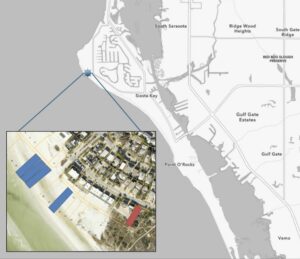
As part of a settlement agreement, Sarasota County approved a land swap involving a parcel it purchased in 2017 (in red) and four lots owned by Siesta Beach Lots (in blue). The deal also required the county to grant a variance allowing Siesta Beach Lots owner Michael Holderness to build a home on the red parcel. | Illustration by Suncoast Searchlight using a Sarasota County maps.
The agreement was made to end a federal lawsuit Holderness had filed against the county over property rights tied to his four beachfront parcels near Beach Access 3. In that case, he argued that public beach access signage near his property invited trespassers and that the county infringed on his rights as a waterfront land owner.
By trading those parcels to the county, he said, they would become a part of the public beach. In exchange, he would get a lot on which he could build a house.
But Ramirez and other petitioners argued the county had no legal authority to give up land it bought for preservation and allow a house to be built.
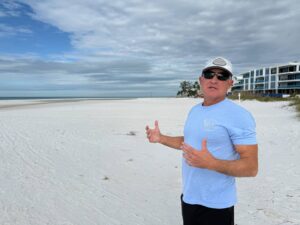
Siesta Beach Lots owner Michael Holderness stands on beachfront property that he currently owns but is expected to trade with Sarasota County after years of litigation about what he can and can not do on the land. In exchange, the county will give him another piece of nearby land. | Photo by Derek Gilliam, Suncoast Searchlight
Circuit Judge Hunter Carroll ruled Tuesday that Ramirez and the other plaintiffs did not have legal standing to challenge the county’s decision.
Holderness celebrated the courtroom victory.
“Now, we can have a public beach forever; complete with Park and Recreation rules our great deputies can use to enforce (the law),” Holderness wrote in a text message to Suncoast Searchlight. “Public ownership ensures this beach remains accessible, not exclusive — and that’s an investment that pays dividends for generations.”
Ramirez, who has been involved in zoning issues on Siesta Key for more than 20 years, has not yet given up.
She said her organization will explore other legal avenues, though she did not know the exact tact she planned to pursue.
Ramirez noted that because the issue was decided on standing, which is a legal term that means the plaintiffs in this case did not have a valid grounds to bring the challenge, she is still hopeful to stop construction.
“It was a disappointment because I know the merits of the case are very strong,” she said.
How the land swap came to be
In November 2024, county commissioners agreed to trade the property on Beach Road to Siesta Beach Lots LLC, a company owned by Holderness. In addition, Holderness would also receive $500,000 in cash and a memorial at Beach Access 3 in honor of his mother.
The settlement hinged on the county giving him permission to build on the Beach Road lot. The county bought the land in 2017 after denying the previous owner’s similar request for a variance to build behind the Gulf Beach Setback Line, a protected zone meant to preserve dunes and natural storm buffers.
In a November meeting, at least two county commissioners expressed concerns with Holderness’ variance request to build there.
Sarasota County Commissioner Tom Knight said he was never informed about the value of the property the county was giving up or that it had been bought for preservation using the Neighborhood Parkland Program. He said he would have not voted in favor in 2024 for the settlement, but felt his hands were now tied given his prior support.
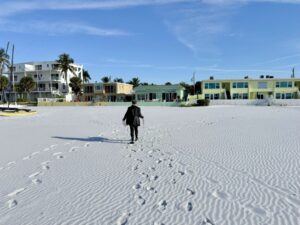
Katie Gerhardt walks along the beach property her family owns on Siesta Key. The county had offered her $30,000 for it. | Photo by Derek Gilliam, Suncoast Searchlight
Knight later told Suncoast Searchlight that “misleading by omission is no better than a lie,” indicating his displeasure with not having all the facts prior to a major land use decision. County Commissioner Mark Smith voted against the request as he believed the deal went against the county’s growth plans to protect sand dunes and natural habitats.
The deal also proved controversial to other beachfront lot owners.
Following a Suncoast Searchlight report about Ramirez’s legal action, nearby property owners along the same stretch of beach said the value Holderness stood to gain dwarfed what the county was willing to offer them.
One owner, who declined to sell her beach lot to the county, was offered $30,000 for a property just two parcels south of a lot the county would give up in the Holderness settlement.
Holderness has disputed the property appraiser’s value of his lots, calling his land “priceless” and recommending the other lot owners package their property together to achieve a greater price. He noted he has been fighting the county on the topic since at least 2019, spending money the entire time.
He dismissed his opponent’s claims his settlement was a bad deal.
Why the judge dismissed the legal challenge
Ramirez hammered the idea the county could sell land it bought from the Neighborhood Parkland Program.
She warned the commissioners at the November meeting that she planned to sue.
The legal maneuver she brought — called a writ of certiorari — often requires the people who file to demonstrate harm. The high bar means that legal challenges to zoning decisions are regularly tossed out of court.
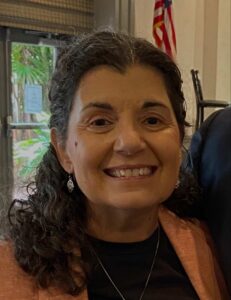
Siesta Key resident Lourdes Ramirez said she will sue Sarasota County to thwart a controversial land swap deal approved by commissioners. | Photo courtesy of Lourdes Ramirez
Ramirez, a veteran of court fights with Sarasota County, found a partner to bring the suit — John Phair who lives in a condominium across from the Beach Road site.
During the court hearing on Tuesday morning, Carroll, the circuit judge in the case, appeared to reject any argument that Ramirez or Protect Siesta Key had standing.
“Ramirez does not live close by, and she has, in both her testimony and letters, not demonstrated a special injury, nor has her organization shown a special injury,” Carroll said in his ruling.
Carroll, though, repeatedly questioned both sets of lawyers regarding Phair’s ability to bring the court action. The strongest evidence presented during the hearing centered on Phair’s letter to the county commission where he argued that allowing construction of a single-family home would go against county zoning codes. Those codes cite impacts from flying debris during storms and new structures hastening erosion near the coast.
Carroll dismissed the legal action in a verbal order that day.
Because Ramirez never discussed harm during the November commission meeting, the judge could not consider those grounds.
“The mistake we made is that we didn’t say it on the record,” Ramirez said.
Derek Gilliam is an investigative/watchdog reporter for Suncoast Searchlight. Email Derek at derek@suncoastsearchlight.org
Never miss a story: Sign up for the Suncoast Searchlight newsletter