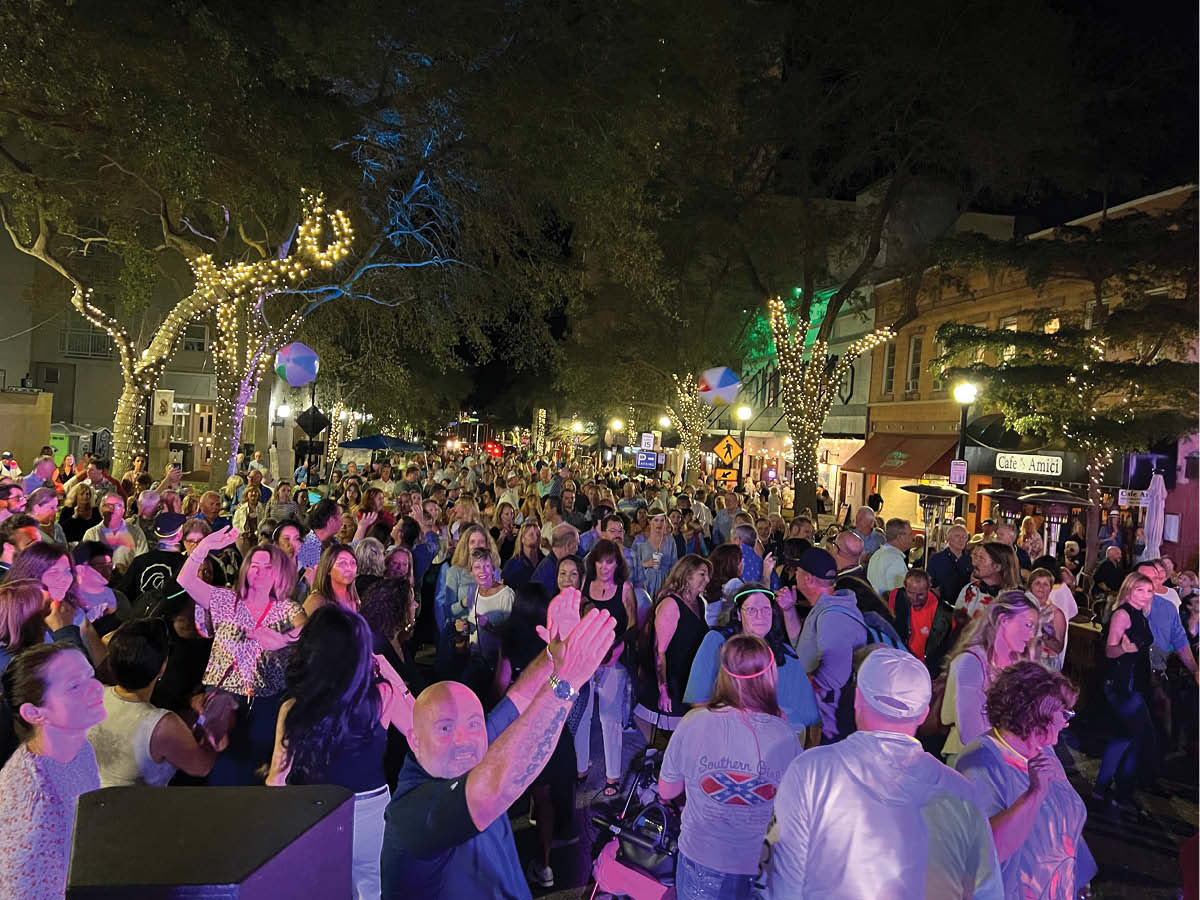
A Fresh Friday block party at Sarasota's downtown. | Courtesy of the city of Sarasota.
Sarasota creates new sound enforcement team after noise pollution study
The Sarasota City Commission will strengthen enforcement of its sound regulations while continuing to study changes to a noise ordinance adopted less than a year ago.
Commissioners voted 3-2 on Monday to create a new sound enforcement team focused in part on what survey respondents cited as their chief noise complaint: the revving of engines and blasting stereos from cars and routine traffic found at the city’s busiest thoroughfares.
The move came after years of complaints from downtown residents and confusion among city staff and police over enforcing regulations passed in December.
Mayor Debbie Trice and Commissioner Liz Alpert dissented, arguing there’s not enough information to create a new enforcement arm.
But now the city has something it lacked when commissioners adopted the regulations — data showing how loud different parts of Sarasota actually are, what causes the largest spikes and which sounds residents find most bothersome.
Phase 1 of the sound study and survey conducted in July by the Gainesville-based Siebein Acoustic found that traffic-related noise was a persistent concern, while bars and restaurants — long a focus of the city’s noise debate — emerged as a secondary concern.
Community stakeholders praised the city during public comments for what they described as a thorough, data-driven analysis. But the findings underscored how difficult it may be to write one set of noise rules for a city where the normal background sound can vary considerably from downtown to residential neighborhoods.
Commissioner Jen Ahearn-Koch noted that average sound levels recorded during the study were above what federal agencies recommend as generally healthy for ears.
“Without the cars, without the amplified sound, it seems that we are still hovering at the top of where we should be,” Ahearn-Koch said.
Officials are planning for two more phases of the study before they commit to a new sound ordinance. One central question will be what constitutes “ambient sound” — the typical background noise in a particular setting — and how those differences should factor into regulations without burdening residents and businesses.
Next phase of sound study to focus on peak season
To understand the city’s soundscape, Siebein Acoustic placed sound meters at eight locations for a week in early July, including Selby Five Points Park, the intersection of Main Street and Palm Avenue, Marina Tower, Orchid Condo and Sarasota Sands on Lido Key, and Fredd Glossie Atkins Park in Newtown.
Sound is commonly measured using “A-weighted decibels” (dBA). A normal conversation would reach about 50 dBA, while a subway train would reach 100 dBA.
Long-term exposure to 70 dBA and above is harmful to humans, according to health experts.
The July measurements provided only a snapshot. The study was conducted during the middle of Sarasota’s slow season, when fewer tourists and seasonal residents are in the city. Siebein Acoustic acknowledged that limitation and plans to conduct another study when tourism picks up.
The measurements also revealed differences across the city.
The highest sound levels were recorded in Newtown. But Newtown residents were proportionally the least surveyed in Siebein Acoustic’s questionnaire.
“The louder sounds were loud cars with amplified music and engine revving while waiting at the traffic light,” the report said.
Noise levels also spiked for city-run events, such as Fresh Fridays at Five Points Park and a July 4 block party downtown.
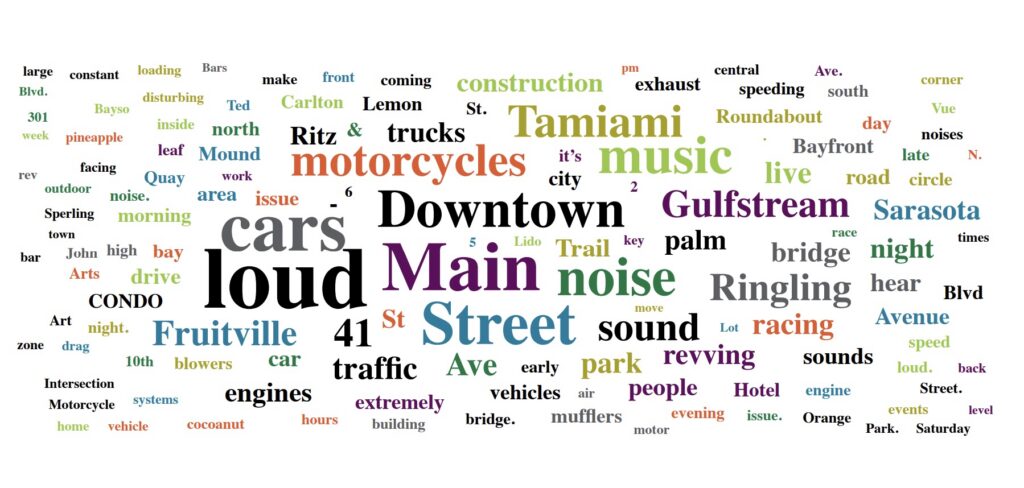
A word cloud created by Siebein Acoustic based on their survey of Sarasota residents on sound concerns.
Traffic noise downtown cited as key concern
The measurements tell officials how loud Sarasota is. A separate survey sought to discover which sounds bothered the people who live and spend time here.
Siebein Acoustic surveyed 1,456 people — about 2.5% of Sarasota’s population — and met with community stakeholders, including the Coalition of City Neighborhood Associations and the Greater Sarasota Chamber of Commerce. Consultants also rode along with Sarasota police officers until 3 a.m. on some nights.
But survey respondents did not evenly represent Sarasota’s population. More than half were 65 or older, while less than half of 1% were under 25. Respondents were also heavily concentrated in the 34236 ZIP code, which encompasses downtown and the barrier islands.
The majority of respondents were concerned with downtown Sarasota and Main Street. The most common culprit: cars. Those surveyed cited the revving engines, car stereos and traffic as the sounds they found most burdensome.
Construction was another source of complaints.
Kelly Brown, president of the Coalition of City Neighborhood Associations, said during the commission’s public comment period that noise tied to homebuilding has been constant where she lives in Gillespie Park. Although she said she appreciates the vitality of the neighborhood, she urged the commission to reconsider a city code that currently allows for construction seven days a week.
“I have not had the peaceful enjoyment of my backyard in over six years,” Brown said, “because there is always a new home being built somewhere near me.”
Christian Casale covers government and politics for Suncoast Searchlight. Email him at christian@suncoastsearchlight.org.