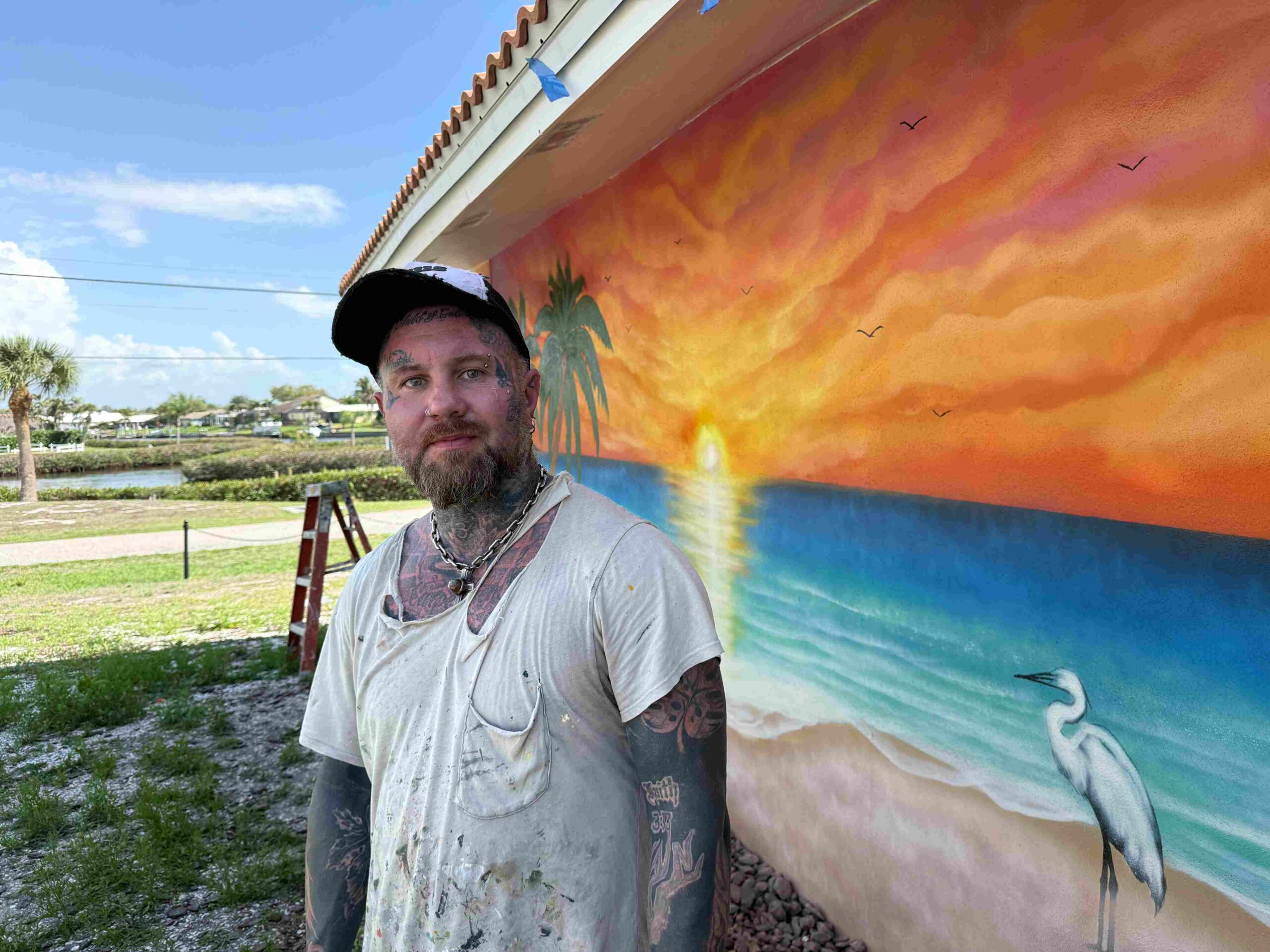
David Blanch is one of nine artists who filed legal notices against Sarasota, claiming the city violated their rights by removing their sidewalk art without first notifying them.| Photo by Derek Gilliam, Suncoast Searchlight
Sarasota erased downtown art without public notice, artists now seek damages
David Blanch labored for hours in the spring of 2024 painting a Sarasota sunset that transformed two sidewalk panels on Pineapple Avenue into a burst of pink, blue and yellow.
It wasn’t a big payday — just a couple hundred dollars. But participating in the city’s Avenue of Art initiative was something the professional artist hoped would bring joy to people strolling downtown.
In August, he learned the city ground away his art in a cloud of concrete dust.
“It was the most ridiculous thing a city could ever do,” the 40-year-old Sarasota resident said.
Within a matter of days last summer, the city removed hundreds of feet of sidewalk art that had drawn visitors downtown for years, rushing to comply with a Florida Department of Transportation memo warning against paint covering public rights of way.
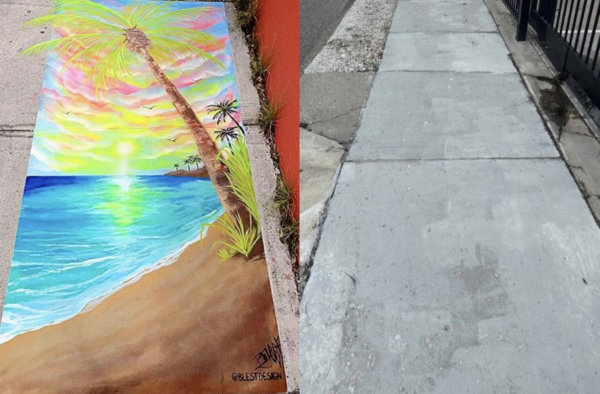
David Blanch painted a Sarasota sunset on Pineapple Avenue in 2024. After the art was destroyed by the city of Sarasota last year, he filed notice that he believed his rights as an artist had been violated. | Photos courtesy of David Blanch and the City of Sarasota
Blanch is one of at least nine sidewalk artists who have since filed legal notices against Sarasota, claiming the city violated their rights by removing the art without first notifying them. The individual claims — filed under the Visual Artists Rights Act, or VARA — seek anywhere from $1,200 to $150,000.
Public records show the city’s decision to remove the artwork unfolded largely behind the scenes — with no public discussion and little evidence officials considered challenging FDOT’s directive even after a state official notified them there was an administrative path to do so.
Emails obtained by Suncoast Searchlight and ArtsBeat show Sarasota officials moved quickly to comply with the directive as they faced the threat of losing $67 million in state funding.
Gone was the sidewalk art in Burns Court, the rainbow crosswalk downtown, even the painted sea creatures near Mote Marine Laboratory on Ken Thompson Parkway.
Sarasota wasn’t alone. Across Florida, FDOT’s directive led to the removal of street murals. A crosswalk painted as a checkerboard racing flag outside the Daytona International Speedway was covered. So was a “Back the Blue” mural at the Tampa Police headquarters. Dozens of rainbow crosswalks vanished, including a memorial in Orlando near the Pulse Nightclub installed after the 2016 mass shooting.
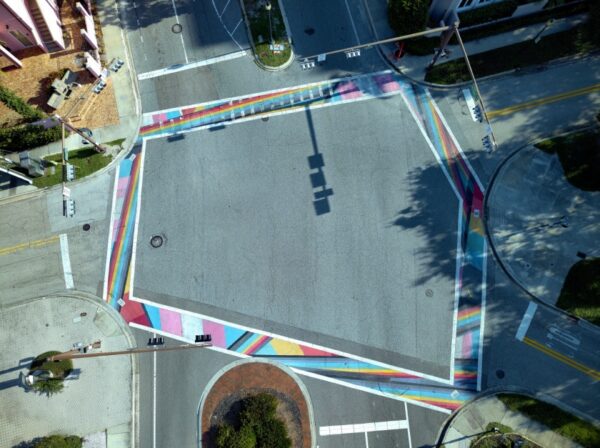
This colorful crosswalk in downtown Sarasota was among the artwork erased in August to comply with a Florida Department of Transportation directive against painting in public rights of way. | Photo courtesy of the City of Sarasota
“The memo from FDOT was clear that noncompliance would jeopardize state funding, which the city could not afford,” Sarasota Communications General Manager Jan Thornburg wrote in an email to Suncoast Searchlight.
Thornburg did not respond to questions about whether the city considered filing a challenge, but an email exchange between then-Mayor Liz Alpert and an angry resident on Aug. 31 offers some insight.
“As we were considering asking for an exception, we received a second letter from the state advising that we should not bother to ask for an exception because they had reviewed the art, including the sidewalk art, and would not grant an exception,” Alpert wrote to the resident. “It is heartbreaking.”
State officials have characterized the removals as a public safety measure, but critics say the move was the latest usurpation of local authority.
They point to similar bans on bridge lighting and laws like Senate Bill 180, which curtails local governments’ ability to control development. In recent years, Florida political leaders have stripped decision-making power from cities and counties — sometimes threatening to withhold funds or remove officials from office.
Representatives from FDOT did not respond to a request for comment.
‘This is about free speech’
At a Sarasota Tiger Bay Club forum in March discussing the sidewalk art destruction, Sarasota County Schools board member Tom Edwards, who until recently was the director of Project Pride SRQ, said the state’s mandate was unjustified and part of a “culture wars” agenda.
“The real impetus of what happened here was this constant crusade against diversity, equity and inclusion that created unintended consequences,” Edwards said. “This was a tragic mistake.”
To the artists and organizers whose work was destroyed without notice, the city’s decision to remove the sidewalk display without a fight also was a blow to all who built Sarasota’s reputation as the Cultural Coast.
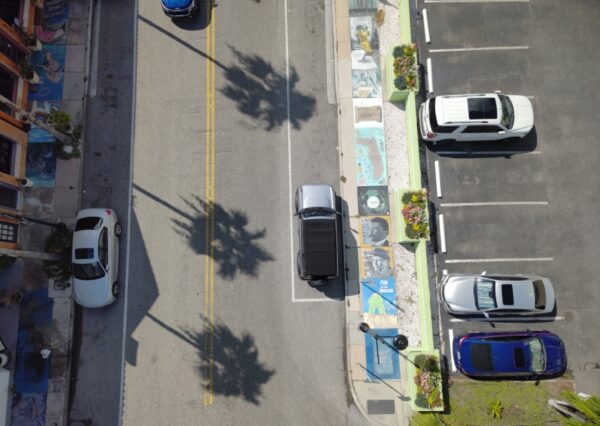
From 2021 to 2025, artists painted nearly 300 sidewalk panels depicting moments, scenes and figures important to Sarasota’s history in Burns Court known as Avenue of Art. All the paintings were destroyed in August to comply with a state order. | Photo courtesy of the City of Sarasota
“This is about free speech, fascism and government overreach,” said Wendy Rosen, a former owner of a national art trade show and two niche art magazines, who helped organize the legal pushback.
“This law (VARA) exists because our creative sector needs protection from overreach, from theft and from destruction,” she said. “If we want to call ourselves a creative community and promote tourism based on our cultural assets, then we need to protect them.”
Denise Kowal, who had conceived of and organized the Avenue of Art installation, declined to comment despite multiple interview requests. But as a panelist at the Tiger Bay Club forum she spoke passionately about the positive impact the artworks had and how devastating its loss was for the community.
“This project was not only the first of its kind in the world, it was the largest public art project … including more artists, more diversity, than any other project in Sarasota County ever,” she told the audience.
Sarasota wanted more time; FDOT said no
The sidewalk art Sarasota removed was part of the city’s Avenue of Art, a yearslong public arts project that lined portions of Orange and Pineapple avenues in the Burns Court neighborhood.
From 2021 to 2025, artists ranging from professional artists to youth painted nearly 300 sidewalk panels depicting moments, scenes and figures important to Sarasota’s history.
The project, initially deemed temporary but renewed annually, received funding from the county’s tourist tax as well as in-kind contributions from local businesses and private donors. It earned the Heritage Award from the Sarasota Alliance for Historic Preservation and was incorporated into the city’s public art plan, with officials promoting it to tourists and considering expansion into the Gillespie neighborhood.
In June, the state intervened.
An FDOT memo dated June 30 arrived in then-City Engineer Nik Patel’s inbox, directing local governments to remove paint from public rights of way.
In email exchanges that followed, Patel alerted city staff, including Public Art Administrator Ciera Coleman. Within minutes, Coleman asked Patel whether it applied to sidewalks and crosswalks. A couple minutes later, Patel confirmed to her that it did.
Behind the scenes, city officials sought legal guidance. Former City Attorney Robert Fournier advised that the city interpret the directive broadly to avoid jeopardizing state funding.
On Aug. 1, Patel sent a memo to FDOT saying that Sarasota would comply by removing the rainbow crosswalks at Coconut Avenue, Pineapple Avenue and 2nd Street; a midblock crosswalk on Main Street; the sidewalk art in Burns Court; and other sidewalk art on Ken Thompson Parkway.
Patel, who is now the city’s Public Works director, said the city would remove all the art within 60 days — a timeline that included notifying stakeholders.
But on Aug. 21, FDOT told Sarasota the art installations needed to be gone immediately.
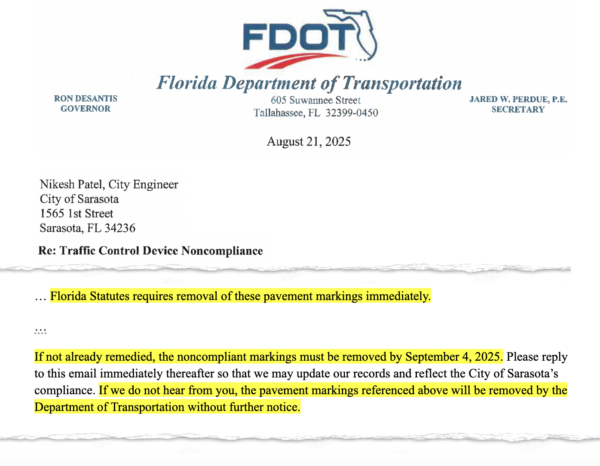
Florida Department of Transportation told Sarasota the art installations needed to be gone immediately. | Suncoast Searchlight illustration based on actual memo
“If not already remedied, the noncompliant markings must be removed by Sept. 4, 2025,” interim District One Secretary James M. Driggers Jr. wrote. “Please note that the department will pursue withholding of state funds as permitted by law should the city of Sarasota reverse course and decide not to comply.”
Driggers also said the city could file a request for an administrative proceeding.
At least two cities did just that. But Miami Beach withdrew its challenge after the state removed its rainbow crosswalk in October, rendering the matter moot.
In Fort Lauderdale, however, a rainbow crosswalk remains intact as the city pursues its claim. City officials entered into settlement negotiations with FDOT last year, but those talks broke down earlier this month, and a final hearing is now scheduled for June.
A Fort Lauderdale spokesperson declined to comment, citing the pending litigation but confirmed the city still retains its rainbow crosswalk — possibly the last one remaining in Florida.
Public records obtained by reporters show no discussion among Sarasota city officials about pursuing a similar challenge.
City commissioners were not publicly briefed on the matter until Sept. 2, when Bullock told them the art had already been removed at his direction. The city had rented concrete grinders and spent about $25,000 destroying the artwork.
Bullock mentioned the possibility of an appeal but said the risk was too great given the threat of withholding state funding.
“So, I have no idea how any of the appeals work,” he told commissioners during the meeting, “but all of those items have been removed.”
‘This would be a historic case’
When an artist’s work is destroyed without any formal notice — or without giving them the ability to save or remove it themselves — they can pursue legal action on grounds known as a VARA claim.
The Visual Artists Rights Act of 1990 is an amendment to the federal Copyright Act, which grants certain “moral rights” to the creators of visual art. Under the law, if artists are not given at least 90 days’ notice of the potential removal of their work — and the opportunity to document or otherwise save it — they can be compensated up to a maximum of $150,000 per work of art.
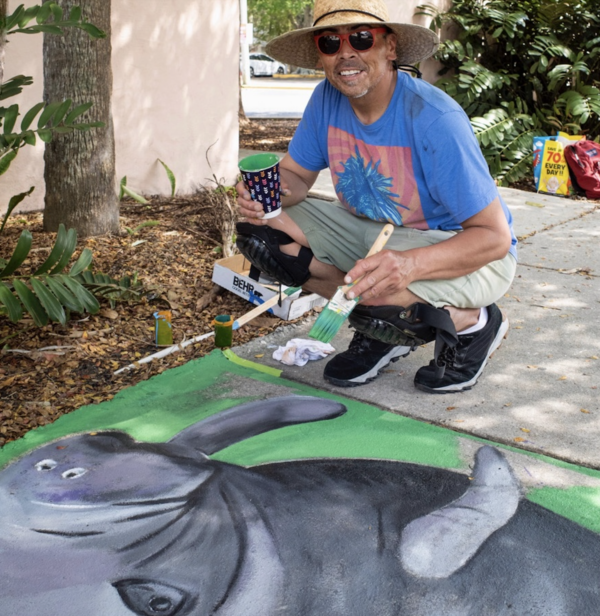
Randall Segura filed a claim for the two squares he painted, including one of a manatee. A Colorado resident, Segura joined the project when he was invited to stay on for a few days after participating in the Chalk Festival. He was offered a stipend of $100 a panel. | Photo courtesy of Randall Segura
The most notable VARA case to date involved 5Pointz, an owner-sanctioned aerosol street art complex in New York known as a “Graffiti Mecca.” In 2013, without warning the artists involved, the owner of the complex painted over the murals in anticipation of demolishing the buildings to develop luxury condominiums.
The artists sued under VARA, and after determining the elimination was “willful,” a judge awarded the maximum statutory damages, for a total of $6.75 million. The judgment, later affirmed by a higher circuit court, solidified that temporary installations have moral rights and public art cannot be recklessly destroyed.
It’s the same legal tactic some of the artists involved in Sarasota’s Avenue of Art project have decided to pursue.
To date, the city has not responded to any of the VARA claims it has received from the nine individual artists. Rosen, the Sarasota native and former art trade show owner, said there is no incentive for the city to react without the threat of a formal lawsuit, something she said she has been working on for the past five months.
Rosen began researching the validity of a VARA claim for Avenue of Art artists as soon as she heard the artwork was being destroyed in August. She consulted with the University of Miami, reached out to participating artists and sought a lawyer willing to take the case on a contingency basis.
“I had to convince artists who really don’t think their work is worth anything or don’t understand the law,” Rosen said. “Most don’t understand that this would be a historic case.”
Rosen also formed the Facebook group “Sarasota Sidewalk Murals” as a way to communicate with the artists. She also launched a petition on Change.org to protest the destruction, which she said “silenced our community stories, damaged Sarasota’s cultural fabric and harmed the affected artists.” The petition currently has about 250 signatures.
In December, the lawyer she’d convinced to take the case reversed course and appeared to back away from pursuing litigation.
Rosen reignited her effort earlier this year, coming to terms with a new attorney who is preparing engagement agreements and communicating with 30 of the artists (representing about 100 panels of art) who she says have expressed interest in joining the VARA case.
She is also in discussions with social justice and civil rights organizations to strategize over how to raise the $30,000 to $50,000 she estimates will be needed to cover legal costs.
Rosen anticipates filing a notice of intent to pursue a VARA claim within the next month. The case would be structured as a mass tort,” similar to a class-action suit but allowing for different outcomes for each artist. Once filed, the city would have six months to assess its risk and respond.
“Some of us are going to stand up on sidewalks with signs,” Rosen said, “and some of us have other skills.”
More artists push back
One of the local artists who has filed a VARA claim — both against the city and the state — is Luther Rosebaro.
A longtime Sarasota resident, Rosebaro created 17 sidewalk panels along the Avenue of Art over the course of about a year, most of them portraying local historic African-American figures like Leonard Reid, Fredd Atkins and Buck O’Neil.
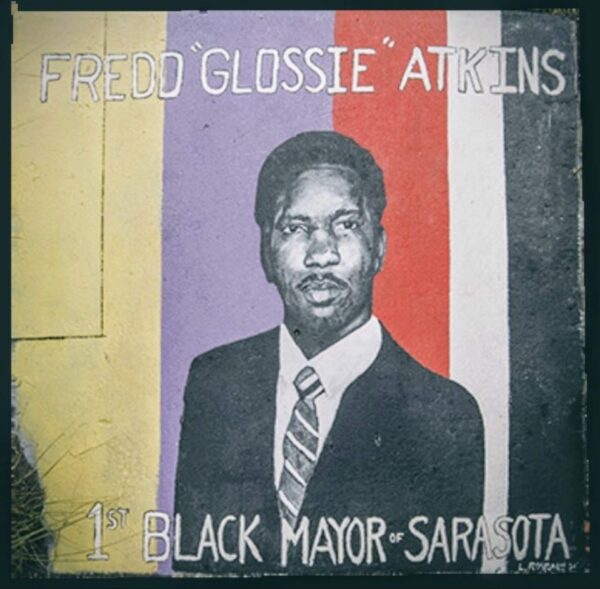
Luther Rosebaro painted many sidewalk panels along the Avenue of Art mostly focusing on Sarasota history like this painting of Sarasota’s first black Mayor, Fredd Atkins. | Photo provided by Luther Rosebaro
Rosebaro wasn’t paid for his work, but he said his participation had promotional benefits and that he appreciated the sense of community the project created. Though he recalled more than a few afternoons laboring in the hot sun, he said he enjoyed the process of talking with the people who walked by, stopping to watch him work and asking questions about Sarasota’s history.
He said he learned of the erasure through a Facebook post just as the destruction was beginning and initially thought it had something to do with “the government wanting us to forget Black history.”
“Then I realized it’s Big Brother,” he said.
Rosebaro filed his VARA claim against the city on Jan. 6 after learning of his right to do so via a Zoom meeting hosted by Rosen. He is asking for $150,000 per panel, the maximum allowable under the law.
“It took me a lot of time and effort and skill, and it’s not too easy putting a portrait down on a sidewalk — it’s not like canvas,” he said. “It’s amazing to me the city just went in and removed it without saying anything. What I would like to see is that the artists are compensated something for the effort they put in and then that they possibly try to recreate it.”
Like Rosebaro, Randall Segura filed a claim for the two squares he painted. A Colorado resident, Segura joined the project when he was invited to stay on for a few days after participating in the Chalk Festival. He was offered a stipend of $100 a panel.
“It sure as hell wasn’t about the money,” said Segura, a muralist and sign painter. “It was a last-minute, off-the-cuff thing for me, but it was fun to be a part of it. The community aspect was wonderful.”
When he learned of the artworks’ destruction from his home outside Denver, Segura said he was “saddened” but didn’t initially think of filing any sort of claim.
“I wasn’t looking to sue anyone or looking to make a buck off of it,” he said. “I blew it off when they first presented the opportunity. I wasn’t thinking of compensation, I just thought it was wrong.”
But a “bad taste” eventually led him to believe the city should “know the repercussions of their actions.” He is asking for damages of $1,500 for his panels of a manatee and some rowers.
“It just didn’t seem fair, after the fact, for them to say these are a liability,” Segura said. “It’s not fair that they couldn’t even explain the situation or where they were coming from or do something ahead of time before it got out of hand. They could have let us know. We’re not nobody.”
This story was produced collaboratively by Suncoast Searchlight and ArtsBeat, both nonprofit newsrooms based in Sarasota and serving the Suncoast region. Email Suncoast Searchlight journalist Derek Gilliam at derek@suncoastsearchlight.org; email ArtsBeat journalist Carrie Seidman at carrie@artsbeat.org.