
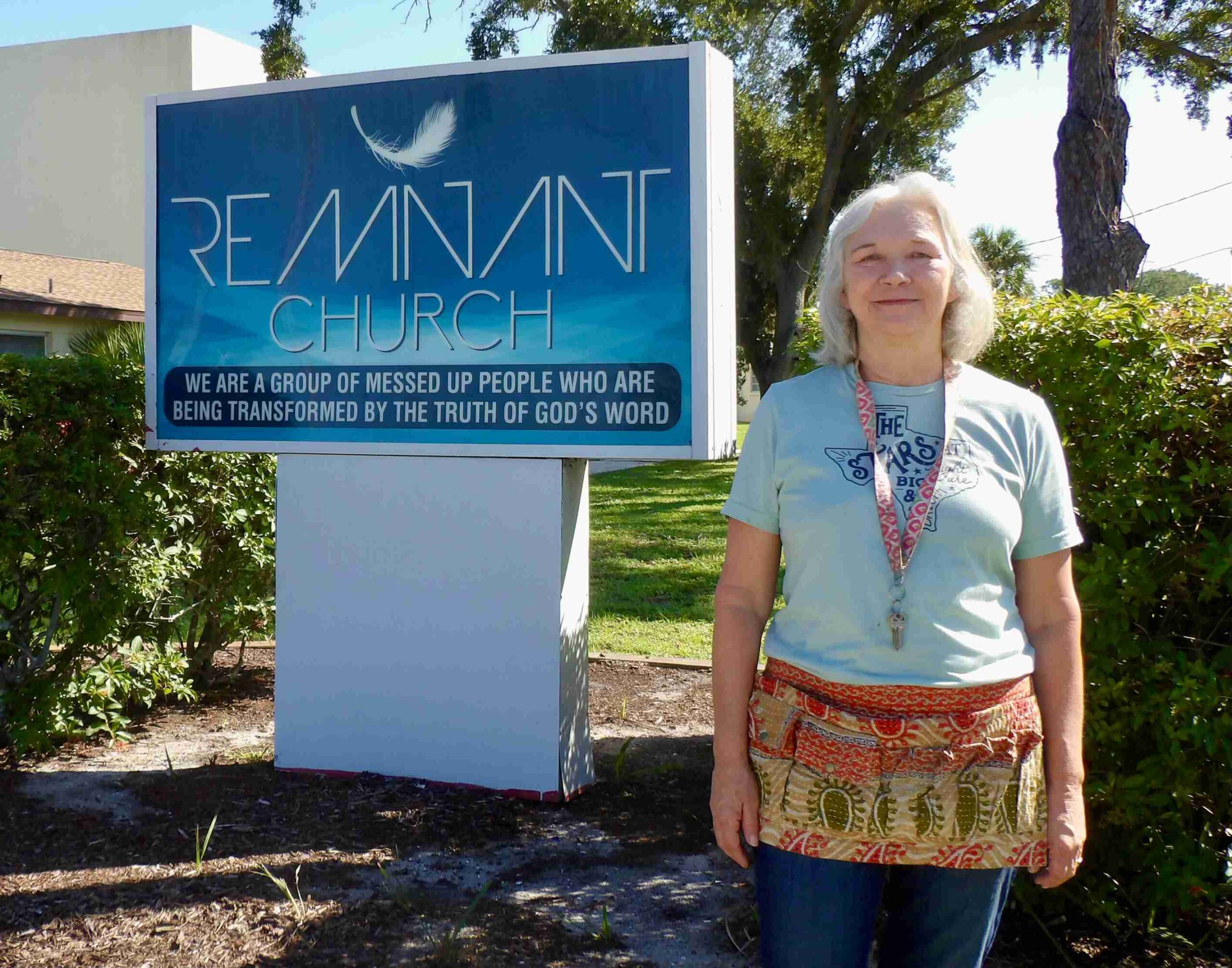
Tammy Burns poses for a photo in front of the Remnant Church, where she is the director of homeless ministry. Tammy and her husband, Frank, founded the church in 2015. | Emily Andersen, Suncoast Searchlight
Sarasota County fight over homelessness services could test religious freedom
A zoning dispute over homelessness services offered by a Sarasota County church could become a test of how far federal religious freedom protections extend.
The Remnant Cafe, operated by the Remnant Church, resumed full operations last week — providing showers, laundry, clothing and meals — after scaling back services for nearly a month in response to a county violation notice saying the property is not zoned to operate a social service facility.
Church leaders have told the county they won’t comply with a December deadline to stop offering services. Instead, they plan to challenge the county’s interpretation of zoning laws in court, arguing the restrictions infringe on their First Amendment right to freedom of religion.
The dispute comes as the U.S. Supreme Court prepares to hear a similar religious zoning case out of Kentucky. An attorney with the legal organization representing that church sent Suncoast Searchlight a statement claiming the same federal law protecting religious land use should apply to Remnant — and urging Sarasota County to withdraw its violation notice.
“Sarasota County would be wise to withdraw its notice to Remnant Church and allow it to continue its religious exercise of ministering to Sarasota’s homeless population, just as it has done for many years,” said Tiffany Dunkin, associate counsel with First Liberty Institute, which does not represent Remnant but weighed in on the dispute.
First Liberty also represented the owners of Sweet Cakes by Melissa, an Oregon bakery that drew national attention after refusing to make a wedding cake for a same-sex couple on religious grounds. That dispute reached the U.S. Supreme Court twice.
Remnant Church and Remnant Cafe were founded in 2015 by Pastor Frank Burns and his wife, Tammy, the church’s director of homeless ministry. The church initially met in temporary locations while the cafe operated out of a small building in downtown Sarasota, providing services to people experiencing homelessness since the start. Both the church and cafe moved to their current Ashton Road location in 2017.
The couple has spent much of their lives working with people experiencing homelessness, and they consider that work an essential part of their religious faith. Tammy Burns said she and her husband always believed they could offer those services on the church property because it is part of their religious worship.
That belief was challenged two months ago, when a complaint from a neighbor prompted county code enforcement to issue a violation notice stating the property is not zoned for a social service facility.
But Tammy Burns said that’s not what the Remnant Cafe is.
“We’re living out our faith,” she said. “To hear people say we’re a soup kitchen or a social service is kind of offensive to us because what we’re doing is living out our faith.”
Notice of violation filed after neighbor complaints
Christine Nordstrom is the president of the homeowners association for the Ashton Enclave Condominiums, a row of six homes across the street from the Remnant Church. She filed a complaint with the county in August, after she said she witnessed a man defecate behind her neighbor’s house.
She said it was the last straw after years of community safety concerns caused by Remnant’s homeless clients.

The six homes that are part of the Ashton Enclave Condo Association, across the street from the Remnant Church, all have raised back porches. Christine Nordstrom, the HOA president for the homes, said that Remnant’s homeless clients sometimes sleep under the porches. | Photo by Emily Andersen, Suncoast Searchlight
Nordstrom’s complaint led county zoning officials to issue the notice of violation. Since then, Nordstrom has been speaking out about the situation on social media and a website she created, ashtonroadmatters.com.
She said she has received a few “threatening and vile, aggressive emails and messages,” from people who support the church. There hasn’t been as much pushback as she anticipated, though, and she said several other neighbors share her concerns.
Another community member complained about the church’s announcement that it would reopen services in an email sent to county commissioners on Oct. 2 and later acquired by Suncoast Searchlight.
“Residents should not have to accept substantial neighborhood impacts simply because the organization responsible for them has a charitable or religious mission,” the email reads. “Helping people in need is admirable, but the location and manner in which those services are delivered still matter.”
Nordstrom said she was glad when the church decreased services in September, because the neighborhood was calmer in the three and a half weeks when those services weren’t being offered. Now, she said she’s frustrated by the church’s unwillingness to comply with the county.
“The blatant disregard for the (notice of violation), it’s pretty appalling,” Nordstrom said. “I expected more integrity out of Tammy and Remnant.”
Nordstrom said she doesn’t believe the church’s stance that this is a religious liberty issue, stating that, in her eyes, the church is acting as a social service agency first, and a religious organization second.
Religion “is literally an afterthought of their mission,” Nordstrom said.
Church plans to cite federal law currently being tried by the United States Supreme Court
When the church first received the notice of violation in late August, church leaders said they were caught by surprise. They quickly found a zoning lawyer, who advised them to reduce services in compliance with the notice.
For a few weeks, the church stopped providing showers and laundry, but continued serving food twice a week alongside Bible study classes and religious services.
But from the beginning, church leaders saw this as a religious freedom issue, not a zoning one. According to Tammy Burns, the church was founded on principles of loving your neighbor, and their homeless services are an essential part of that.
Volunteers at the Remnant Church in Sarasota County serve lunch to people experiencing homelessness on Sept. 4, 2026. | Photo by Emily Andersen, Suncoast Searchlight
Church leaders used those weeks off to discuss options, eventually deciding to go back to full services — a deliberate choice not to comply with the notice of violation, despite the county extending the deadline until December.
“We’re doing what we’re called to do,” Tammy Burns said. “To not do what God called us to do would be sinful.”
The church has broken with their zoning lawyer, according to Burns, and is instead seeking a constitutional lawyer who can help them make a religious freedom argument — first, in front of a county magistrate, then, if necessary, through an appeal in circuit court, and possibly a lawsuit.
They haven’t secured a constitutional lawyer yet, but have scheduled meetings with some potential attorneys. A special magistrate hearing also has not been scheduled, according to county officials.
The county declined to comment on the case, besides sharing basic information about the code enforcement process.
Tammy Burns said the church intends to fight the violation under the Religious Land Use and Institutionalized Person Act, or RLUIPA, a federal law passed in 2000 that says governments cannot “impose or implement a land use regulation in a manner that imposes a substantial burden on the religious exercise of a person, including a religious assembly or institution.”
The act is at the center of a case that was picked up this month by the U.S. Supreme Court, in which a zoning board in Kentucky approved a permit for a nonprofit religious group to build a shrine to the Virgin Mary on a church property, and was subsequently challenged by neighbors who believe the board misapplied zoning laws.
Dunkin, associate counsel with First Liberty Institute, a legal organization representing the Kentucky church, told Suncoast Searchlight in an email that Remnant Church’s case should trigger RLUIPA as well.
“Unfortunately, local governments across our nation frequently try to use land use regulations to shut down religious activity,” Dunkin said in the email. “Such enforcement actions represent a significant and widespread threat to religious liberty.”
Religious land use act has been applied to similar cases
The Supreme Court has never examined the land use aspect of RLUIPA before, but lower courts have applied it in cases similar to Remnant’s.
In 2016, a U.S. Court of Appeals ruled in favor of Harbor Missionary Church in Ventura, California, which had been denied a conditional use permit to continue its homeless ministry, which included providing food, showers and counseling services.
“The city’s denial of the conditional use permit prevents the church from conducting its homeless ministry, an integral part of its religion, without suffering substantial delay, uncertainty, and expense,” the appellate judges wrote in their decision on the case.
The judges ruled that “the city had a compelling interest in promoting public safety and in preventing crime” — something that Remnant’s neighbors are also concerned about — but that denying the conditional use permit was not “the least restrictive means to achieve this goal.”
There are differences between the zoning laws at play in the Harbor Missionary case and Remnant’s, since Harbor Missionary Church had been denied a permit for social service operations, while Remnant Church is located in an area where zoning ordinances don’t allow any exceptions for social services.
But Denise Harle, a Florida State University law professor and director of the school’s First Amendment Clinic, said the religious land use act should still apply.
Even though Remnant’s property is not zoned for a social service operation, it is zoned to operate a church, and Harle pointed to previous Supreme Court decisions that ruled governments cannot limit what counts as religious activity.
“Judges aren’t really in the business of deciding whether someone’s religious practices or religious exercise is valid, or dictating what a church can, or should, or shouldn’t be doing as part of its religious ministry,” Harle said.
For the Burnses, helping those in need has always been a part of their ministry.
“This is what our church was founded on, and started with, and we’ve always done it,” Tammy Burns said. “Church isn’t just a Bible study or just a worship service. It’s caring for people, and we feel like what we do every day is church.”
Emily Andersen is a watchdog/investigative reporter for Suncoast Searchlight. Email her at eandersen@suncoastsearchlight.org.