Suncoast Searchlight will host two, free public workshops focused on accessing public records.| Photo by ChristianChan via iStock by Getty Images
Decisions are buried in public records. Here’s how to access them in Florida
At a time when access to government records is increasingly under pressure — and key decisions are often buried within them — a series of upcoming community events aims to show Suncoast residents how to find and use public information for themselves.
Suncoast Searchlight will host two, free public workshops focused on accessing public records, one of the most powerful, and often overlooked, tools available to everyday citizens. The events are part of the newsroom’s ongoing community engagement series, presented in partnership with Gulf Coast Community Foundation.
The workshops will come on the heels of Sunshine Week, a national initiative held March 16–20 that promotes transparency, open government and the public’s right to know.
“These laws aren’t about journalists. Journalists use them because they’re trying to get information on behalf of the public, but really, this is for the public,” said David Cuillier, director of the Joseph L. Brechner Freedom of Information Project at the University of Florida, who also participated in an earlier virtual session about public records hosted by Suncoast Searchlight this month.
“Research shows that these public record laws, they help all of us,” Cuillier said. “They lead to cleaner drinking water, safer restaurants. They build trust in institutions.”
The upcoming sessions — scheduled for March 31 and April 10 — are designed to take that foundation a step further, offering practical guidance on how to request records and how to use them.
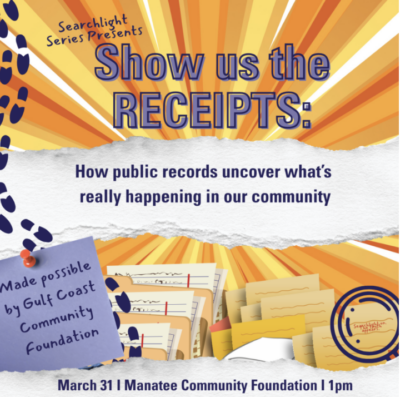
The March 31 event will focus on how public records are used to uncover information, shape reporting and hold decision-makers accountable.
The March 31 event will focus on how public records are used to uncover information, shape reporting and hold decision-makers accountable. The April 10 session will walk participants through how to request and obtain records, breaking down a process that can often feel confusing or intimidating.
Together, the sessions are designed to demystify a system that is legally accessible to anyone, but not always easy to navigate.
“There’s a perception that journalists have access to tools the public doesn’t, but we’re using the same sunshine laws anyone can use, including access to public records,” said Emily Le Coz, executive editor-in-chief of Suncoast Searchlight. “Anyone can tap into those laws to understand how decisions are made and hold those in power accountable.”
Public records laws allow citizens to access a wide range of information — from emails and contracts to inspection reports and government data — offering a window into how decisions are made and how public money is spent.
In Florida, anyone can request public records without stating a reason, and requests can be made by email, phone or in person. Those records have been used to shed light on issues ranging from local development decisions to government spending and public safety.
But advocates say those rights require constant vigilance.
In recent years, lawmakers in Florida and across the country have proposed and passed exemptions that limit access to certain records. Journalists and open-government groups warn that even small changes can erode transparency over time.
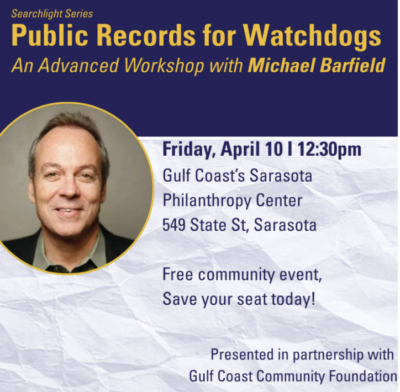
The April 10 session will walk participants through how to request and obtain records, breaking down a process that can often feel confusing or intimidating.
“There’s a war being waged against transparency, and it’s happening in slow, often subtle ways — through delays, denials, excessive fees, and expanding secrecy,” said Michael Barfield, executive director of the Florida Center for Government Accountability and investigative reporter for the center’s news publication, Florida Trident. “Public records are the front line of accountability and speak truth when politicians try to hide facts. Without constant vigilance, the public loses its ability to see how decisions are made and how power is exercised.”
Barfield will present at both upcoming events.
For many residents, filing a public records request can feel confusing or intimidating — from not knowing what to ask for to worrying about delays, costs or being ignored.
The workshops are designed to break down those barriers, showing participants how to make requests effectively and what to expect in response.
“An informed and engaged community is essential to a strong and resilient future,” said Phillip Lanham, president and CEO of Gulf Coast Community Foundation, which sponsors the series. “Through partnerships with organizations like Suncoast Searchlight, we champion access to reliable information and encourage civic participation — helping guide not only our work, but also the decisions our community makes as it continues to grow and evolve.”
The events build on a growing effort by Suncoast Searchlight to engage directly with the community, not just through its reporting but by offering tools and training that help residents better understand and participate in local government.
The goal is to make public records feel accessible and useful — not just something used behind the scenes by journalists.
“Freedom of information is freedom for all,” Cuillier said. “I hope that we can find ways to help educate the public so they can exercise their rights and improve their lives and their communities.”
Event details:
- Show us the Receipts: How public records uncover what’s really happening in our community
1-2:15 p.m., March 31 at Manatee Community Foundation in Bradenton. Lunch provided. Registration required; register here. - Public Records for Watchdogs: An advanced public records workshop
1-2:30 p.m., April 10 at Gulf Coast Community Foundation in Sarasota. Lunch provided. Registration required; register here.