
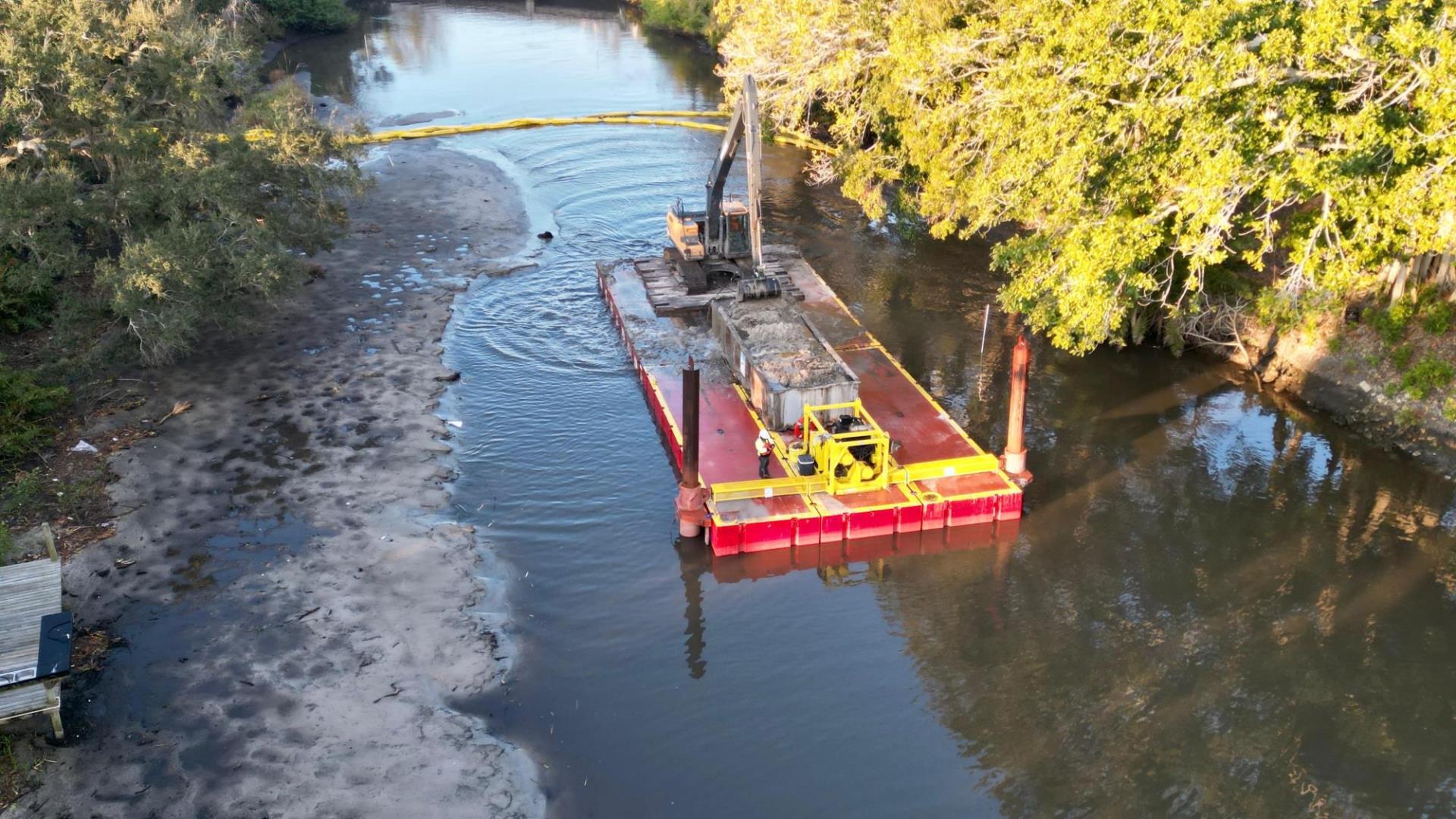
Workers have finished dredging the “high spots” of a 1.7-mile stretch of Phillippi Creek. | Photo courtesy of Sarasota County.
First round of Phillippi Creek dredging completed
Anxious residents who live near flood-prone Phillippi Creek can expect at least some relief this storm season now that the county has removed 60 tons of sediment from the creek bed.
But there is still a long way to go.
Workers have finished dredging the “high spots” of a 1.7-mile stretch of Phillippi Creek as part of a $41 million stormwater project.
The project calls for dredging roughly seven miles of the creek from where it empties out at Roberts Bay north to South Beneva Road. Over the years, the creek, which drains stormwater from surrounding neighborhoods, has flooded due to a buildup of sediment.
Sarasota County Commissioner Mark Smith said he was told there has been enough progress already to have a significant impact on flooding, but if a major hurricane hits, all bets are off.
“If it were a hurricane with a storm surge, the water can’t get to the bay,” he said. “Rain we can deal with. Storm surge is a different item.”
Project planners say there are nearly 45,000 homes within the Phillippi Creek basin and about 2,100 commercial properties. Major dredging for the first phase of the project took place between South Beneva Road and South Tuttle Avenue.
Thanks to the effort, that stretch of water in the high-spot areas is now four feet deep and 50 feet across.
Sarasota County Stormwater Director Ben Quartermaine | Photo courtesy of Sarasota County
“What we’ve done is effectively remove high spots along the creek,” Sarasota County Stormwater Director Ben Quartermaine said in a video update on YouTube.
Quartermaine told county commissioners on Tuesday that the 60,000 cubic yards already dredged equals about “8,000 dump trucks – or a football field 30 feet deep.”
The contractor, Continental Heavy Civil Corp., has started clearing sites where the dredging material was dumped and transporting it to Lorraine Road, where it will be stored for future use.
“We’ve been able to remove approximately 225,000 pounds of phosphorus and 44,000 pounds of nitrogen,” Quartermaine said. “The added benefit of water quality as it relates to the bay is something that is a big win.”
As the county begins planning the second phase of dredging, the West Coast Inland Navigational District is currently working on a simultaneous dredge from the mouth of the creek to U.S. 41.
The lower creek dredging will provide a 30-foot wide by four-foot deep channel.
For its second phase, the county will make another pass with a continuous dredge to further deepen and widen the creek.
Stephen Suau, a civil engineer who worked on contract for the county earlier this year, said it’s not clear to him why the county isn’t dredging in one pass.
“It’s definitely going to be more expensive,” he said.
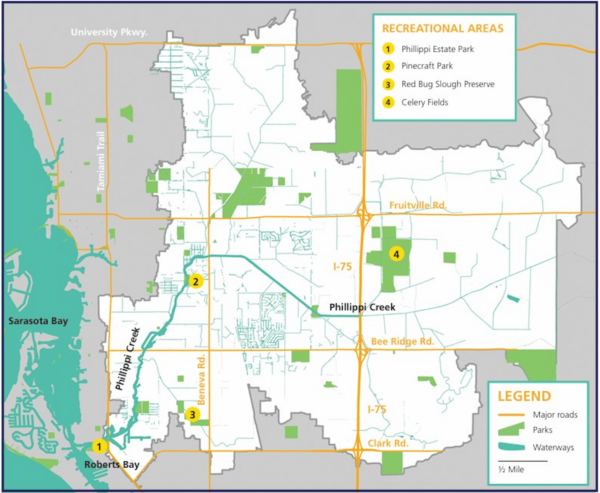
A watershed is an area of land over which rain water flows before collecting in a waterbody. The Phillippi Creek Watershed is highlighted below in white | Map provided by the Sarasota Water Atlas and University of South Florida.
Before the next phase can begin, county staff will need permits from the U.S. Army Corps of Engineers and the Florida Department of Environmental Protection. Quartermaine says the county is on track to get its permits by the end of the year.
At the Tuesday county commission meeting, Smith said some residents wish the work was progressing faster.
“I’ve gotten comments from the Phillippi Creek folks about phase two, and I guess angst about the permitting,” he said. “Is there a reason why … it’s taken this long to go in?”
Quartermaine said the county is on track with having a permit for the work and a construction project by the end of the year. All phases of the project are expected to be complete by the end of 2027.
The creek floods during torrential rainstorms. Flooding was especially bad in 2024 during Hurricane Debbie, Hurricane Milton and Hurricane Helene.
Smith told Suncoast Searchlight he understands the worries of his constituents.
“Everyone’s very anxious and rightfully so,” he said. “When you’ve been flooded three times, you want it to be done. We’re going as fast as we can, and it’s going to take time.”
John Dunbar is a watchdog/investigative reporter at Suncoast Searchlight. Email John at john@suncoastsearchlight.org.