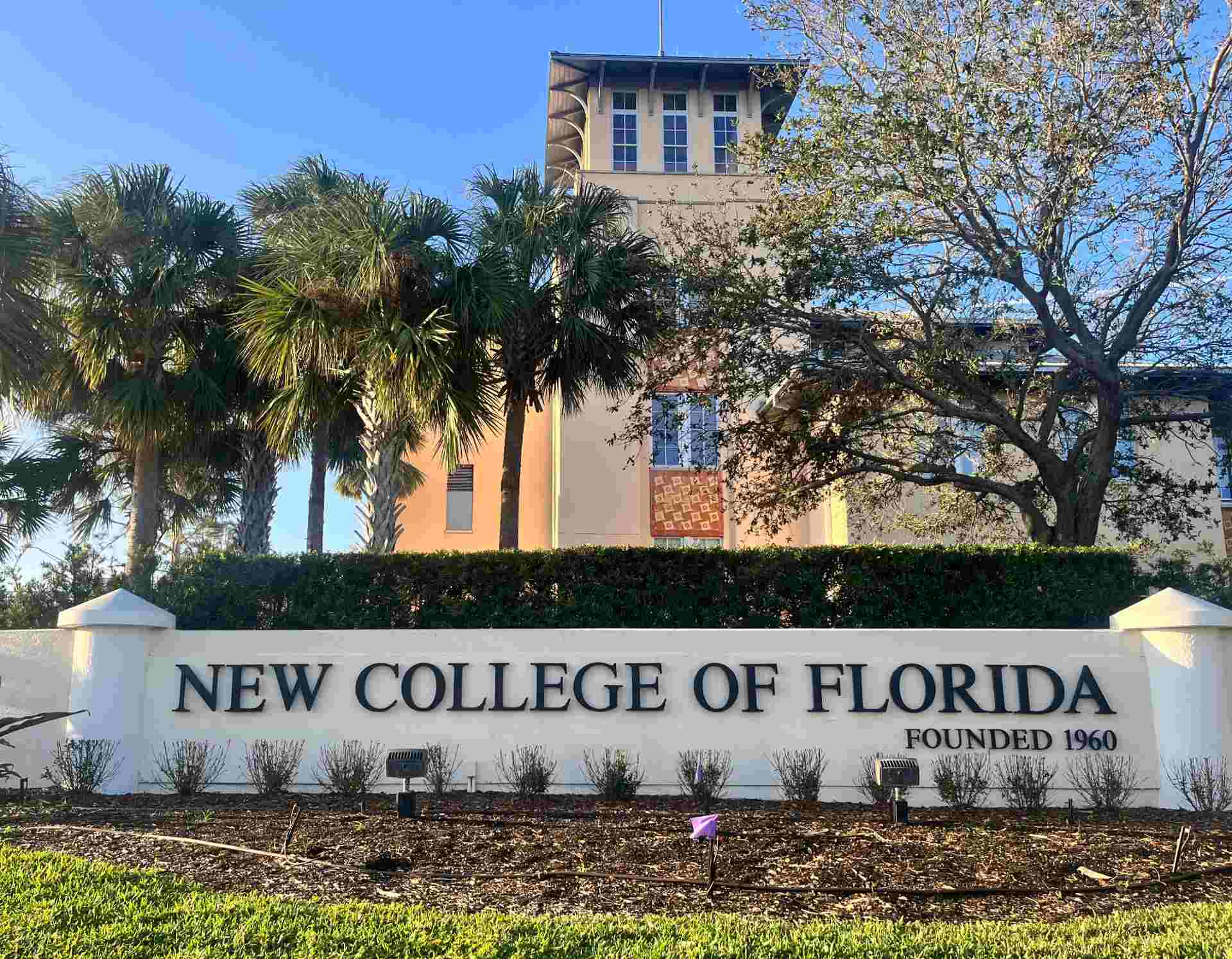
New College of Florida is set to raise out-of-state tuition by 15%. | Photo by Emily Le Coz, Suncoast Searchlight
New College tuition hike may contradict Trump ‘compact’
New College of Florida trustees voted Wednesday on a tuition hike — raising questions about whether it would still qualify for a Trump administration agreement barring such increases for the next five years.
The 15% price hike for out-of-state students, which is set to go into effect in fall 2026, could complicate the college’s plans to sign Trump’s “compact,” which offers priority funding to schools willing to adopt a range of ideologically-driven policies — and implement a tuition freeze for American students.
In response to questions from Suncoast Searchlight, a New College spokesperson said the school remains “first in line” to sign the compact and suggested the outlet ask the White House whether it still qualifies.
The White House did not return a request for comment.
Since Gov. Ron DeSantis overhauled the leadership of New College in 2023 and helped install former Republican Florida House Speaker Richard Corcoran as president, the school — previously known for its progressive student body — has sought to remake itself into a conservative institution. New College has leaned into opportunities to bolster that image publicly, bringing on the rightwing commentator Christopher Rufo as a trustee and hosting roundtable discussions with figures like Tom Homan, Trump’s designated “border czar.”
An Oct. 27 press release announcing New College’s intention to sign the federal agreement touted some of the changes the school has made in recent years, including disbanding its diversity, equity and inclusion (DEI) programming and eliminating Gender Studies from the college’s curriculum.
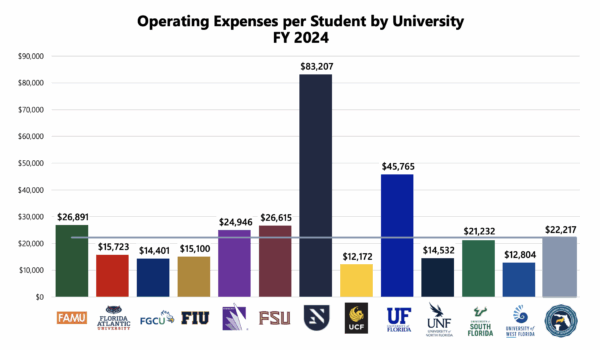
Image from the Florida State University System Efficiency Study showing New College with the highest costs per student, a figure that was derived by dividing operating expenses for each university by its student enrollment.
“New College of Florida has implemented many of the principles outlined in President Trump’s Compact for Academic Excellence in Higher Education, and will happily be the first college in America to formally embrace and sign President Trump’s vision for higher education,” the college said in the press release.
The Trump administration initially offered the deal on Oct. 1 to nine selective universities, none of which have so far publicly agreed to sign on. Brown University, Dartmouth College, Massachusetts Institute of Technology and the Universities of Pennsylvania, Southern California, Virginia and Arizona rejected the compact outright, which requires signatories to adopt a binary definition of gender and purge “institutional units” that “punish, belittle, and even spark violence against conservative ideas.”
The compact purports to help colleges create an “intellectually open campus environment, with a broad spectrum of ideological viewpoints.” But First Amendment groups, including PEN America, Knight First Amendment Institute at Columbia University and Foundation for Individual Rights and Expression (FIRE), have warned the compact restricts academic freedoms and may be unlawful.
Numerous universities and university associations, including the Council for Christian Colleges and Universities, which represents more than 150 largely evangelical institutions, have objected to the compact — signing onto an Oct. 17 statement that called the agreement “nothing less than government control of a university’s basic and necessary freedoms.”
The White House offered an initial deadline of Nov. 21 for universities to sign on.
In response to a question from New College Student Alliance president Kyla Baldonado during a Dec. 8 Board of Trustees meeting, Corcoran claimed that the proposed out-of-state tuition rate hike “would not affect the compact because our in-state tuition is not being raised and has not been raised in over a decade.”
But the compact does not address in-state versus out-of-state tuition and instead specifies that signatories must “commit to freezing the effective tuition rates charged to American students for the next five years.” According to the college’s most recently available “fact book” on enrollment, 18% of undergraduates enrolled in fall 2024 were out-of-state, non-international students.
During the Dec. 17 meeting, Baldonado was the only member to vote against the rate hike.
The Florida Board of Governors — which oversees the state’s university system — moved in June to raise out-of-state tuition in colleges across Florida, capping possible tuition hikes at 15%. New College trustees will vote Wednesday on a proposal to increase out-of-state tuition by the maximum amount.
The proposed tuition jump comes as New College increasingly leans on state appropriations to fund its operations, with the legislature nearly doubling funding for the school in the last five years. A November 2025 state report found New College’s annual per-student operating costs exceeded all other state schools at around $83,000.
Even as the school comes under increased scrutiny over its finances, DeSantis has signaled his continued support for the embattled institution and is seeking to transfer University of South Florida’s Sarasota-Manatee facilities to New College as part of his 2026-27 budget proposal.
Whether the state legislature will approve such a plan, which it rejected during the last legislative session, is unclear.
Alice Herman is an investigative/watchdog reporter for Suncoast Searchlight. Email Alice at alice@suncoastsearchlight.org
Editor’s Note: This story has been updated to include the Board of Trustees’ Dec. 17, 2025, vote on the tuition hike. It has also been updated to reflect the correct name of an organization, Foundation for Individual Rights and Expression.
Get stories like this delivered to your inbox weekly: Sign up for the Suncoast Searchlight newsletter