
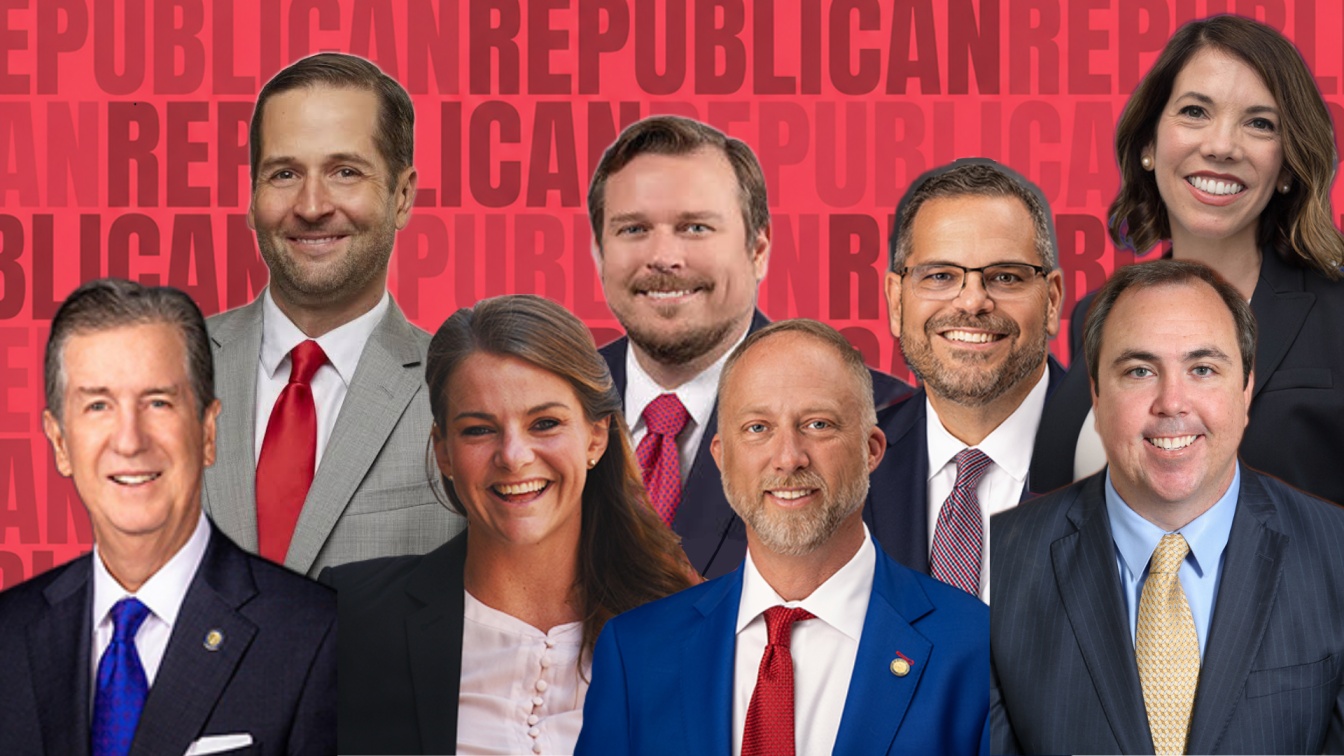
State lawmakers representing Sarasota, Manatee and DeSoto counties voted in favor of every one of the more than 50 measures restricting local control passed within the past five years, with vanishingly few exceptions. | Suncoast Searchlight illustration using publicly available photos of Florida lawmakers
Suncoast lawmakers hollowed out home rule. Do voters care?
On a late afternoon in May, Sarasota County’s statehouse liaison explained to a group of residents how a controversial state law required county staff to approve large apartment projects despite heavy opposition.
It was one of five workshops the Sarasota County Commission organized after several developers filed proposals under the Live Local Act. The property owners aimed to build large-scale apartments in rural areas where county regulations would otherwise not have permitted them.
For months, angry residents furiously lobbied county commissioners and demanded they stop the projects. When the officials listened, developers filed lawsuits against the county.
While Live Local has drawn ire, it is far from the only example of new state laws that override local decision making.
During the last five years alone, the Florida Legislature has voted to pass more than 50 laws restricting local government’s ability to respond to issues ranging from how they manage growth to how they handle public health matters or oversee elections, according to a review of legislation by Suncoast Searchlight.
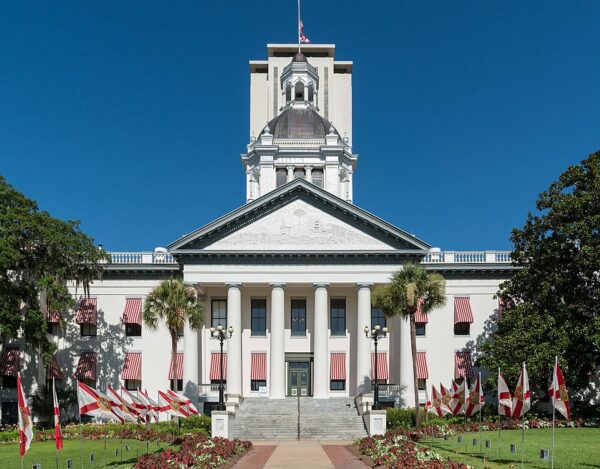
During the last five years alone, the Florida Legislature has voted to pass more than 50 laws restricting local government’s ability to respond to issues. | Photo courtesy of DXR through a Creative Commons license (BY-SA 4.0), via Wikimedia Commons
Suncoast Searchlight also reviewed the voting records of the eight state lawmakers representing Sarasota, Manatee and DeSoto counties — Rep. Danny Nix Jr., R-Port Charlotte; Rep. Fiona McFarland, R-Sarasota; Rep. Bill Conerly, R-Lakewood Ranch; Rep. Will Robinson, R-Bradenton; Rep. James Buchanan, R-Sarasota; Rep. Vanessa Oliver, R-Punta Gorda; Sen. Jim Boyd, R-Bradenton and Sen. Joe Gruters, R-Sarasota.
Together, they voted in favor of every one of those measures, with vanishingly few exceptions, like when one of them was absent.
The only lawmaker to vote against any of the bills reviewed by Suncoast Searchlight was Robinson — who is not running for re-election — when he opposed a preemption restricting diversity and inclusion efforts by local governments.
With few serious challengers in this year’s elections, the six incumbent lawmakers seeking another term now seem poised to sweep back into office. Three are running unopposed in the Republican primary, while three others face less-funded, lesser-known GOP challengers.
Suncoast Searchlight contacted every incumbent state lawmaker representing the tri-county region about their votes on legislation affecting local government authority. Not one agreed to comment.
Local leaders say Tallahassee has tied their hands
During the October and November legislative delegation meetings in Manatee and Sarasota counties, then-Longboat Key Mayor Ken Schneier, a Republican, requested that state lawmakers stop passing laws that stripped local governments of home rule powers. He pointed specifically to SB 180 — a law billed as a hurricane recovery measure barring local governments from adopting tougher land use regulations after a storm— and Live Local as preemptions that harm local leaders ability to govern.
“This year Tallahassee seems out for blood with legislative and executive branches dueling over the best way to cut municipal finances,” he said during the Sarasota County Legislative Delegation held in Venice. “… Simply put, this can’t go on, this can’t happen.”
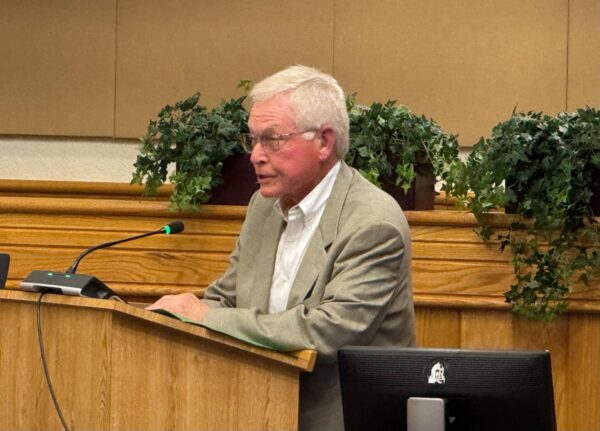
Then-Longboat Key Mayor Ken Schneier, a Republican, requested that state lawmakers stop passing laws that stripped local governments of home rule powers during the Sarasota County Legislative Delegation last year in Venice. | Photo by Derek Gilliam, Suncoast Searchlight
None of the lawmakers addressed Schneier’s concerns during the meeting.
Nor did they heed his call when they went back to Tallahassee in January for the 2026 legislative session. There, they joined their colleagues in passing 10 new bills that preempted local authority and, during a special session, approved perhaps the broadest assertion of state authority over local government — a proposed constitutional amendment that would reduce property taxes, the main funding source for local governments.
That constitutional amendment will require local governments to spend only on “core services” defined by the legislature and increase homestead exemptions for longtime residents, with the promise of phasing out non-school property taxes on homesteaded properties entirely.
Unlike previous state preemption laws, which limit local governments’ authority in specific policy areas, the amendment would affect the revenue that pays for nearly every local service. Cities and counties rely on property taxes to fund everything from law enforcement and fire protection to parks, libraries and road maintenance.
“It is the ultimate preemption,” Sarasota County Commissioner Tom Knight told Suncoast Searchlight. “Now, they are going to tell us what you can spend your money on and at the same time they’re going to limit the amount of dollars that flow into the local government.”
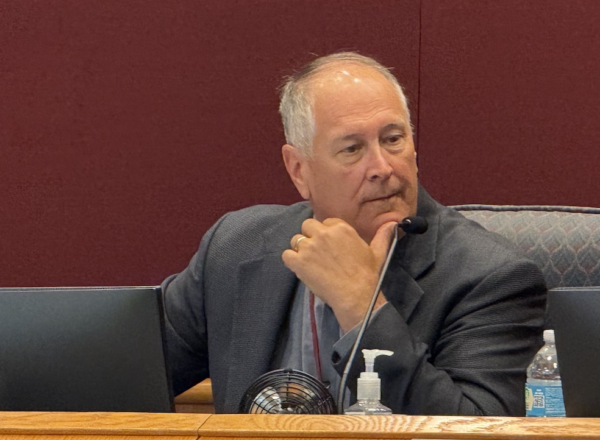
Local elected officials, including Sarasota County Commissioner Tom Knight (pictured. here), described a growing sense of frustration over how the Legislature has tied their hands.| Photo by Derek Gilliam, Suncoast Searchlight
In interviews with Suncoast Searchlight, local elected officials described a growing sense of frustration over how the Legislature has tied their hands. Since he was elected to office in 2024, Knight said he has had to constantly explain to voters how the county has lost control over issues like future development.
“The bulk of the conversations I’ve had with citizens over the last 12 to 15 months have been ‘I can’t help you, because state laws have changed and prohibit me from helping you,’” Knight said in an interview. “Right now, it’s pay to play in Tallahassee.”
Carol Weissert, a professor emerita of political science at Florida State University, described Florida as a “vanguard” in a larger national push away from local control.
“This is the trend, where state legislatures just bigfoot local governments,” Weissert said. “It’s particularly interesting because Republicans traditionally really were the ones that supported home rule and Democrats were the ones who tended to want, you know, a higher level governmental involvement … certainly the local officials know what’s going on, and they’ve really been unable to stop it.”
Eroding home rule years in the making
Florida’s history of “home rule” — the delegation of policymaking authority to local governments — traces back to the state’s 1968 constitution, which set a standard of broad local powers.
Prior to that, local governments had only the powers expressly granted by state law. In the decades since, Tallahassee has slowly turned back the clock.
Local officials and political observers say the trend has accelerated under Gov. Ron DeSantis, with preemption that takes aim at hot-button political issues, like vaccines and diversity programming, along with development-related regulations — long the bread and butter of local governance.
In 2021, the legislature passed a law limiting the ability of local officials to increase impact fees, the one-time charges developers pay toward the roads, parks, schools and other infrastructure needed to offset the strain of their new projects.
Three years later, legislators adopted a rule prohibiting counties and municipalities from requiring employers to provide heat protections for outdoor workers after local authorities in Miami-Dade tried to implement such a measure.
And in between, they passed SB 250 — a law enacted after Hurricane Ian to hasten rebuilding efforts and that served as a precursor to SB 180 by limiting local governments from adopting new development regulations after storms.
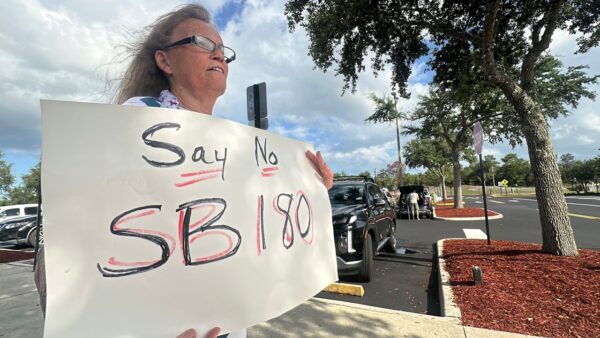
Billed as a hurricane recovery measure, Senate Bill 180 bars local governments from adopting tougher land use regulations after a storm and has triggered protests and lawsuits across the state. | Photo courtesy of Brandon Spencer, Spectrum News 13
Bob Fournier, who retired last year as the city of Sarasota’s attorney after more than two decades, recalled when SB 250 prevented the city from closing a zoning loophole that allowed developers to increase the height of their projects by adding extra space between floors.
In April 2023, city commissioners approved an ordinance limiting the amount of “interstitial space” — the area between floors used for mechanical, electrical and plumbing systems — after developers proposed using it to increase the height of the planned Obsidian condominium tower. But the developer argued that regulation was unlawful under SB 250, and the city ultimately repealed it.
“It almost feels punitive,” Fournier said of the state lawmakers’ actions. “When it comes to local government, it does appear they feel they know what’s best.”
But they didn’t stop there.
In 2025, McFarland, who represents Sarasota in the state legislature, added language to a new bill — SB 180 — that expanded the prior hurricane-related preemption law and extended its reach to all 67 counties until the end of 2027.
Lawmakers who advanced preemption face no campaign consequence
For all the criticism from their own local elected leaders, the state lawmakers who backed Tallahassee’s preemption push have faced little political risk at home.
Of the six area legislators who voted for nearly all of the preemption measures reviewed by Suncoast Searchlight, only Buchanan, Conerly and Oliver face Republican primary challengers.
And they so far have dramatically outraised them. Buchanan has brought in nearly $268,000 — 15 times more than Vic Rohe. Conerly has earned roughly $152,765 compared to John Phillips’ $12,903. Oliver, who represents parts of Charlotte and Lee counties and all of DeSoto County, has raised $142,592 compared to Julie McCormack, her Republican primary challenger, who has earned $2,832.
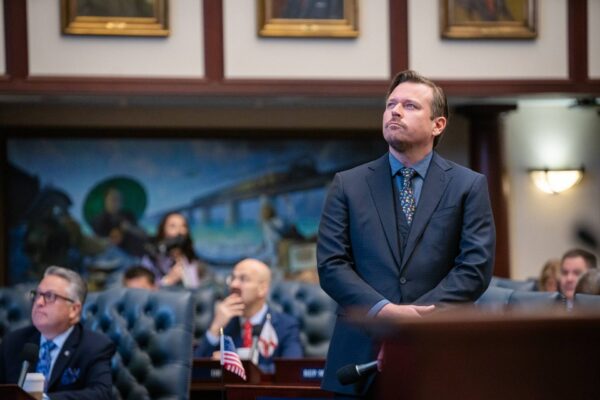
State Rep. James Buchanan, R-Osprey. | Photo courtesy of James Buchanan’s office
Absent an upset, the state lawmakers who have consistently backed state limits on local authority will likely remain at odds with their legislative delegations for years to come.
“People in office know they can get away with doing whatever they want,” said George Kruse, a Republican commissioner from Manatee County who was elected in 2020 and advocates for more local control on his blog. “Money has taken over — everything they do in Tallahassee and DC is based on how to make the people with the most money the most happy.”
One law Kruse has taken aim at is SB 180, which he says has effectively stopped a slate of Manatee County commissioners from fulfilling campaign promises to put back in place wetland buffers that a previous commission rolled back.
Manatee County Chairman Tal Siddique said that when SB 180 sunsets at the end of 2027, he has several policies — currently prohibited — that he would introduce, like requiring 50-foot buffers between wetlands and new developments.
“Maybe out of spite we’ll do 100 [feet] just because we’re pissed off,” Siddique said. A ban on data centers could come next, and then the commission would tackle development in the urban fringe areas.
But given past history, Siddique fears Tallahassee will step in again to block any local efforts.
“[By] taking away … these decisions, they help special interests that fund elections at the state level,” he said. “That is it.”
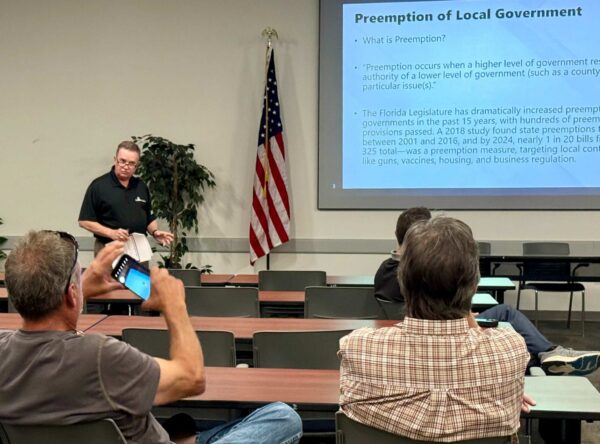
Rob Lewis, the Sarasota County director of government relations, talking to a group of residents about the Live Local Act. | Photo by Derek Gilliam, Suncoast Searchlight
Meanwhile, local residents can expect more meetings from officials explaining how state law has tied their hands. Rob Lewis, the Sarasota County director of government relations who’s been with the county for nearly four decades, put it simply.
“We oppose — capital letters — cost shifts, unfunded mandates or preemptions,” he told a small group of people earlier this year. “I’ve been fighting [preemptions] since 1982. It’s been a continuous uphill battle.”
Derek Gilliam and Alice Herman are investigative/watchdog reporters for Suncoast Searchlight. Email Derek at derek@suncoastsearchlight.org and Alice at alice@suncoastsearchlight.org.