Florida lawmakers introduced a slew of bills to restrict access to public records. | Photo by Aneese via iStock by Getty Images
Less sunshine, more secrecy as Florida limits public records access
After state lawmakers introduced dozens of measures this year restricting access to government records, only a few cleared the Florida Legislature. But open government advocates warn the ones that did pass could substantially limit transparency.
Lawmakers proposed more than 50 such measures, which ranged from increasing privacy for individuals on the Parkinson’s disease registry to exempting records regarding the selection of data center sites from public disclosure. More than a dozen of the bills would have shielded the personal information of different government employees from public view.
Fewer than 10 will ultimately reach Gov. Ron DeSantis’s desk to be signed into law. Government watchdog groups say this year’s legislation reflects a longstanding trend toward government secrecy in the Sunshine State.
“In Florida and throughout the country, we’re seeing more and more bills being introduced to keep records secret from the public,” said David Cuillier, director of the Joseph L. Brechner Freedom of Information Project at the University of Florida. “The exemptions just keep piling up every year.”
Never miss a story: Sign up for the Suncoast Searchlight newsletter
Marsy’s Law is back
One of the bills that cleared the Legislature would allow agencies to withhold from the public the names of crime victims — including temporarily shielding the identities of law enforcement officers who say they were assaulted or threatened on the job. The bill expands on the victim’s rights measure known as Marsy’s Law, which blocks sensitive information about crime victims from public view. This measure specifies that the names of victims are exempt.
It comes just two years after the Florida Supreme Court prevented law enforcement officers from hiding their identities under that law.
After Tallahassee police invoked Marsy’s Law — which was passed in Florida through a 2018 constitutional amendment — to withhold the names of officers who said they were threatened before fatally shooting people, the state’s high court ruled that the amendment does not shield their identities.
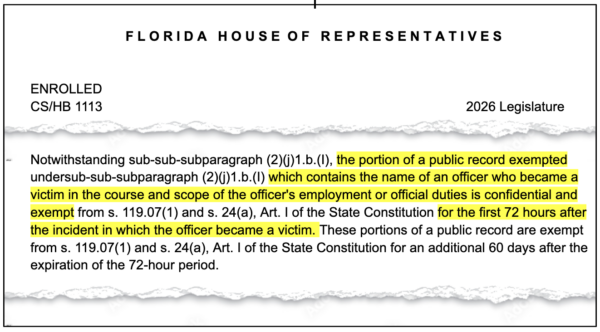
House Bill 1113 expands on the victim’s rights measure known as Marsy’s Law, which blocks sensitive information about crime victims from public view. This measure also would temporarily shield the identities of law enforcement officers who say they were assaulted or threatened on the job. | Suncoast Searchlight illustration of HB 1113
Now, the Legislature has effectively brought the exemption back, making police officers’ names confidential for 72 hours and exempt for up to two months.
Law enforcement officers have used Marsy’s Law to block local media coverage of police use of force, too. In 2022, the Sarasota Herald-Tribune sought to report on a sheriff’s deputy who shot and killed a man authorities said waved a knife while being evicted from his rental.
After the Sarasota County Sheriff’s Office learned of the newspaper’s reporting, the agency petitioned for an emergency injunction to block the publication of the officers’ names. The injunction lasted less than a month before a judge knocked it down — but the dispute highlighted how local law enforcement could invoke the new law.
The bill, HB 1113, was passed unanimously in the House of Representatives, with only four voting against it in the Senate.
“It just shows that so few legislators actually read and consider what it is they’re passing,” said Barbara Petersen, CEO of the watchdog group Florida Center for Government Accountability.
‘We’ve created this state-level FBI’
During the annual session, the Legislature also passed an exemption that would shield the public from information about the designation of “domestic terrorist organizations” under HB 1471.
The measures grant sweeping power for the state to sanction and label organizations that Florida’s chief of domestic security determines to be domestic terrorist groups.
Groups that the state designates as such could lose access to public funding and face restrictions from activities involving public schools and universities. Individuals associated with these groups could then be expelled from public universities or face criminal penalties.
During House debate over the bill on March 12, opponents suggested the state could use the designation arbitrarily, or to punish political dissidents exercising protected speech and raised questions about the process for the state to label organizations as terrorist groups.
“This bill is not a judicial process bill, this does not require the due process that is required at the level of the court system,” said Rep. Hillary Cassel, R-Dania Beach, who introduced the legislation.
The bills on domestic terrorism — a category for which there is no criminal charge under federal law — come as DeSantis seeks to declare the Council on American-Islamic Relations (CAIR), one of the largest Muslim advocacy groups in the United States, a foreign terrorist organization via executive order. U.S. District Judge Mark Walker issued a temporary injunction blocking the executive order earlier this month.
In defense of the public records exemption that passed alongside the bill, Cassel said organizations could sue and reveal records relating to the terrorism designation through the legal discovery process.
“They’re in essence saying, ‘instead of taking one step, you have to take 10 steps,’ and those 10 steps are going to cost you money,” said Omar Saleh, an attorney at CAIR-Florida. “A small school or an entity might not have the funds to litigate or the resources, and even if they do, it doesn’t necessarily mean that they’ll be able to get that in discovery.”
In December, CAIR-Florida filed a pending public records request seeking communications and other materials relating to the executive order — the kinds of records that could be exempt under the new bill.
“We’ve created this state level FBI,” Petersen said. By exempting records related to the designation of domestic terror groups, she said, “it’s just like unbridled authority that is deeply disturbing to me. There’s no accountability, there’s no oversight.”
Most bills didn’t make it
With the House and Senate gridlocked over dozens of bills, including the budget, most measures related to public records did not go far this year.
Among the bills that failed were two that could have significantly complicated the process of obtaining records from law enforcement agencies.

David Cuillier, director of the University of Florida’s Joseph L. Brechner Freedom of Information Project, talking about his book, The Art of Access: Strategies for Acquiring Public Records, during a 2017 C-SPAN interview. | Photo courtesy of C-SPAN
One would have required individuals requesting the personnel files of law enforcement officers to reveal their personal details, including their name, address and identification — a departure from Florida’s public records policies, which typically allow requesters to maintain anonymity.
Upon reading the bill, Petersen, of the Florida Center for Government Accountability, said she was “horrified.” She recalled a case she had worked on for the First Amendment Foundation involving a woman who requested the personnel file for an officer who she had filed a complaint against.
“When she went into the office, she made a request, and they put her in one of those small interrogation rooms with the door shut, and she waited for like 10 (or) 15 minutes,” Petersen said. “They’re supposed to bring the file to her, and the door opens, and it’s the cop (who) she filed the complaint against holding his personnel file in his hand, and he slapped it on the table and sat down.”
Another bill, which would have banned police officers from processing public records requests while engaging in “official duties,” died in a House committee and made no progress in the Senate. That bill would have also classified the act of repeatedly requesting records from a police officer as obstruction of law enforcement — a misdemeanor offense.
The Legislature only introduced one bill to reform the public records process — passing unanimously in the House but making no progress in the Senate.
That measure would have imposed specific time frames for agencies processing requests and forced those that don’t respond within a timely manner to drop fees for public records. It would have also created civil penalties for government employees who violate provisions of the state’s public records law.
“I was a little disappointed, because the reforms really weren’t that drastic at all,” said Cuillier, of the Brechner Freedom of Information Project. “I think Florida can do better than that, and it’s going to take some intentional backbone on the part of the Legislature. If they really believe in transparency and government accountability, they need to pass substantive legislation, because right now, we don’t have it in Florida.”
Alice Herman and Derek Gilliam are watchdog/investigative reporters for Suncoast Searchlight. Email Alice at alice@suncoastsearchlight.org; email Derek at derek@suncoastsearchlight.org