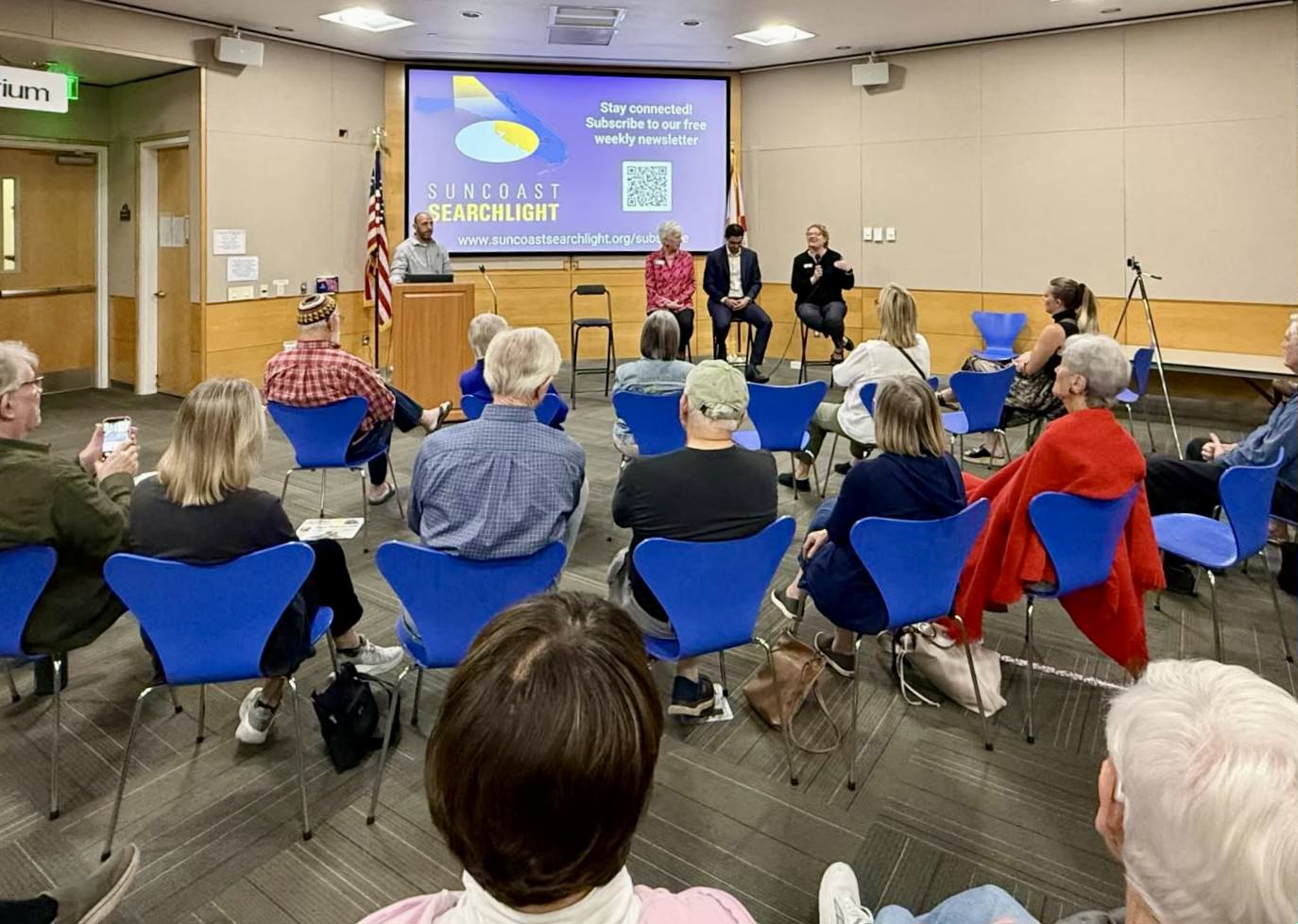
Dozens of Sarasota residents attend Suncoast Searchlight’s forum on navigating misinformation in the age of artificial intelligence at Selby Library. | Photo by Derek Gilliam, Suncoast Searchlight
Feeling overwhelmed by misinformation online? Sarasota panel says slow down
An Internet scammer posing as Taylor Swift to sell cookware sets. An audio clip of what appears to be then-President Joe Biden telling Democrats not to vote in the New Hampshire primary. Photos of President Donald Trump tussling with law enforcement during a court arraignment.
All went viral. None were real.
In an era of AI-generated deepfakes and algorithm-driven feeds, distinguishing fact from fiction has grown more difficult — and more important — than ever.
That reality drew dozens of residents to Selby Library last week for a community forum hosted by Suncoast Searchlight called “Asking Questions in a Noisy World.” The event focused on helping residents navigate an increasingly confusing digital information landscape.
For the first time, more Americans last year reported receiving their news from platforms like Facebook, YouTube and TikTok rather than from television broadcasts or traditional news websites. In an environment designed to capture attention and provoke emotion, half-truths often travel faster than corrections — and trust in journalism has fallen to historic lows.
“Each individual person now has the burden of saying: ‘Is that true? How do I know that’s true?’ And that’s exhausting and sometimes impossible,” said Joy Mayer, founder of Trusting News, a Sarasota-based national nonprofit organization that helps journalists earn trust with their audiences.
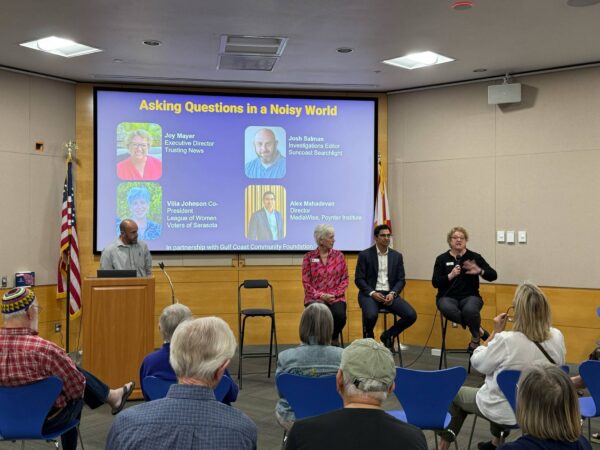
Panelists gather at Selby Library for Suncoast Searchlight’s forum on misinformation and artificial intelligence. From left , seated, are Vilia Johnson of the League of Women Voters of Sarasota County, Alex Mahadevan of MediaWise at the Poynter Institute, and Joy Mayer of Trusting News. Josh Salman of Suncoast Searchlight (far left) moderated. | Photo by Derek Gilliam, Suncoast Searchlight
Mayer was joined on the panel by Vilia Johnson, co-president of the League of Women Voters of Sarasota County and Alex Mahadevan, director of MediaWise at the Poynter Institute, a global nonprofit journalism training and research organization based in St. Petersburg.
Suncoast Searchlight Investigative Editor Josh Salman moderated the discussion, which was the fourth in the newsroom’s ongoing community engagement series sponsored by Gulf Coast Community Foundation. The series is part of the entities’ shared commitment to strengthen civic engagement and foster dialogue around issues shaping the region.
The series is part of the entities’ shared commitment to strengthen civic engagement and foster dialogue around issues shaping the region.
Throughout the evening, panelists turned to a central theme: Slow down.
Mayer, who founded Trusting News in 2016, said determining what’s real has never been more difficult now that anyone can find information online that supports their viewpoints. She recommended verifying information by cross-checking multiple sources.
She said consumers should consider how the information is framed. Does the post attempt to inform, persuade or entertain? And how does the publisher handle transparency, especially when they get something incorrect?
Mahadevan added that people should be wary about content that fits a particular narrative too well, leaning on the old adage that if it is too good to be true, then it probably is.
“If it makes you want to do a touchdown dance, that’s your cue to slow down,” he said. “Your entire online experience is designed to sell you something or keep you somewhere … you have to be a conscientious consumer of information online.”
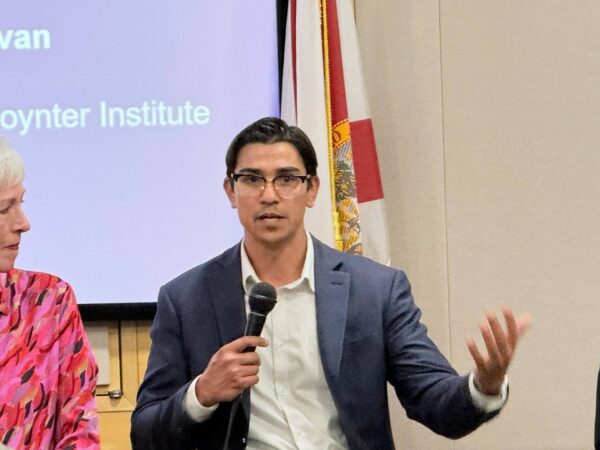
Alex Mahadevan, director of MediaWise at the Poynter Institute, speaks during Suncoast Searchlight’s “Asking Questions in a Noisy World” forum at Selby Library as Vilia Johnson of the League of Women Voters of Sarasota County looks on. | Photo by Derek Gilliam, Suncoast Searchlight
The advice reflects a growing body of research showing that emotionally charged content spreads more rapidly online than neutral information. For example, a recent review of peer-reviewed studies found that disinformation spreads up to six times faster than accurate information online, driven in part by emotion and social media algorithms.
Like Mayer, Mahadevan advised consumers of online information to figure out who’s behind the claim being presented. Try to find the original source, he said. Then compare the evidence. Is there real data, documents or sources? Are the graphs accurate or are they misleading?
Finally, check what traditional news sources are reporting.
“Go to the boring,” Mahadevan said. “Go to the AP (Associated Press). They’re boring.”
Johnson said that consuming factual information is an important part of civic life. If audiences lose trust in institutions, people check out and stop believing they can have an impact.
“Our democracy depends on diverse ideas,” she said, “and we cannot afford to lose civic participation if we want our laws and policies to reflect our values.”
Derek Gilliam is an investigative/watchdog reporter for Suncoast Searchlight. Email Derek at derek@suncoastsearchlight.org