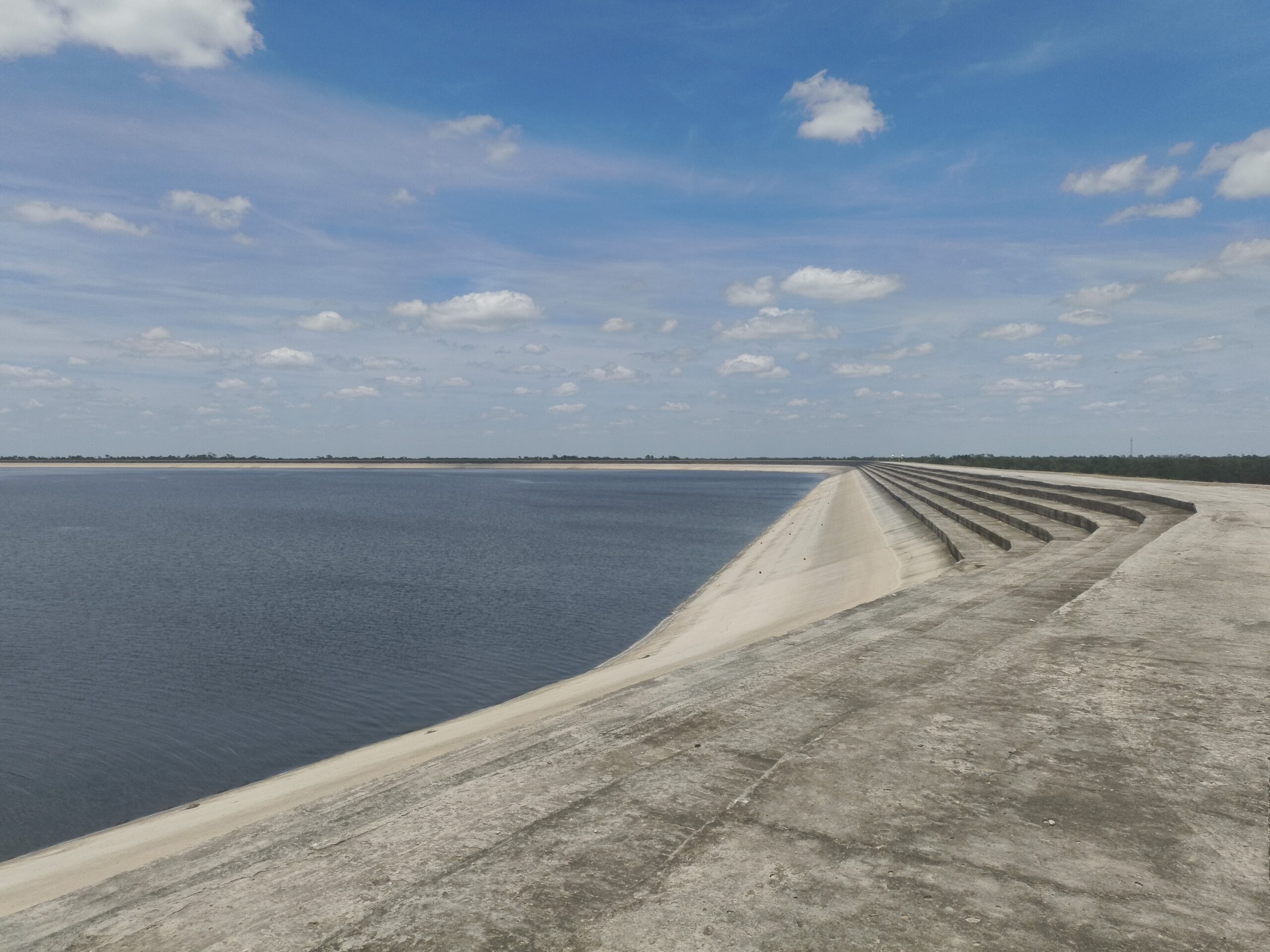
The Peace River Manasota Regional Water Supply Authority’s 6-billion gallon reservoir currently holds about 3 billion gallons of water. Between its reservoirs and its underground storage systems, the water supply authority now has about eight months of water in reserve — far less than normal. | Photo by Emily Andersen, Suncoast Searchlight
Drought drains Southwest Florida water reserve, officials say supply is secure
Standing on the wall of a reservoir the size of about four golf courses, it’s easy to see the impact of Southwest Florida’s extreme water shortage.
Operated by the Peace River Manasota Regional Water Supply Authority, the reservoir is built to hold 6 billion gallons of water. It is now half empty, and the distance between the current waterline and the visible mark where the water normally sits is striking.
The lack of water has become dangerous for local ecosystems, but as far as drinkable water supply is concerned, officials say they’re not panicking yet. Even if the drought continues through this year’s rainy season, officials are confident they can refill the supply before the end of the summer.
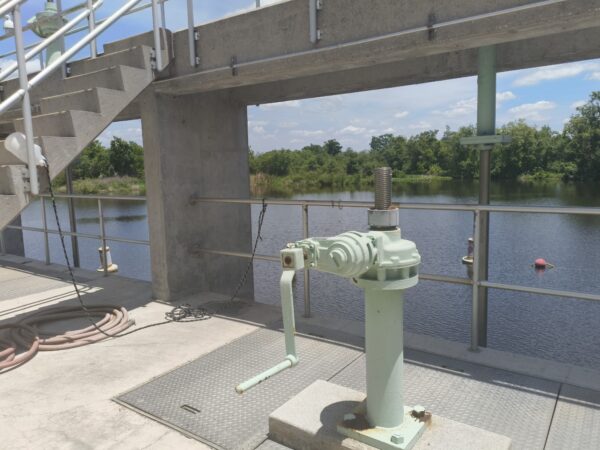
The Peace River is seen from above the water pumps operated by the Peace River Manasota Regional Water Supply Authority. In March, the pumps pulled an average of 8.73 million gallons per day from the river. | Photo by Emily Andersen, Suncoast Searchlight
“This summer, we’ll probably fill up a little faster. Usually, during the rainy season, there’s more water flowing than we even need to take, or can take, with the pumps we have out there,” said Katie Gilmore, the director of operations for the Peace River Manasota Regional Water Supply Authority. “So this year, we’ll definitely pull as much as we can, until we’re full.”
The Peace River Manasota Regional Water Supply Authority is also planning ahead for projected population growth, future droughts and the extreme swings of climate change by expanding capacity to more than double the amount of above-ground water in reserve.
The authority is the primary water supplier for Sarasota, Charlotte and DeSoto counties. It’s stationed near North Port along the Peace River, where each day, pumps pull millions of gallons of water from the river into a reservoir big enough to hold more than 9,000 Olympic-sized swimming pools.
The water is treated and either sent out to the water supply authority’s municipal customers or injected into an underground storage system called Aquifer Storage and Recovery, or ASR.
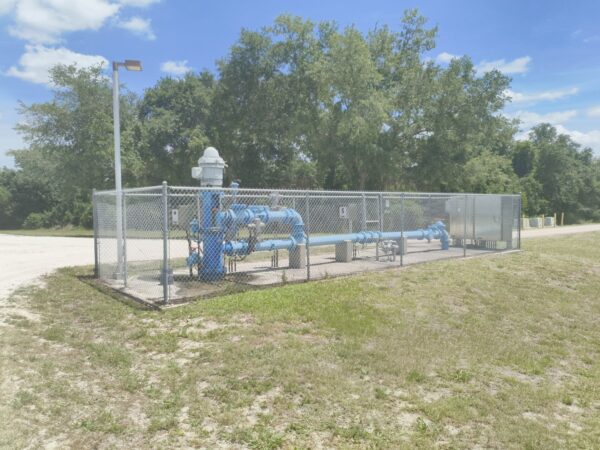
Pipes and machinery mark the location of an Aquifer Storage and Recovery well, where the Peace River Manasota Regional Water Supply Authority keeps underground water reserves. | Photo by Emily Andersen, Suncoast Searchlight
To get an idea of how the drought is impacting the region’s water supply, Suncoast Searchlight toured the authority’s sprawling outdoor facility, which includes a pump station on the river, the main reservoir and a collection of blue well pumps marking the ASR underground storage locations.
There is also a second 500-million-gallon reservoir and a blocked-off construction zone, where work has recently begun on what will be a 9-billion-gallon reservoir when finished in about three years.
Water reserves fall to about eight months’ supply
Between the ASR and the two completed reservoirs, the facility usually has between a 12- and 13-month supply of water, based on its usual output of almost 1 billion gallons per month.
That has now dropped to about eight months’ worth of water, according to data that Gilmore presented to the facility’s board of directors on April 1.
“This really is a drought situation,” Gilmore told Suncoast Searchlight. “There’s less rainfall. One can assume, even without watching the weather and their predictions, that there’s going to be less rainfall, so we needed to start preparing for that.”
Southwest Florida is currently experiencing its worst water shortage in almost a decade, prompting the Southwest Florida Water Management District to implement Phase 3 water restrictions for the first time since 2017.
Previous Suncoast Searchlight reporting found that the restrictions are not being evenly enforced across Sarasota County and that lack of compliance could be detrimental to the local environment.
“History has shown us that voluntary water restrictions do not work,” said Glenn Compton, the chairman of ManaSota-88, a local environmental nonprofit. “There need to be more mandatory restrictions that are put in year-round, so that we don’t end up in a situation where we’re concerned about reduced water supply in a drought.”
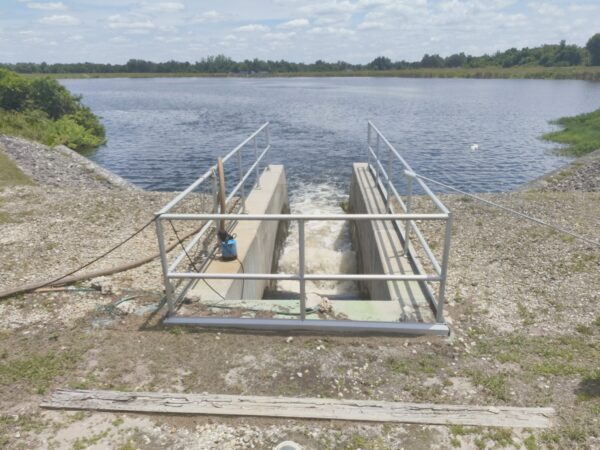
Water flows into a 5-million-gallon reservoir operated by the Peace River Manasota Regional Water Supply Authority. The water is transported from the water supply authority’s larger reservoir, which holds 6 billion gallons of water. | Photo by Emily Andersen, Suncoast Searchlight
Without emergency rule changes put in place this year, the water supply situation could have become much worse. But Compton said changing the protocol for water collection could exacerbate the environmental impact of the drought.
In a typical year, the Southwest Florida Water Management District doesn’t allow the water supply authority to pump water out of the Peace River if the river’s flow is lower than 130 cubic feet per second.
The river has been below that limit since November — around the same time the water management district first declared that Southwest Florida was in a water shortage. Despite the lower flow, an emergency order issued in March allows the water supply authority to continue pumping a small amount of water from the river.
It’s not enough to erase the deficit.
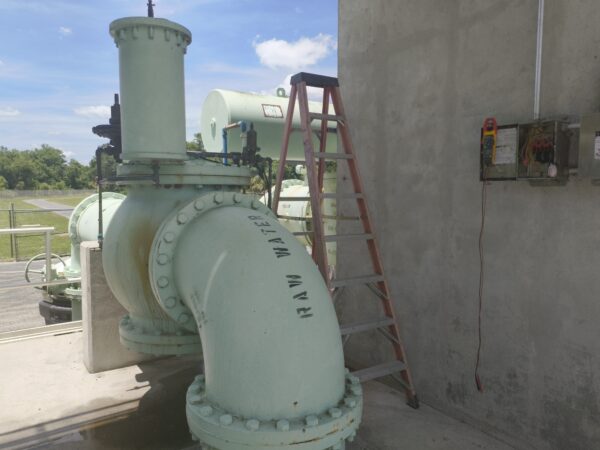
A pipe labeled “raw water” sticks up from the water pumps operated by the Peace River Manasota Regional Water Supply Authority. In March, the pumps pulled an average of 8.73 million gallons per day from the Peace River. | Photo by Emily Andersen, Suncoast Searchlight
Water system releasing more than triple what it pulls from river
In March, the water supply authority pulled an average of 8.73 million gallons per day from the river, but it dispensed an average of more than three times that amount each day to the communities it serves.
The emergency order expires at the end of May, so the water authority will soon be relying only on its stored water — until expected summer rains bring an increase in river flow levels. If this year’s rainfall follows the Peace River Basin’s usual pattern, that likely won’t happen until June or July.
“That’s why it was built, to handle stuff like this,” the authority’s executive director, Richard Anderson, said. “We’ve been able to use a little bit of rain and the emergency order that we got to basically keep the reservoir level where it was at the end of March.”
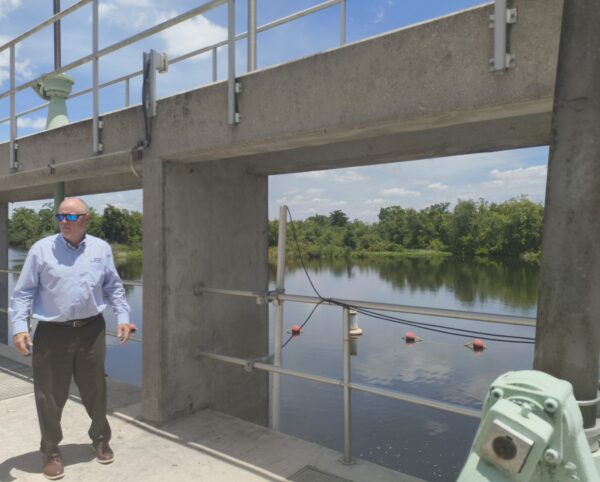
Richard Anderson, the Executive Director of the Peace River Manasota Regional Water Supply Authority stands at the authority’s water pump site along the Peace River during a tour of the water facility on May 6. | Photo by Emily Andersen, Suncoast Searchlight
Anderson and Gilmore said the only anticipated long-term effect on water supply and operations will be an increased cost this summer as the staff and machinery at the plant work harder to refill, but those costs aren’t likely to be passed on to customers.
“The power, the chemicals to treat the water, all costs money, so if we’re running at a higher demand than normal, that’ll be an additional cost on us,” Gilmore said. “We have enough built into our budget to handle that, but that’ll be our impact.”
The environmental impact will likely last much longer. According to Compton, taking even a small amount of water from the already low river is dangerous for wildlife and local ecosystems. Lack of water can change which plants are able to thrive in certain areas, causing more competition for local native vegetation, and it can cause animals to change their concentration patterns in search of more water, impacting predator and prey dynamics.
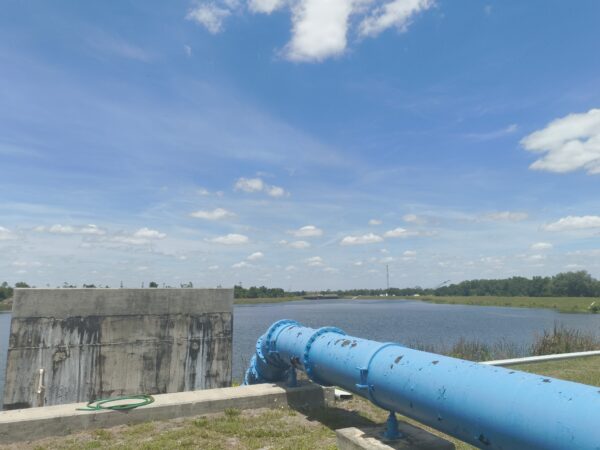
A pipe carrying water sticks out of a 5-million gallon reservoir operated by the Peace River Manasota Regional Water Supply Authority. It’s the smaller of two reservoirs that are part of the water treatment process at the facility, which has lower water levels this year than normal after several months of drought. | Photo by Emily Andersen, Suncoast Searchlight
“It’s almost equivalent to taking a little bit of oxygen out of the system and expecting it to remain healthy,” he said. “Having an emergency declaration where you can withdraw more water than what is permitted could have a devastating impact on the river’s resources.”
Emily Andersen is a watchdog/investigative reporter for Suncoast Searchlight. Email her at eandersen@suncoastsearchlight.org.