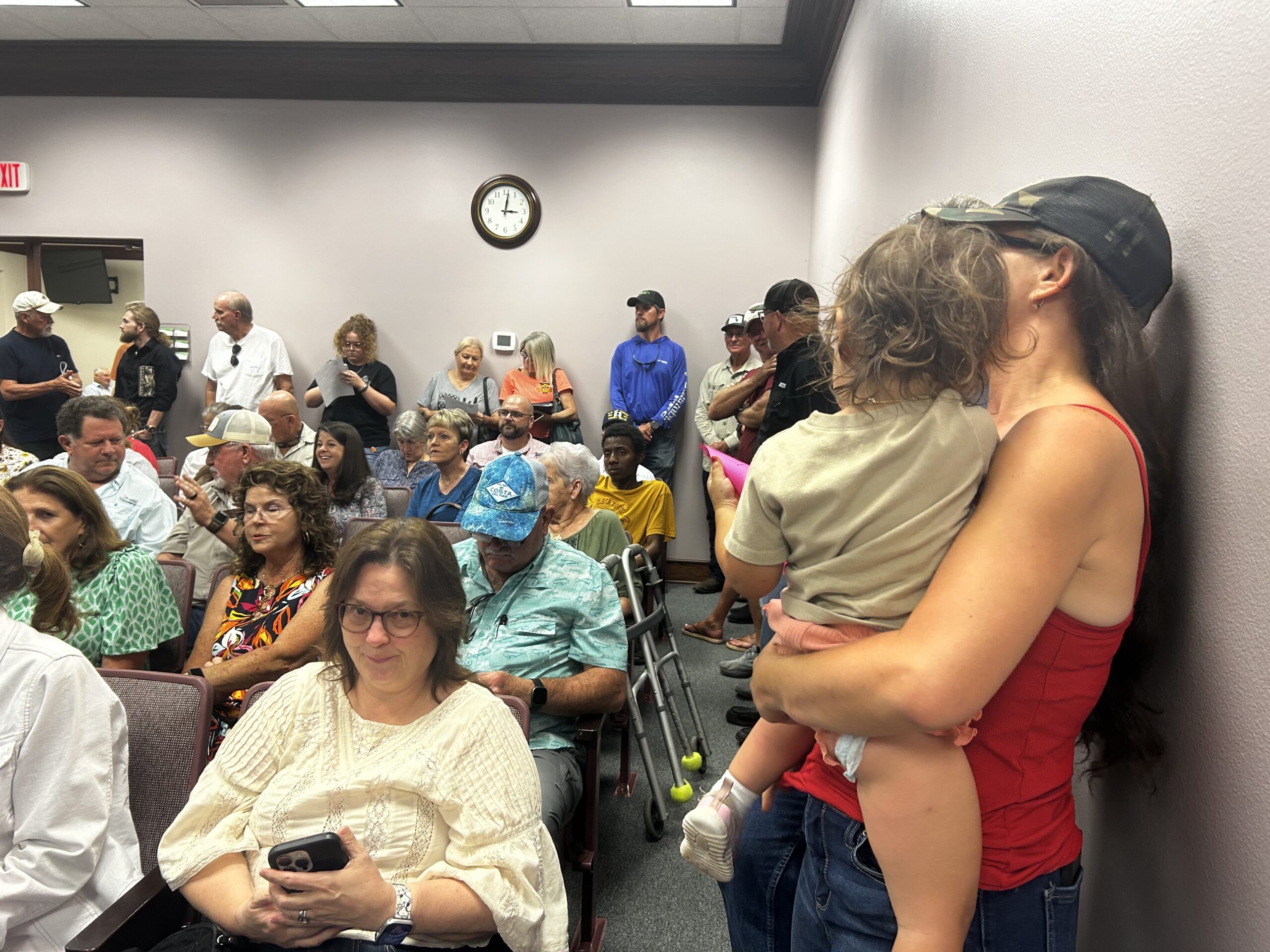
DeSoto County residents packed a county commission meeting on June 23 to speak in favor of a moratorium on data centers. | Photo by Alice Herman, Suncoast Searchlight
After public outcry, DeSoto County moves forward on data center moratorium
After nearly three hours of emotional public comment, DeSoto County commissioners on Tuesday took the first step toward a one-year moratorium on data centers.
By a unanimous vote, four of the county’s commissioners — one recused himself — agreed to direct the county attorney to prepare language for an ordinance that would bar them from accepting new data center applications in the coming year.
The moratorium would not apply to already pending projects, according to the county attorney. That includes a rezoning application for the buildout of a more than 800-acre gas-powered hyperscale data center complex, which is still working its way through the county.
DeSoto commissioners declined to comment on the application from DCIP Group, the company behind the project, citing due process concerns that could arise given the quasi-judicial nature of the hearing on the rezoning application.
But the commissioners’ vote may signal a shift in their stance on these kinds of projects, the first of which they initially welcomed with enthusiasm, hoping it would draw millions in tax revenues.
“I think they’ve come to their senses about the negative aspects of it and how the public thinks about it,” said Sarah Hollenhorst, a DeSoto County resident who has advocated for the county to reject the hyperscale data center proposal. “I think they’ve educated themselves.”
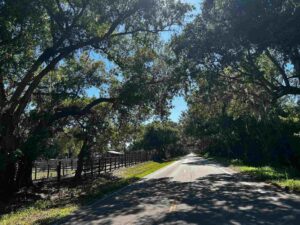
DeSoto commissioners voted to rezone 34 acres of land on Roan Street for an initial data center facility in March. | Photo by Alice Herman, Suncoast Searchlight
In March, DeSoto commissioners approved DCIP Group’s request to rezone 34 acres for an initial data center facility on the site of a decommissioned power plant on Roan Street, a canopied lane in rural DeSoto County.
The company pitched that facility — which has not yet been built — as phase one in a longer-term project that would eventually span as many as 1,300 acres of land dotted with data centers.
A second rezoning application, which has been submitted to county planners, would bring the project to more than 800 acres and, according to initial maps, include more than a dozen additional facilities.
The county is considering the project under its Rapid Response pilot program intended to usher in economic development. Emails obtained through a public records request show how commissioners sought to prioritize the project, spurring staff to fast-track the application process.
Representatives of DCIP Group have said it will use a “closed-loop” cooling system to reduce water use and that it will seek to use reclaimed water to avoid burdening local water sources. The company also has said it will use “acoustic modeling” to “ensure that sound levels remain well within acceptable limits and do not create a nuisance,” promising that “every aspect of our project is being planned to operate responsibly, quietly, and respectfully within the community,” according to its website.
But when a reporter asked CEO Jon Brown for detailed information about the project’s anticipated daily water use and the number of gas turbines it would eventually employ, Brown was unable to provide specifics. It could use as little as zero gallons of water a day — or as many as 3 million, he said.
As for the buildout of turbines, that number could vary depending on the availability of other technologies supporting the microgrid it seeks to build.
“You’ll have batteries that also support those turbines, and it’s a full, very complicated design for a micro grid,” Brown said during a May 20 interview.
Representatives for DCIP Group did not speak during public comment at Tuesday’s meeting, and the company’s chairman, Wilson Trilha, told a reporter after the meeting that he needed more information about the moratorium before commenting on it.
The uncertainty surrounding the project’s long-term environmental impacts, and the scale of the project, has fueled backlash in the community.
“Residents should not be asked to accept unknown water impacts based on future promises,” Arcadia resident Asha Stalnaker said during the June 23 commission meeting. “This county deserves facts and not assumptions, and until these facts exist, I do not believe additional approvals should be able to move forward.”
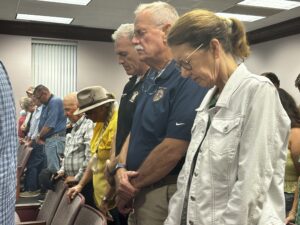
DeSoto County staff and residents prayed before a county meeting where commissioners voted to advance a data center moratorium proposal. | Photo by Alice Herman, Suncoast Searchlight
Speaker after speaker echoed Stalnaker’s sentiment, with not one resident speaking in support of the pending project or against the proposed moratorium on data centers.
“I can’t find anybody that wants this,” said Nathan Headrick, an Arcadia pastor who said he speaks with “hundreds of people” on a weekly basis.
“We don’t have enough information really to make an informed decision,” Headrick said. “This seems like something that’s being pushed on us, and I don’t know about you guys, but when I’ve been pushed into purchasing things, I’ve made really bad decisions. That’s how I ended up with a timeshare in Las Vegas.”
Commissioners deliberated for about 15 minutes before voting to pass the moratorium proposal on to the county attorney, directing her to draft language for a county ordinance, to later come to a vote before the commission.
“I know more about a data center than I ever wanted to know because I’ve done a lot of studying,” Commissioner Elton Langford said.
He and other commissioners said they had listened to residents and rejected the idea that they were not taking their concerns seriously.
“I look in this crowd today, and I see people that are like family to me, that I’ve known for a long time … y’all see that we do care about Desoto County,” Langford said. “We’re not a bunch of bought and paid for puppets.”
Alice Herman is an investigative/watchdog reporter for Suncoast Searchlight. Email her at alice@suncoastsearchlight.org.