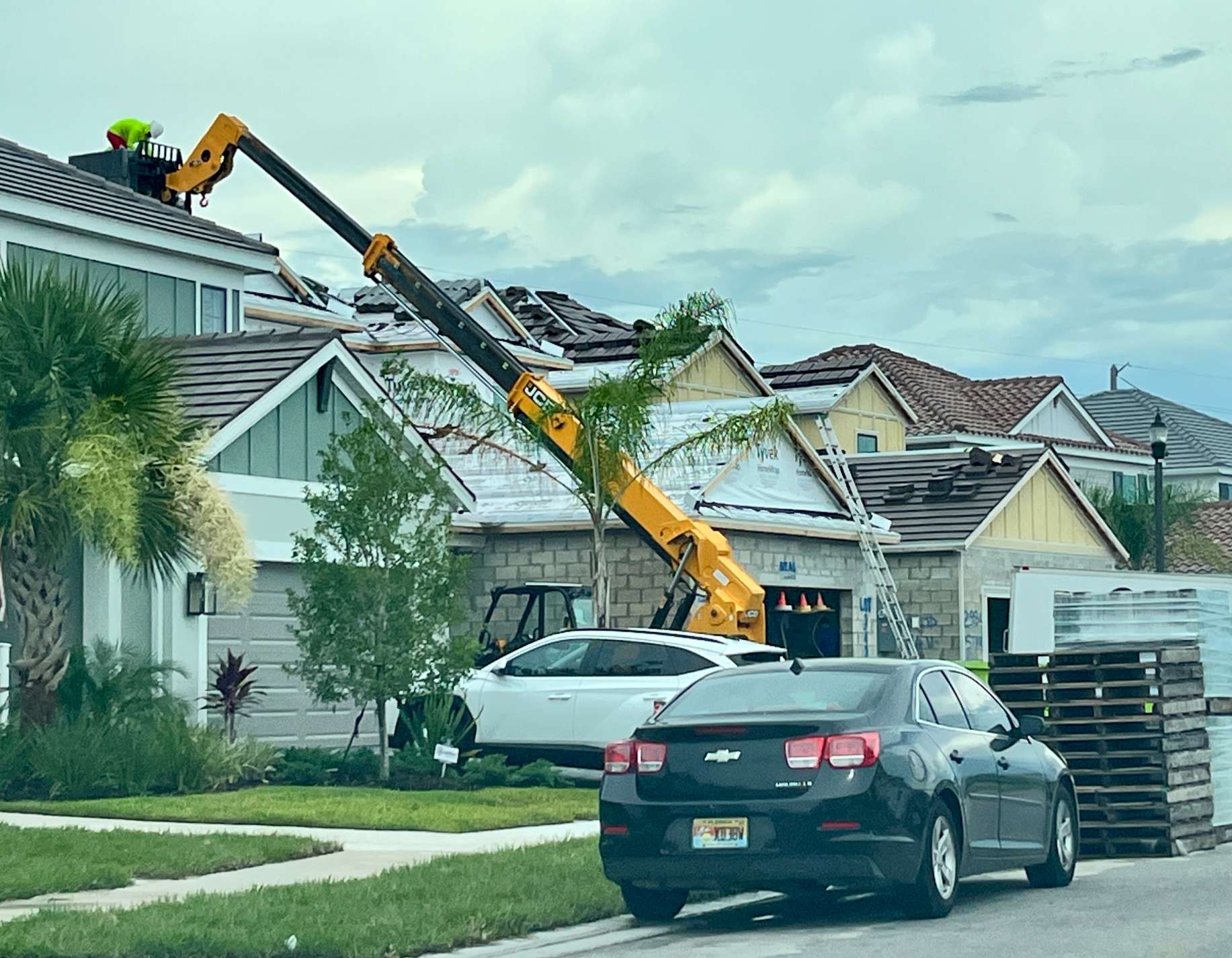
New homes under construction in Lakewood Ranch. | Photo by Emily Le Coz, Suncoast Searchlight
Manatee leads nation in home permits as infrastructure struggles to keep up
In areas of Manatee County long defined by agriculture, like Parrish and east toward Myakka City, signs tout brand new residential communities with resort-style pools, fitness centers and quick connections to incoming commercial developments.
Farther south, around Lakewood Ranch, new neighborhoods continue to spread east of Interstate 75 where, along once-rural roads, construction crews are clearing land for still more homes to come.
The seemingly endless march of new development is no illusion.
Manatee County is approving new homes at a faster rate than any comparable sized county in America. But as thousands of new houses rise, local officials are struggling to provide the roads, schools and emergency services those neighborhoods will need — raising questions about whether the county can keep pace with the growth it has allowed.
Last year, Manatee County issued 11,015 new residential building permits, the highest rate per 1,000 residents of any other U.S. county of similar or larger size, according to a Suncoast Searchlight analysis of U.S. Census Data.


That’s more per capita than some of the nation’s fastest-growing communities like Miami-Dade County and Montgomery County in the suburbs of Houston.
Builders in Manatee last year pulled triple the number of permits for single-family homes than unincorporated Sarasota County. And so far in 2026, the numbers are showing similar trends.
The influx of new residents is forcing Manatee officials to make multimillion-dollar investments in new schools and emergency services substations, while adding dozens of new law enforcement deputies.
But the cost of keeping pace with that growth — from expanding roads to ensuring adequate drinking water and sewage capacity — comes as county leaders face millions in lost revenue after Florida voters approved a measure this month to slash property taxes.
Some commissioners say the projected budget restraints could have major implications for the new infrastructure they need.
“Will the infrastructure ever 100% catch up? Who knows,” Manatee County Commissioner Mike Rahn said. “You’re going to see (Capital Improvement Plan) projects on roads either be delayed to the point where they’re never going to happen, or just not going to happen.”
Commissioners recently have tried to rein in development by rejecting some large projects — like a 2,000-home proposal in Parrish proposed by Lennar Homes — and raising the impact fees that builders pay to offset the cost of new roads, schools and other infrastructure needed to support more residents.
But developers sued over the higher fees, arguing they violate a state law restricting local governments from imposing more burdensome regulations after hurricanes. The dispute has tied up more than $14 million in collected impact fees as of July, according to the Bradenton Herald. That’s money the county could otherwise use for infrastructure if it prevails.
“I’d say our approach has been to slow the approvals pretty significantly and focus more on filling in gaps,” Manatee County Commissioner Tal Siddique said.
Traffic continues to rise across Manatee, but fixes remain elusive
As more homes rise in areas like Parrish and Lakewood Ranch, traffic congestion has spiked on roads never designed to handle so many vehicles, leaving local officials scrambling to keep pace at the same time as funding grows increasingly scarce.
Much of Manatee County’s construction boom is concentrated east of Interstate 75, where once-rural areas offer vast stretches of undeveloped land for new neighborhoods.
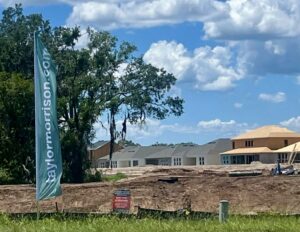
Firethorn is a new community in Parrish. | Photo by Josh Salman, Suncoast Searchlight
North of Moccasin Wallow Road, up-and-coming residential neighborhoods like Sawgrass Village and North River Ranch are adding hundreds of homes to the Parrish area, straining nearby corridors.
For example, a segment of I-75 in Parrish serving these new developments saw a 12.5% increase in average daily traffic from 2021 to 2025, according to data from the Florida Department of Transportation.
The same data shows a nearly sixfold increase in traffic to the segment of Buckeye Road from Carter Road to U.S. 301, increasing from about 800 daily drivers to 4,600 from 2021 to 2025. The road draws traffic from the nearby Harvey K-8 School and communities like the Lennar at Prosperity Lakes development.
Out east, similar congestion persists near major residential developments off State Road 70 and State Road 64, like on Lorraine Road, where traffic counts are already up 32% and are expected to worsen with a new high school and a 232-unit multi-family project on the way.
That’s why Commissioner Bob McCann has urged the board to fund the road’s $117 million expansion from two to four lanes. He voted against the county’s Capital Improvement Plan because it did not include improvements to Lorraine Road.
These costly infrastructure projects are likely to become even more difficult after Florida voters this month passed Amendment 3.
The measure will dramatically reduce the amount of revenue available to local governments by raising the homestead exemption from $50,000 to $150,000 in the first year and $250,000 the second year. The measure also would reduce taxes on second homes and commercial property, restrict what local property taxes can fund and make it harder for local governments to replace lost revenue.
Property taxes are the primary source of revenue for local governments to use on projects like road widening. At a commission meeting on Wednesday, County Administrator Charlie Bishop estimated the new exemption could result in up to $176 million in lost revenue over the next two years.
“On the infrastructure side…we’ll barely keep up with maintenance,” Siddique said. “I don’t think you’ll expect to see new road projects any time soon.”
More deputies and EMS stations added to respond to growth
The development surge also puts additional strain on public safety, like emergency medical services and law enforcement deputies.
Manatee County’s population rose by more than 68,000 people from 2020 to reach 468,200 in 2025, according to census data. That means more resources are needed to keep the same levels of service when someone calls for an ambulance or to report a suspected crime.
“As Manatee County continues to grow, we continually evaluate staffing levels and adjust resources to address the areas experiencing the greatest growth,” Randy Warren, a spokesman for the Manatee County Sheriff’s Office, said in an email to Suncoast Searchlight.
Warren said the office added 65 deputy positions over the past four years to keep pace with the growing population, which doesn’t include additional positions in investigations, corrections and communications centers.
Those deputies each earn between $77,522 to $117,099 per year, according to the Sheriff’s Office.
“Our approach is to remain proactive and responsive as the community grows,” Warren added. “In previous years, we’ve been able to add deputies to patrol these expanding areas, and we continue to look at ways to position our existing resources where they are needed most.”
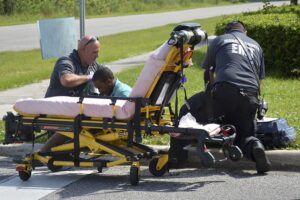
To accommodate an uptick in housing construction, officials have had to extend emergency medical services to growing parts of the county. | Photo courtesy of Manatee County via Flickr
Officials have also had to extend emergency medical services to growing parts of the county. For example, the county opened EMS Station 22 on Moccasin Wallow Road in December.
But for some developments, like the Greyhawk Landing community in northern Bradenton, the nearest EMS stations are more than 4 miles away, and about a 12-minute drive without traffic. The county’s average emergency response time is just over 8 minutes.
When new developments go through the county planning process, Manatee County spokesperson Casey Zempel said the developers are required to review EMS and public safety capacity “and the county’s ability to provide adequate emergency response times as development occurs.”
The reviews are intended to give county commissioners a better understanding of what services surround new developments, which inform land use decisions.
“The goal is to ensure that public safety considerations are part of the development review process and that the county can plan appropriately as our community continues to grow,” Zempel said in an email.
School district forced to reevaluate student populations, add new schools
Manatee County’s surging population also means more children, forcing the public school district to reevaluate student populations and build new campuses to handle the expected growth.
The district completed a four-year strategic planning process before this academic year. Kevin Chapman, the district’s associate superintendent of administration and strategic engagement, said this planning was crucial to handle the county’s growth.
Part of the effort meant redistricting schools to balance out student populations starting this academic year. The last time the district redrew its school boundaries was in 2019.
Before the latest redistricting, B.D. Gullett Elementary School — located near high growth areas between S.R. 64 and S.R. 70 in Lakewood Ranch — was approaching 2,000 students, according to Chapman. That’s almost double the school’s capacity.
“We had to be ready this year to handle everything that was going to happen over the next four or five years,” Chapman said. “That plan was really dedicated to building schools, having the right support staff and teachers and being ready for what was coming.”
Since Aug. 20, Chapman said almost 200 new students joined the district.
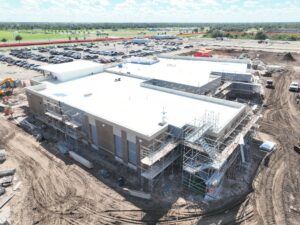
The new Rangeland High School, at the corner of Rangeland Parkway and Premier Sports Boulevard, will add 2,089 students to the district’s capacity. | Photo courtesy of the School District of Manatee County
With more students anticipated to come, district leaders also had to invest in new buildings.
That included the new Rangeland High School, at the corner of Rangeland Parkway and Premier Sports Boulevard, which will add 2,089 students to the district’s capacity. The $144 million, 300,000-square-foot building is planned to start its phased opening in August, and will include college-style lecture halls and several sports fields.
The investments also include two new elementary schools, each adding 970 students to the district’s capacity. Rye Ranch Elementary and Veterans Elementary each cost $75 million, and opened for students this academic year.
These new schools are funded largely through impact fees charged to developers, according to Chapman.
But new schools also require investments in infrastructure, like roads and water lines.
“We can’t build a school unless there’s, you know, sewer lines, and roads, and power, and traffic lights and all that,” Chapman said. “It’s really got to be very well coordinated, so we do work very well with the county on that.”
The district is also eyeing more land in case more schools are needed. Chapman said the district is working on land agreements for more than 100 acres of land in different parts of the county to be prepared.
“We’re probably, at this point, finished with building for the time being,” Chapman said. “We’re just kind of getting the land in case the growth continues.”
Carter Weinhofer is a contributing writer for Suncoast Searchlight and previously was a government accountability reporter for the Bradenton Herald. Email Carter at weinhofercar@gmail.com.