
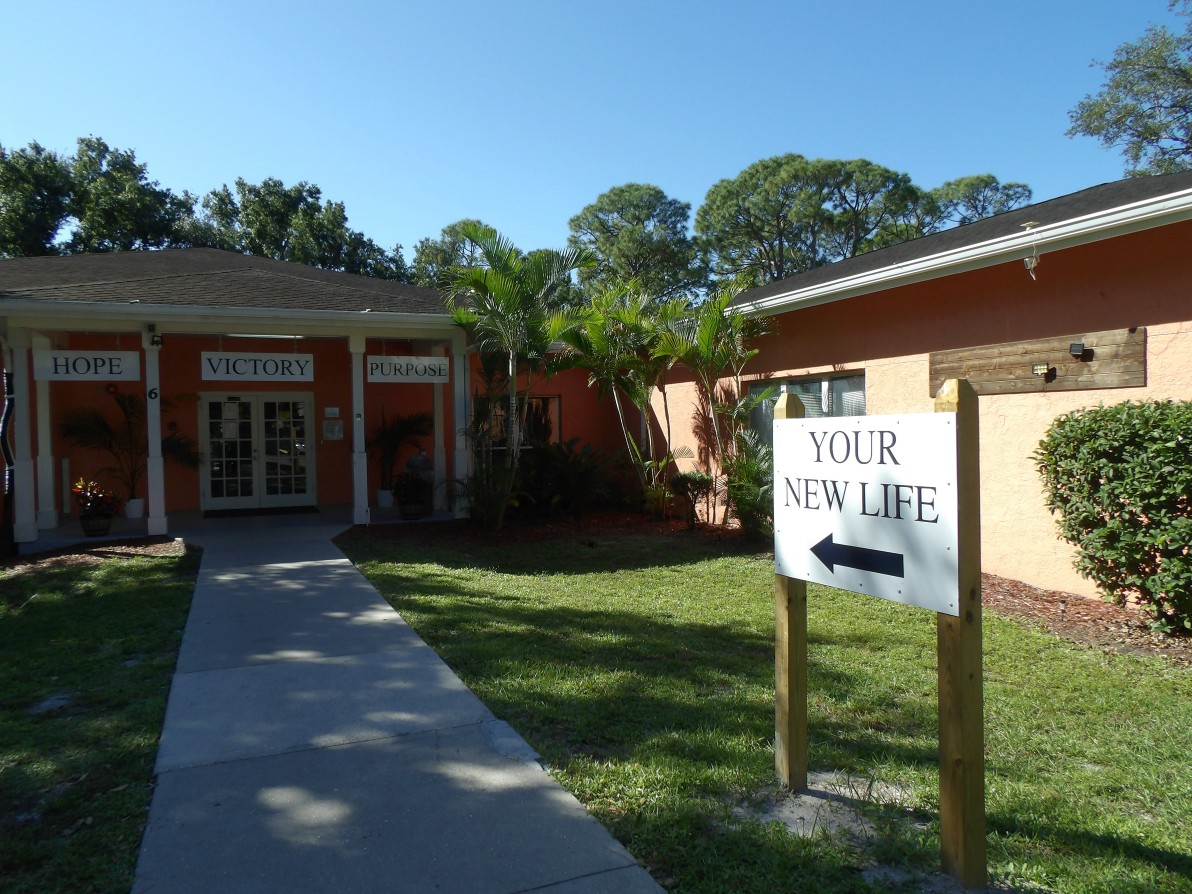
The front entrance to The Crossings, a drug rehab facility in Oneco, in Manatee County. Residents who live near the facility recently hosted a protest, asking county commissioners to shut it down. | Photo by Emily Andersen, Suncoast Searchlight
Needed but not wanted here: Suncoast social services face neighborhood opposition
A protest in September urged Manatee County commissioners to shutter a drug recovery center after a former client attempted to break into a neighborhood home.
Neighbors of a church offering homeless services in Sarasota County complained to local officials of clients defecating in their yards and sleeping under porches, spurring a code violation this year and orders for the church to stop service operations.
In both cases, residents behind the complaints said they have no problems with — and even applaud — the social work the organizations are doing. But they fear allowing the services in their own neighborhoods has created a dangerous environment for their communities.
The disputes have raised questions about how local governments balance neighborhood safety with the need for social services — and whether zoning restrictions are making it difficult for organizations to operate.
In Sarasota County, social service operations are allowed in just four types of zoning districts, covering about 20% of the land under county jurisdiction. Even there, providers must obtain special approval from county commissioners.
In Manatee County, where zoning rules are less restrictive, neighbors of a drug recovery center said county commissioners made a mistake by allowing the facility to operate in their community. The center’s new leadership has since acknowledged shortcomings in its previous procedures.
It’s a problem that social science researchers said is common across the country. Communities rely on social services to care for the most vulnerable members of society, including those dealing with substance use disorders and homelessness. But concerns over public safety and neighborhood well-being can often drive them out.
When these complaints begin to mount, it becomes increasingly difficult for local governments to find the right balance.
Jon Thaxton is a director with the Gulf Coast Community Foundation and a former Sarasota County commissioner. He compared the friction to playing a game of whack-a-mole — the problem will usually resurface somewhere else, in another neighborhood that doesn’t want to deal with it either.
“The reason we have this problem is we’re trying to sweep these people under the rug rather than supply them with the services they need,” Thaxton said.
It’s not a new problem on the Suncoast.
In 2014, a plan for a large homeless shelter funded by both the city of Sarasota and the county was abandoned after officials failed to find a location. Consultants and staff identified several properties both in and out of the county, but government leaders ultimately rejected all of them after facing blowback from constituents living near each location.
Then, earlier this year, the Suncoast Partnership to End Homelessness — a nonprofit organization that coordinates homelessness services — finally moved some operations into a co-work space in Manatee County after spending several months struggling to find a landlord who would rent to them. The organization has a central office in Sarasota, but wanted to open a second location closer to its Manatee County partners.
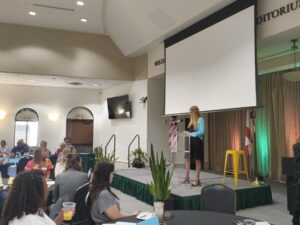
Taylor Neighbors, the CEO of Suncoast Partnership to End Homelessness, spoke to representatives from organizations across Manatee and Sarasota counties that work to combat homelessness on Wednesday, Aug. 19. | Emily Andersen, Suncoast Searchlight.
“We’re not even in the direct service business. We’re not a shelter. We’re not a rapid rehousing provider. We’re pretty much administrative,” said Taylor Neighbors, the CEO of Suncoast Partnership. “It was really disheartening … how difficult it was just to find a place to rent, and some of the perceptions that some landlords had.”
Public perception is something that social service providers are constantly battling, Neighbors said.
When these complaints rise to the level of government intervention, she said she encourages local leaders to look for ways to promote public safety without shutting down services.
“You’re not going to please everybody,” Neighbors said. “That’s just the world we live in, but how do we come to that common ground and support one another?”
Manatee County safety concerns stem from attempted break-in
Margi Nanney has lived in Oneco for 40 years. Her home, nearly 120 years old, received the first Manatee County historic landmark designation earlier this year.
Needless to say, her neighborhood, and the people in it, are important to her.
That’s why she said The Crossings should never have been opened.
“Our county commissioners made a huge mistake when they allowed that to happen in our neighborhood. That would never happen in Lakewood Ranch, or Heritage Harbor, or any of these other places. But they let it happen in Oneco,” Nanney said. “This neighborhood’s never been the same, and we’re not going to stop until we get it closed.”
The Crossings has been operating for a little over two years, according to founder Jim Rouches. Rouches said he wanted to create a safe space for addiction recovery after overcoming his own struggle with substance abuse disorder.
“I’ve been exposed to a lot of the good and bad and ugly of the whole continuum of care treatment line from beginning to end,” Rouches said.
In 2025, The Crossings sought approval from county commissioners to continue operating the drug recovery program on 24th Street East. The facility had to seek special approval because residential treatment facilities are typically only allowed in residential areas where the roads have higher traffic capacity.
Commissioners approved the plan, with Amanda Ballard, who represents the district where The Crossings is located, casting the lone dissenting vote.
Even since then, neighbors have pushed back.
They believe The Crossings shouldn’t even be classified as a residential treatment facility, but rather a large recovery home, which could change how zoning laws apply.
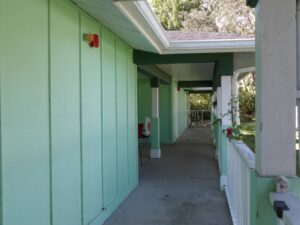
The outside of the one of the housing areas on the campus of The Crossings, a drug rehab facility in Oneco. The facility houses up to 90 clients at a time in dorms and small apartments. Residents who live near the facility hosted a protest earlier this year, asking the county to shut The Crossings down. | Photo by Emily Andersen, Suncoast Searchlight.
In addition to hosting a protest in September, Nanney said she and other neighbors have filed complaints about The Crossings with multiple statewide organizations that regulate medical and substance abuse services.
The Crossings doesn’t provide clinical or medical care, though leadership is working on getting the proper licensing to open a clinical treatment facility on the campus, Rouches said. For now, the organization provides case managers who work with outside providers to ensure clients have and follow a comprehensive recovery plan.
Those plans often include working a job outside The Crossings, meaning that clients regularly come and go from the campus.
“Whatever their treatment plan is … we bring their recovery and their life skills and that service plan alongside that,” Rouches said. “We maintain compliance for the courts and for the clinicians.”
Nanney said she’s supportive of The Crossings’ mission, but she sees its location and lack of regulation as a safety concern for the surrounding neighborhood.
“No one’s against people that need help. The program could be fabulous, but not in that location,” Nanney said. “Our whole deal is the location is wrong for that program, and it never should have been allowed to happen.”
Her concerns aren’t unfounded.
In June, Jacob Sulzman was charged with possession of a controlled substance and prowling after he attempted to break into a house down the street from The Crossings, according to a criminal complaint.
According to Nanney, a woman and her grandchildren were inside the home, hiding, while Sulzman was on the porch trying to open their front door.
Sulzman’s listed address on arrest documentation was The Crossings, though leadership said he had been discharged from the facility 10 days before the attempted break-in.
Sulzman has a history of violent crime. In 2022, he pleaded guilty to attempted murder in Pinellas County. Court records say he shot at his girlfriend.
“Those kids, they’re never going to be able to sleep, and they’re going to be scared their whole lives,” Nanney said. “This would have never happened if we didn’t have that facility down there.”
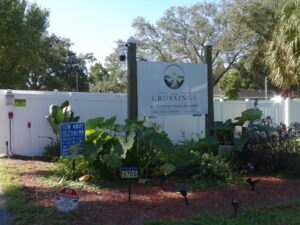
A sign at the entrance to the parking lot for The Crossings, a drug rehab facility in Oneco, in Manatee County. | Photo by Emily Andersen, Suncoast Searchlight
Leadership at The Crossings acknowledged that the way the facility has been run created the possibility of a dangerous situation, like the one with Sulzman. But they say they’ve taken community concerns to heart.
After Sulzman’s arrest, The Crossings removed and replaced every member of its board of directors and most of the staff. Chad Dubin, the new CEO, said that although he doesn’t believe it was malicious, the previous leadership left several gaps in processes like background checks at intake and proper discharge of clients that contributed to potentially dangerous situations, like the incident with Sulzman.
Dubin said that if he lived in the neighborhood, he too would have been concerned.
“They weren’t doing it on purpose,” he said. “They just didn’t know any better. But there are a lot of things that weren’t being done right.”
Now, though, Dubin said the processes and procedures are being updated, and community concerns are top of mind.
“There are two communities that we want to protect in our decisions,” Dubin said. “The first one is our community here of our clients and our staff, but the other community is our neighbors. We really try to think about every decision we make.”
Sarasota County church plans to cite freedom of religion
Like The Crossings, the Remnant Church in Sarasota County has come under fire from nearby homeowners who say the social services provided make their neighborhood unsafe.
The church offers meals, showers, clean clothing and laundry services four days a week for people experiencing homelessness — all services that county zoning officials say makes the church a social service operation.
In August, the church was issued a notice of violation after a neighbor, Christine Nordstrom, complained to county officials. Nordstrom said she witnessed a man defecate behind her neighbor’s house, and it was the last straw after years of community safety concerns caused by Remnant’s homeless clients.
According to Nordstrom, neighbors regularly find things like needles and bottles of urine left in their yards, and people have been found sleeping under the raised back porches in the neighborhood.
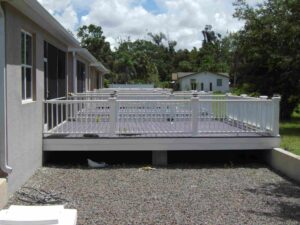
The six homes that are part of the Ashton Enclave Condo Association, across the street from the Remnant Church, all have raised back porches. Christine Nordstrom, the HOA president for the homes, said that Remnant’s homeless clients sometimes sleep under the porches. | Photo by Emily Andersen, Suncoast Searchlight
“I’m not anti-homeless. I’m not anti-services,” Nordstrom told Suncoast Searchlight in an interview after the notice of violation was issued. “It’s a matter of, this operation has had a detrimental impact on the neighborhood around it, and at what point do we listen to the homeowners that are being impacted? Charities should solve problems, not relocate them.”
This isn’t the first time Remnant has faced neighborhood pushback over its services, according to Tammy Burns, the church’s homeless services director.
Before moving to its current location on Ashton Street, the church offered homelessness services out of a small building in downtown Sarasota, where nearby businesses complained.
“Businesses complain, and if you go where there’s no businesses, residents complain,” Burns said. “It’s just harder and harder to find somebody a place to be.”
Per Sarasota County’s zoning code, social services cannot be operated in a residential area, like the one the church is located in, even with a special exception. If the church were to move to another part of town, it would still have to seek an exception from county commissioners to run a social service operation.
Remnant could petition the county for the property to be rezoned to a commercial district, with an exception for social services, but it would cost thousands of dollars just to make the request, and it’s not guaranteed to be approved.
“People keep saying, ‘Well, apply for the zoning.’ Well, first off, we’re probably not going to get it. And, we still feel like what’s being done to us is against the First Amendment,” Burns said. “So, we’re not willing to follow that route.”
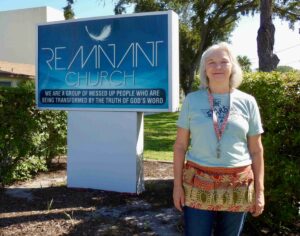
Tammy Burns poses for a photo in front of the Remnant Church, where she is the director of homeless ministry. Tammy and her husband, Frank, founded the church in 2015. | Emily Andersen, Suncoast Searchlight
Instead, the church is trying to find a constitutional lawyer who can help argue that the way zoning laws are being applied is a violation of religious freedom rights.
In the meantime, church leaders said they are trying to be good neighbors. They shut down services for a few weeks after receiving the notice of violation, while they decided what legal pathway they wanted to take. Since returning to full operations, they’ve been especially cautious about the impact they have on the streets around them. One of Remnant’s clients has even volunteered to walk the street every day the cafe is open to look for and pick up trash, according to Burns.
“People have this mental idea of what somebody … who’s homeless, of who they are and what they are, and don’t really get to know the story of who they are and what they are,” Burns said. “I’ve got a room full of people who are very sweet … I’m not saying that group is amazing, and they’re not throwing trash or whatever, but we try to keep up with that. We do our very best.”
Zoning laws differ between counties
When it comes to creating locations for those programs to operate, Thaxton said the zoning and development in Sarasota County haven’t helped.
“We’ve not made it easier,” Thaxton said. “I’m not going to say we’re making it harder, but we’re not making it easier.”
In Sarasota County, there are four types of base zoning districts where social service operations — including soup kitchens, homeless shelters, rehabilitative facilities, and others — are allowed to operate. Those zoning districts cover about 20% of the land under county jurisdiction, much of which is already in use.
Even within those four zoning districts, social services can only be operated in Sarasota County with a special exception, meaning any new operation must appear before the county commission for approval.
If the Remnant Church were to attempt to move its homelessness services to another location or request a rezone, the church would also need to seek a special exception from commissioners.
“Zoning codes are based on compatibility of uses,” said Rob Robinson, a Sarasota lawyer who specializes in land use and property rights. “In most zoning codes, you can find a place in the county or city where social services … can go. The question is, is there land available there, or are there already structures there that are for sale that could be purchased at a price that they want to pay?”
In Manatee County, social service providers have more options, and zoning is more dependent on the kind of service offered. Most nonprofits that offer public services are considered “public community use,” and are allowed in 22 zoning districts without special approval, and in five others with a special permit.
The Crossings is classified by Manatee County as a residential treatment facility, which are allowed in 4 different zoning districts without a permit, and 12 zoning districts with a special permit.
But even regardless of zoning codes, nonprofit services in both counties must grapple with legal approvals and community pushback in order to provide for the vulnerable people they serve.
Charley Willison, a political scientist with Cornell University, said this isn’t a unique problem. Social services across the country face community pushback related to zoning and public safety.
But in most cases, providing social services in places that are accessible to those that need them actually reduces crime, she said.
“People who experience homelessness are far more likely to be victims of crime than to be engaging in crime themselves,” Willison said. “Housing people, giving people a place to go, reduces the risk of crime.”
Emily Andersen is a watchdog/investigative reporter for Suncoast Searchlight and previously covered criminal justice, public safety and social services for The Gazette in Cedar Rapids, Iowa. Email Emily at eandersen@suncoastsearchlight.org.