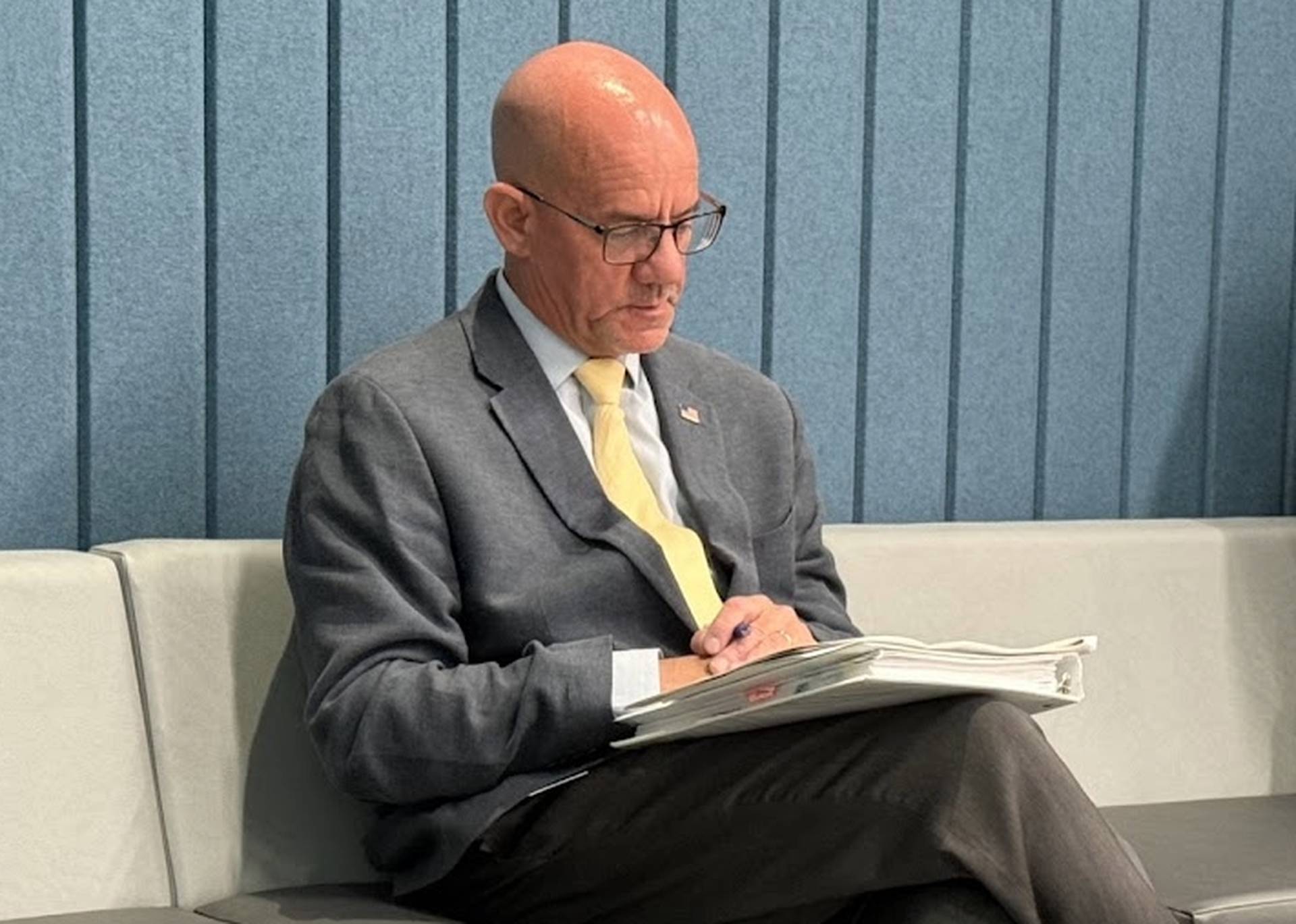
Ben Quartermaine prepares to update both the city and county commissions on Sept. 18, 2026, after more than a year on the job. He took the job in August 2025 after Sarasota County commissioners created the Stormwater Department. | Photo by Derek Gilliam, Suncoast Searchlight
Ben Quartermaine was hired to fix Sarasota stormwater. A year later, problems persist
Two years ago, water rose as high as door knobs in Sarasota’s South Gate neighborhood. Rescuers in boats ferried families from the Laurel Meadows subdivision to safety. Residents of the Amish-Mennonite community of Pinecraft watched as water pushed into homes then pooled there for days.
Following the floods caused by Tropical Storm Debby, a slow boiling anger from the residents who were affected manifested at Sarasota County meetings, each featuring increasingly more livid crowds. Neighbors formed groups to protest their dismay, demanding to know what went wrong and how to prevent the next floods.
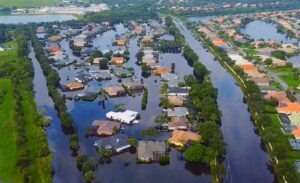
Flooding of Laurel Meadows during Tropical Storm Debby.
For years, county officials had touted their Stormwater Environmental Utility, a dedicated funding stream meant to maintain drainage infrastructure and protect communities from flooding. But a 2025 investigation by Suncoast Searchlight and the Florida Trident found an operation in disarray — rife with vacant positions, dodging responsibility for maintaining its largest stormwater system at Phillippi Creek and employees who were unprepared when the storm came.
County commissioners responded by splitting stormwater into its own department, hiring a new leader for the division and promising to do better.
Commissioner Mark Smith sarcastically summed up the expectations for the new director on the day the department was created last summer.
“This may be the most highly anticipated savior since Jesus Christ, and with a bit of Moses in there, in that we don’t need you to part the water, you need to part the sand,” Smith said.
A year after Stormwater Director Ben Quartermaine was brought on to lead the embattled department, Suncoast Searchlight and the Florida Trident set out to examine what has changed — and what hasn’t.
Reporters interviewed more than a dozen current and former county employees, residents, neighborhood leaders, elected officials and others; reviewed six months of emails representing thousands of communications between stormwater officials, personnel records and staffing data; and examined maintenance records, contracts and other documents detailing the county’s efforts to rebuild its stormwater operations.
The review found signs of progress. Residents and county commissioners praised Quartermaine’s professionalism and responsiveness. Some pointed to noticeable improvements and said they have seen crews clear ditches and culverts that had gone neglected for years, while chipping away at a backlog of routine stormwater maintenance.
But some of the underlying problems that plagued stormwater before Quartermaine arrived remain.
Despite adding 26 employees, the department’s vacancy rate has barely budged, from 20% when the newsrooms examined the operation last year to 18% today. Ten vacancies remain among the field crews responsible for maintaining canals, ditches and culverts — and the manager position overseeing those crews has been vacant since spring.
The maintenance backlog, after shrinking, has begun to grow again. Major dredging projects stretch years into the future. And although county com
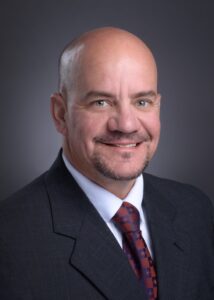
Sarasota County Stormwater Director Ben Quartermaine | Photo courtesy of Sarasota County
missioners have committed more than $80 million to dredge clogged creeks, oxbows and bayous, much of that money remains unspent.
To be sure, Quartermaine inherited problems that took years to form, making a wholesale turnaround nearly impossible in a single year. Some drainage issues date back more than two decades or longer, and fixing them can carry multimillion-dollar price tags. In one Sarasota neighborhood, for example, improvements to address standing water after routine summer storms are estimated to cost more than $7 million.
But for residents who flooded in 2024, or who have been complaining about drainage problems for years, patience is beginning to wear thin.
“They all say they’re going to do something,” said Joel Schleicher, a resident of the Harbor Acres neighborhood, which still floods after routine afternoon thunderstorms. “But they do nothing.”
In September, Quartermaine sat down with a reporter for an interview in a county conference room to talk about his first year leading the new department, the progress he believes he has made and the work still ahead.
A Sarasota native who previously spent more than a decade working in the county’s stormwater operation, Quartermaine described the job as personal. He knows the waterways, the drainage system and many of the people who are charged with fixing it.
“This is my backyard,” Quartermaine said. “I know these creeks. I know the canals. I know the drainage system. I know the staff.”
One of the biggest tests of that turnaround will be Phillippi Creek, a major drainage artery that carries stormwater through some of the areas hardest hit by flooding in 2024. Years of accumulated muck and sediment have reduced the creek’s capacity to move stormwater.
When Quartermaine took the job, he expected to be close to signing a contract to dredge a middle section of the creek by spring 2026. That permit remains under review, and Quartermaine is now targeting the end of the year for approval. It could be well into 2027 before the section — where some of the most severe flooding occurred in 2024 — sees its first bucket of silt removed.
Some worry that improvements will not come soon enough — and say Quartermaine’s performance can’t truly be judged until the work is done.
“I can’t tell you if they’ve done a good job until the job is done,” said Connie Neeley, a Forest Lakes resident who’s been a vocal advocate of dredging. “There’s been a lot of schedule and calendar sliding.”
Quartermaine takes over a department in disarray
After community outcry over the flooding and the newsrooms’ joint investigation — which found that the county’s own mismanagement contributed to the problems — Sarasota County turned to a former insider to rebuild its troubled stormwater operation, Quartermaine was hired in August 2025 at $190,000 per year to rebuild the new department.
He had worked in the county’s stormwater division twice, from 1998 to 2004 and again from 2013 to 2018, rising to engineering and operations manager during his last stint, before leaving for a private-sector job at Stantec, an engineering firm with a large presence in the region.
At the time, stormwater was not its own department. It was a division of the Public Works Department, led by Spencer Anderson, who oversaw stormwater during the 2024 flooding.
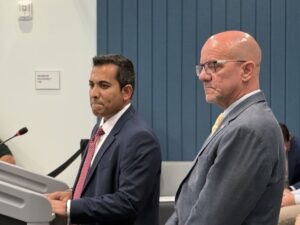
City of Sarasota Public Works Director Nikesh Patel (left) stands next to Sarasota County Stormwater Director Ben Quartermaine at the September 18 joint city and county meeting. The pair provided an update about the stormwater system to both the their elected boards. | Photo by Derek Gilliam, Suncoast Searchlight
By separating stormwater from the department responsible for roads and other public works, county leaders hoped to give greater attention to the sprawling network of pipes, ditches and creeks designed to direct water safely away from homes and businesses.
Despite the public fury towards the division, Quartermaine said he took the job because he felt that he could make a difference and lead the turnaround.
Working with Steve Suau, an independent contractor who wrote a report about what went wrong during Tropical Storm Debby, Quartermaine worked quickly to make changes that initially received praise from residents.
One of Quartermaine’s first changes was to increase drainage ditch cleaning from once every 10 years to once every three years. Residents noticed crews clearing ditches that had long been choked with sludge and debris.
He also created an online tool where residents track maintenance and improved communication with the neighborhood groups and stakeholders who had been demanding changes, including some of the department’s fiercest critics.
Smith, the Sarasota commissioner who joked about the high expectations for Quartermaine when the department was created, said he believes the new director has done a good job in a nearly impossible situation. The problems he inherited, Smith said, were “25 years in the making” and could take “three or four years” to solve.
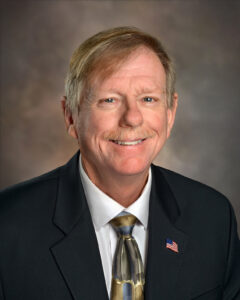
County Commissioner Mark Smith | Photo courtesy of Sarasota County
Smith likened the job to “building a plane in the air” — creating a department from scratch while trying to find the right people to staff it.
“It’s an incredible scope of work,” Smith said, “and quite frankly I think it will need four years to be back where it (the system) won’t be a threat.”
But the early improvements have not quieted all of the criticism.
At a joint city-county meeting last month, Kelly Brown, president of the Coalition of City Neighborhood Associations, questioned the usefulness of the department’s new transparency maintenance map because it shows where work is planned but not when it will be completed. At the same meeting, residents from St. Armands also pressed Quartermaine about continued flooding problems there.
“Please go faster,” Brown said. “All of the people that live in that area, 2024 hurricanes were like yesterday to them. So to hear a date of 2031 is just not soon enough.”
Staffing woes continue under new leadership
Despite an aggressive push from Quartermaine to shore up the new stormwater department, the staffing problems that have plagued the operations for years have proved stubborn.
Emails obtained by Suncoast Searchlight and the Trident show that effort has at times been complicated by delays inside the department, as well as difficulties recruiting and paying employees.
Quartermaine was slow to post vacant positions and fell behind on employee evaluations, contributing to delayed raises and prompting some employees to contact human resources directly.
At the same time, he struggled to attract candidates for key positions and sometimes clashed with county HR officials over what it would take to hire them.
The department’s second-in-command job sat vacant for roughly a year. A second posting in February drew just six applicants, only one of whom met the minimum requirements. That position was eventually filled in June.
The search for a stormwater finance manager proved difficult, too, according to internal emails.
In December, a candidate turned down the county’s offer for a job in Gainesville that paid $30,000 more. Quartermaine then turned to an internal candidate, Joseph Gentile. But he and county HR officials ended up $1,200 apart on what Gentile should be paid. HR refused to go higher, citing “internal equity concerns” because Gentile would already earn more than others in similar positions.
Six minutes after that refusal, Quartermaine offered to make up the difference himself.
“I am under tremendous pressure to get this position filled,” he wrote the county’s chief human resources officer. “I’m willing to give back $100/mo. Just to have this. Take $1,200 from me.”
HR didn’t budge. Gentile was hired in February at the lower salary, with a review for a possible 1% raise after six months that was “not guaranteed.”
In an interview with Suncoast Searchlight, Quartermaine acknowledged challenges in hiring but also defended the county’s pay scale, pointing to benefits that don’t show up on a paycheck like retirement, insurance and “a really good work-life balance.”
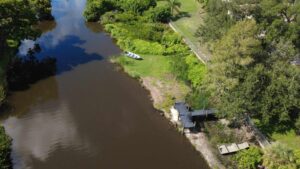
Some areas of Phillippi Creek have seen large embankments form well past where the creek once flowed. These photos were taken in the South Gate community in the middle section of the creek.| Photo by Seth Johnson for Suncoast Searchlight
He also said he’s focused on providing career paths for people in field services. Two of his current operations managers worked their way up through the ranks.
“I understand that the county positions aren’t for everyone, but we’ve been able to find some really good staff, and a lot of that is in-house staff that we’re able to promote,” Quartermaine said.
Phillippi Creek dredging faces delays to resident dismay
Along parts of Phillippi Creek, the waterway has filled in so dramatically that Seth Johnson sees lawn mowers where kayaks once traveled.
At his own property, Johnson has walked beyond his seawall onto dry land to cut the grass growing on an embankment. The vegetation has now reached over 10 feet high. A neighbor’s dock that once had a boat now sits on dry land.
It’s a vivid example of the accumulation county officials are now trying to remove from the creek — and a project where even some of the department’s critics acknowledge progress.
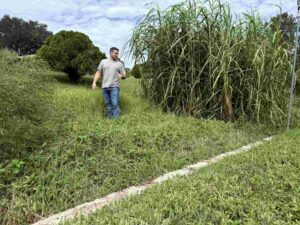
Seth Johnson walks past the seawall at his South Gate home on Oct. 1, 2026. He said the flow of the Phillippi Creek oxbow he lives on has been impacted by sedimentation. | Photo by Derek Gilliam, Suncoast Searchlight
Johnson and other leaders of the Phillippi Creek Coalition said the stormwater department has been moving in the right direction since last year, when county staff disputed responsibility for dredging the creek. The county now considers the dredging an imperative project.
Contractors dredged about 1.7 miles this summer, removing more than 60,000 tons of muck. Quartermaine said the work has increased the creek’s capacity to handle storm runoff.
It also has produced an environmental benefit. Quartermaine said the dredging has removed more than 200,000 pounds of phosphorus and 40,000 pounds of nitrogen — nutrients that can feed the algae blooms responsible for red tide.
Kristy Molyneaux, whose home flooded three times during 2024, credited the new stormwater director for recognizing that the entire creek needs to be dredged, highlighting both the unexpected levels of pollution pulled out of the creek and the improvement to stormwater capacity as the clogged, slow-moving waterway begins to see some relief.
“I have been here for 10 years, and I had never seen them clean any of the ditches in the neighborhood… that has been done (now) after Ben came on board,” she said.
But she has been less impressed by the blown deadlines, lengthy permitting process for the full dredge and the lack of accountability after deadlines are missed. She said there’s been little explanation about what went wrong and why it won’t happen again.
Quartermaine maintains the project is on track.
“We are on schedule with Phillippi Creek,” Quartermaine said. “We’re on track for the phase two dredge … our goal is to still have a project that’s biddable and permitted by the end of the year.”
That is later than Quartermaine originally anticipated.
So far, Sarasota has been spared a major storm. For residents living along Phillippi Creek, however, the possibility remains difficult to ignore.
“We are probably going to be into the next hurricane season before something gets started,” Molyneaux said.
When Allison Werner moved into her home off North Seclusion Drive nearly a decade ago, she thought she would never leave. Located on an oxbow of Phillippi Creek, the three-story house had everything she ever wanted, including views of the water.
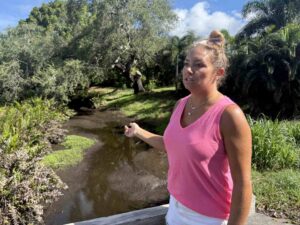
Allison Werner’s home was flooded during Tropical Storm Debby, trapping her inside her three-story home in South Gate. She’s since rebuilt but remains worried that without a full dredge of Phillippi Creek, her property could flood again. | Photo by Derek Gilliam, Suncoast Searchlight
But during the relentless rain of Tropical Storm Debby, that view turned perilous.
Water climbed the bank through the night until it reached just below the home’s door knobs. Werner was trapped in her property for more than a day before evacuating.
While she has since repaired her property, save for a slight discoloration from muck that settled in her pool, it’s an uneasy memory she still carries.
“Every day, I walk the dogs, and every day, I look both ways on that bridge,” she said.
“And I see that there’s still loads of sludge in it, and every day, you see nothing happening.”
Other homeowners express lingering frustration
The attention and money flowing to Phillippi Creek has not resolved longstanding drainage problems elsewhere in Sarasota County.
In Harbor Acres, an upscale neighborhood near downtown Sarasota, Joel Schleicher first emailed the county about flooding in his neighborhood in 2015 after standing water was left for hours from an afternoon thunderstorm. Some residents, he said, had been stuck in their homes with a foot of water covering the streets.
After stormwater staff visited the neighborhood in 2025, they were sympathetic to his concerns. But a fix remains elusive.
“You are right that is 20 (years) or maybe longer in the making,” County Administrator Jonathan Lewis responded to Schleicher in a February 2025 email about the neighborhood continuing to flood.
Harbor Acres was developed in the 1940s, and its drainage system has struggled as nearby development added more pavement and more impervious surfaces. Even a normal storm can overwhelm the neighborhood.
A county-commissioned study completed by engineering firm Kimley-Horn in 2021 estimated that improvements to the pipes alone would cost more than $7 million.
In February, Harbor Acres residents met with county officials and agreed to give workers access to private property needed for drainage work. By June, residents had submitted the necessary access agreements, according to resident Anand Pallegar.
Then, residents said, the project stalled.
When a reporter asked Quartermaine about the lack of progress in September, he said the county still did not have all the property access it needed. A reporter relayed that explanation to residents, who went back to the county seeking answers.
“We are beyond disappointed by the lack of progress,” Pallegar wrote in a Sept. 23 email to Lewis. “What’s difficult to understand is why, after decades of studies documenting capacity and level-of-service issues, we still don’t have a clear plan, a responsible lead or an implementation timeline.”
A county spokesman now said that work to address some drainage features in the 160-home community is being scheduled.
“There are several steps involved in scheduling and coordinating this type of work, but the project is moving forward,” wrote Brian White, the stormwater public information officer.
Schleicher remains skeptical, pointing to emails he retained from a decade ago when Quartermaine himself looked into the neighborhood’s drainage problems during his previous stint with the county. Years later, residents are still waiting.
Residents on St. Armands have raised a different concern: whether the county is keeping up with the routine maintenance that Quartermaine said is a priority.
At a joint city-county meeting in September, Chuck Haff, vice president of the St. Armands Residents Association, displayed a photo of a roll of carpet and a patio-furniture cushion pulled from a county-maintained stormwater baffle box in August. Haff contended the debris had been there since the 2024 flooding.
“This sure doesn’t look like increased service in my view,” he said.
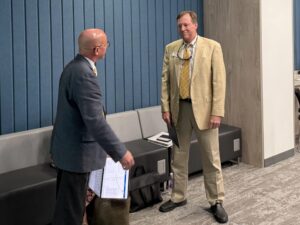
Chuck Haff, vice president of the St. Armands Residents Association, and Ben Quartermaine argue about debris found in the county-maintained stormwater system on Lido Key. Haff was upset that a 80 pound roll of carpet and patio-furniture cushion was found in a baffle box, while Ben explained that illegal dumping is a major problem for the stormwater department. | Photo by Derek Gilliam, Suncoast Searchlight
After the meeting, Quartermaine and Haff got into a heated exchange, with Quartermaine insisting the material couldn’t have been there for two years and noting the department’s constant battle with illegal dumping across its more than 20,000 stormwater inlets.
County records support at least part of Quartermaine’s account. Stormwater staff inspected the baffle boxes four times last year, including on Dec. 3, 2025, and did not document construction debris.
“We are fishing garbage out of these on a daily basis, old couches, old refrigerators,” Quartermaine said. “You name it, we fished it out of our system.”
For some residents, however, the dispute goes beyond how quickly drainage problems are being fixed. It’s about who bears responsibility when the system fails.
In Laurel Meadows, where families were rescued by boats during Tropical Storm Debby, residents sued Sarasota County in March over flooding they say was worsened by a damaged county-owned dike that funneled water into the roughly 80-home neighborhood.
After initial claims were dismissed, the judge in the case reopened the door in September for negligence against the county for not maintaining Cowpen Slough, the dike responsible. The lawsuit remains ongoing.
Many of the residents say they continue to see a county that’s dodging responsibility for maintaining the infrastructure that protects residents from flooding.
“The county,” said Laurel Meadows resident Alex Krumm, “has rejected any form of accountability for damages to our neighborhood.”
Derek Gilliam is a watchdog/investigative reporter for Suncoast Searchlight, and Michael Barfield is an investigative reporter for the Florida Trident, both nonprofit newsrooms serving the Sunshine State. Learn more at suncoastsearchlight.org and floridatrident.org