

Under Florida’s Live Local Act, rents that qualify as affordable in the Sarasota area can still exceed what many local workers can afford. | Photo illustration by Suncoast Searchlight
Florida’s Live Local Act promises affordable rent. For many in Sarasota, it’s still out of reach
Sean Patton would love to live in one of the new apartment complexes multiplying across Sarasota County. But despite a college degree, a steady income and his own business, the rents remain out of financial reach — even for those considered “affordable housing” under a landmark state law.
It’s been nearly a decade since the 33-year-old paid a monthly rent that met experts’ definition of affordable — no more than a third of his income — and even then, it was only because he was splitting the costs with four roommates.
Since he started his environmental consulting business in 2018, Patton’s annual income has fluctuated between $40,000 and $80,000. Yet he finds it hard to live in Sarasota, relying on clients who rent housing to him and his employees at below-market rates.
Patton, who’s also an adjunct professor at Ringling College of Art and Design, is among thousands of renters in Sarasota and Manatee counties struggling with soaring housing costs. Rents have skyrocketed since 2021, far outpacing wage growth.
State lawmakers have tried to address the affordability crisis by encouraging more attainable housing development. But experts say one of their biggest efforts yet — the Live Local Act — will instead flood the market with units that fail to address the core need. Many will remain out of reach for middle-class renters like teachers, secretaries and firefighters.

A 250-unit apartment project called Bahia Vista Apartments at the corner of Tuttle Avenue and Bahia Vista Street, was still under construction last year. While it didn’t use Live Local, more than half of its 35 units designated as affordable can be rented to people making between 100% and 120% of the area median income. It started leasing units earlier this year. | Photo by Derek Gilliam, Suncoast Searchlight
The Live Local Act was pitched as a way to fast-track affordable housing near urban centers by cutting through red tape to build large-scale apartment developments.
But the 2023 law defines affordable housing broadly, allowing rents based on households earning up to 120% of the area’s median income. Developers who reserve 40% of their units under these guidelines can receive incentives that unlock more land for development, increase density and sidestep some local restrictions.
Since then, Sarasota County alone has received at least 18 applications under Live Local that would bring more than 7,600 units to rural areas of the county where developers cannot currently build at such scale.
The options considered affordable under the special rules allow them to lease a two-bedroom apartment for nearly $3,100.
For renters like Patton, that’s just too expensive.
“While (Live Local) is supplying more units, it’s not addressing the people who have the largest need,” said Jack McCabe, a Florida real estate consultant. “For senior citizens and the younger generation, that’s a very expensive rent.”
Suncoast Searchlight analyzed area rental data, pored through details of Sarasota County’s current Live Local applications, scoured studies on affordable housing and interviewed nearly a dozen economists, landlords and renters about how the legislation would affect the market.
The reporting found that from 2021 to 2024, wage increases failed to keep pace with apartment prices — forcing more renters to devote a larger share of their income to housing. Economists generally consider households that spend more than 30% of their income on housing and utilities to be cost-burdened. But over 140,000 Sarasota-Manatee households meet that definition — more than one in three.

The number of cost-burdened households has reached one in three in Sarasota and Manatee counties. | Graphic produced by Suncoast Searchlight
By far, the greatest need for affordable housing across the Suncoast comes from workers making below 80% of the area median income. That means less than $64,000 annually for a one-person household or up to $91,280 for a family of four.
Right now, there’s a gap of more than 11,000 affordable housing units in that range, according to the Sarasota Housing Action Plan, a collaborative effort between the Florida Housing Coalition and the region’s four largest philanthropic foundations.
But the Suncoast’s relative wealth pushes up the area’s median income — and, with it, the rents considered “affordable” under Live Local. A one-bedroom can rent for as much as $2,568 a month under the law. A family of four would need to earn $136,920 a year to afford it.
Even amid a construction boom that saw more than 25,000 multifamily units permitted in Sarasota and Manatee counties over the past six years, rents have fallen only slightly. Instead of lowering prices, landlords seeking to woo renters instead are offering temporary deals, like a month of free rent. That means waiters, office clerks, nursing assistants, truck drivers and teachers are paying more to put a roof over their head — and leaving less for food and other basic necessities.
“The reality is when standards allow you to go to 120%, that’s above market rates,” said Chris Jones, a professor at the University of South Florida and owner of Florida Economic Advisors. “It’s a scenario where the legislation doesn’t have the teeth behind it.”
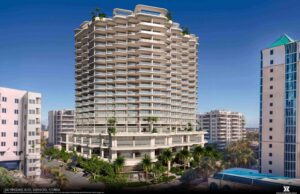
The Adagio has been proposed in downtown Sarasota as a Live Local project. | Screen capture of a city development application
To be sure, tackling affordable housing is a difficult challenge where compounding issues impact the ability of builders to cover all the costs associated with construction, including permitting and regulations.
The same economists who decried Live Local’s inability to meet core needs also cited a surge in construction costs making it nearly impossible to build units affordable to average wage-earners. Some also argued that any new housing units — regardless of price — will help stabilize rents eventually, as greater supply reduces prices, especially of older or less desired units.
“I don’t think there’s a wrong level (to incentivize rent),” said Christine Robinson, CEO of the Argus Foundation. “If you polled across all income levels … you would find that all of them have affordability as a top concern.”
For Patton, making the rent has meant sacrifices elsewhere. Even as he has taken on second jobs, he is saving less money for retirement and neglecting routine medical care.
“I definitely skimped on the dentist,” he told Suncoast Searchlight. “I’ve had a lot of dental work over the years, and I just kind of stopped doing it.”
Who can afford ‘affordable’?
The median wage for construction workers in Sarasota and Manatee counties is just under $24 an hour.
Nursing assistants take home a median wage of $19 an hour.
For office support staff, it’s about $22 an hour, according to federal data from the Bureau of Labor Statistics.
Even with two full-time wage earners at those incomes, none of them would be able to comfortably afford rents under the “affordable housing” requirements of Live Local.
Under Live Local, rents considered “affordable” can require households to earn between $46 and $66 an hour to keep housing costs to about a third of their income, depending on the household size.

This aerial photo was taken on April 16, 2026, of the Tatum Ridge Golf Links. Neighbors of the golf course have been fighting against development proposals using the Live Local Act after the property was sold for $2.9 million. | Photo by Michael Barfield, Florida Trident
That means even an area lawyer earning the profession’s median wage of $66 an hour would still qualify for the units set aside as affordable.
“We’re giving for-profit developers incentives that are as valuable as the ones we provide to nonprofits doing real affordable housing,” said R.N. Collins, a local resident who’s been involved in community affordable housing initiatives for more than 20 years. “It’s a giveaway to developers.”
Since May, the Sarasota County Commission has been locked in a legal battle with developers proposing new apartment projects under the Live Local Act.
The litigation followed the commission’s unanimous April decision to block Live Local projects in rural areas, arguing that the legislation was never intended to override local control for low-density zoning.
Even though state lawmakers amended the legislation this year to prevent Live Local projects on rural lands, they left open a short window for developers to submit plans under the prior version, which allowed for large-scale apartments in any property “zoned for commercial, industrial or mixed-use.”

Former state senator Jeff Brandes founded the Florida Policy Project after leaving office. | Photo courtesy of the Florida Policy Project
The county’s attorneys have argued in court that its rural commercial uses are ancillary to the underlying residential zoning and have asked the judge to dismiss the lawsuits.
All four court cases are proceeding, with trials expected by August 2027.
Developers say that, by expanding into rural zones, they can offer cheaper rents because of the lower land acquisition costs.
But even with those projects located far from urban job centers, where land is less expensive, the rents landlords can charge would be out of reach for most workers.
Under Live Local, even a studio apartment can go for as much as $2,397.
“The problem right now is the building costs,” said Jeff Brandes, a former Florida state senator who launched the Florida Policy Project after leaving office. “Live Local is a step toward a solution, but it isn’t the solution to the other 70% of the problem.”
What affordable housing actually looks like
The late Harvey Vengroff dedicated his life to affordable housing, building an empire across multiple states where the number of affordable housing units now reaches more than 4,000. Mark Vengroff, his son, has taken the reins and pledged to continue the legacy.
Over the next few years, his company, One Stop Housing, plans to build more than 2,000 units across the region funded in part by federal hurricane stimulus money. Already, he’s achieved lower construction costs than most industry experts believed were possible with The Nest in Bradenton, a 182-unit affordable housing development.
He’s also under construction on a Live Local development with the 202-unit Sarasota Station project. But even he says Live Local guidelines are not affordable. While the intent behind Live Local was a step in the right direction, he said, the 120% figure set the bar too high to really address the problem.
“That’s not affordable,” Vengroff said. “It’s not addressing the need. Working families don’t earn enough to afford those rents.”

Mark Vengroff is CEO and managing partner of One Stop Housing, which specializes in affordable rental housing across the Suncoast region and beyond. | Screenshot from a One Stop Housing YouTube video
That’s why all of his projects, including Sarasota Station, target renters earning 80% of area median income, he said.
“That’s where you’ll find support staff, food workers, your bus drivers, maintenance workers,” Vengroff told Suncoast Searchlight. “It’s really our backbone.”
Like Vengroff, Scott Eller, CEO of Community Assisted and Supported Living, has taken on the challenge to build affordable housing.
Eller agreed that demand for affordable housing far outpaces supply, noting that when CASL opened New Trail Plaza north of downtown Sarasota in February, it was fully leased in just a month. Another project his group built in Miami filled in just eight days.
“The reason that one took so long is because we didn’t have enough staff members to lease up people faster,” he said.
Both said Live Local is a step in the right direction to help drive costs lower but said its income limits were too high to meet the greatest need. For example, a family of four earning as much as $136,000 can qualify.
“You’re telling me somebody making roughly $11,000 a month is in crisis?” Eller said. “It’s the same family of four making less than $75,000 a year that is in crisis.”
When there’s no money for an emergency
Housing costs have soared so high in Sarasota and Manatee counties that any unexpected expense could land renters in court facing eviction.
That’s exactly what happened to James Shaw, 67, and his partner after the couple moved to Sarasota from Minnesota in 2024. Shaw, who worked in roofing sales, thought he would have plenty of business following the hurricanes that year.
Instead, unable to afford housing, he found himself homeless for the first time in his life. He’s also recently been diagnosed with prostate cancer and is disabled, receiving about $60,000 in support a year.
But it wasn’t the cost of medical treatments that led to eviction proceedings last month.
A blowout on Interstate 75 sent their life into a tailspin that had them on the verge of getting kicked out of the two-bedroom duplex off Bee Ridge Road they now rent with the assistance of a federal housing voucher for low-income veterans.
The $800 vehicle repair left them unable to make rent on Aug. 1. With plans to now move by December, any units priced at the levels of Live Local would just be a pipe dream to them. After the voucher pays the majority of the couple’s rent, they contribute just $972, which equates to 30% of their income.
“There’s nothing out there for anybody really,” Shaw said. “I mean, ain’t never seen anything like this.”
That reality is exacerbated for younger workers without as much career experience.
Alexis Heuss, a barista at DD Roasters on Main Street in downtown Sarasota, said she commutes from Palmetto because rents in Sarasota are too expensive. The 19-year-old has two roommates in a modest apartment 30 minutes away from her job.
Still, her parents cover some expenses, like tires for her car.
“It’s annoying, but I mean, I can do it,” Heuss said. “But like it just all goes to rent. It just drains your account, like, significantly.”
Derek Gilliam is a watchdog/investigative reporter for Suncoast Searchlight. Email him at derek@suncoastsearchlight.org.