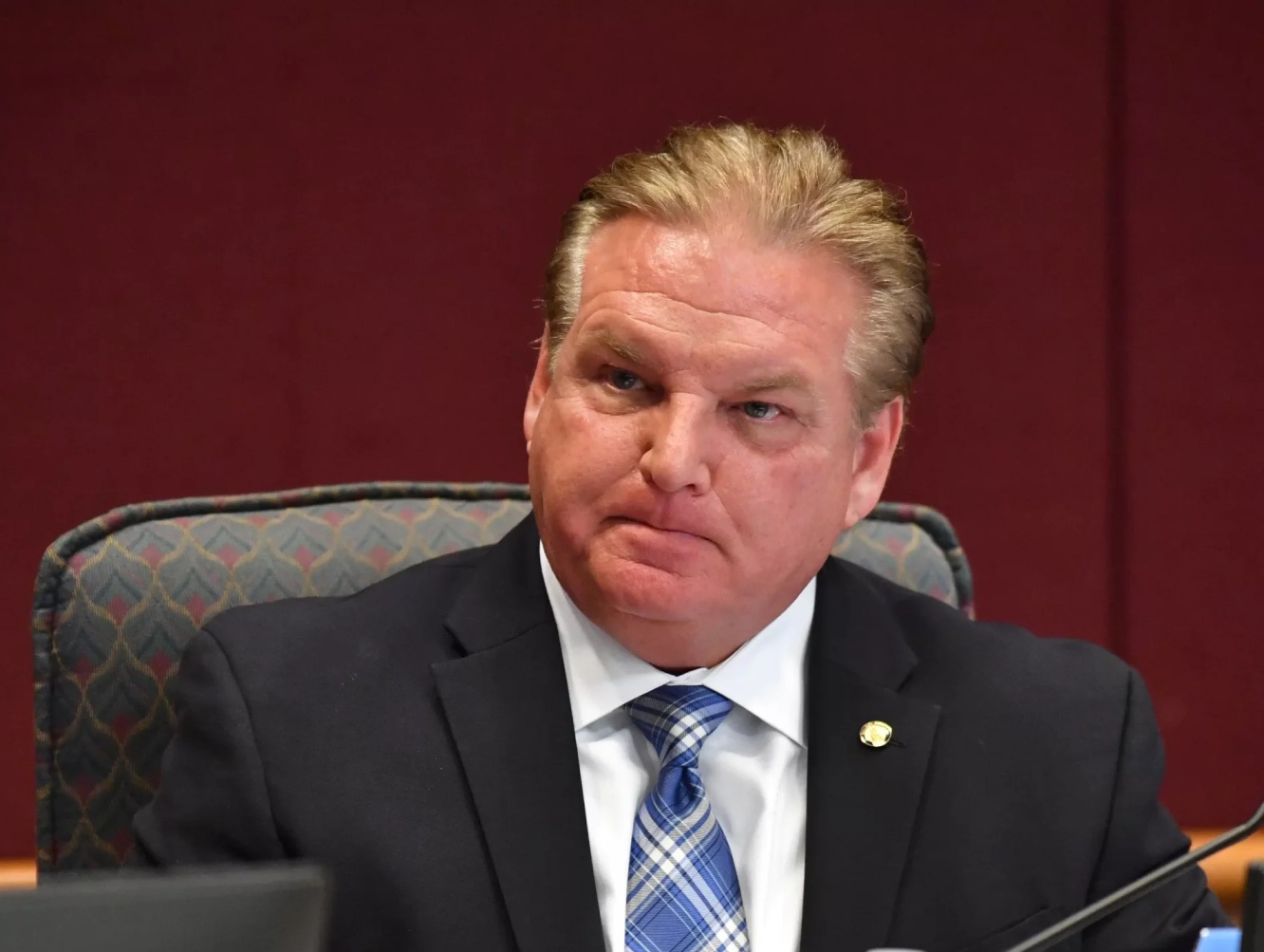
Sarasota Tax Collector Mike Moran | Photo by Michael Barfield, Florida Trident
Auditors say Sarasota tax collector’s $100,767 payout violated state law
Six days after Mike Moran took office as Sarasota County’s newly elected tax collector, another government agency he had just left paid him $100,767.
The money came from the Florida PACE Funding Agency, an independent special government district Moran ran for more than five years while also serving as a Sarasota County commissioner. PACE helps homeowners finance improvements like new roofs, hurricane protection and energy upgrades, with the debt repaid through assessments on their property tax bills.
Moran resigned from PACE after winning the tax collector’s race. But on his way out, the agency agreed to pay him for six months of “transition services” — and then paid the entire amount upfront.
State auditors now say the agreement violated Florida law and that PACE could not produce a single record showing Moran performed any services for the money.
The finding carries a striking irony.
Soon after taking over as tax collector, Moran ordered a forensic audit of the office he inherited from longtime Tax Collector Barbara Ford-Coates. The audit found $461,753 in additional pay and leave distributed to 13 exempt employees without records showing who authorized the payments.
Moran sent those findings to State Attorney Ed Brodsky, who referred them to the Florida Department of Law Enforcement, launching a criminal investigation that remains ongoing.
Now Brodsky says he plans to send state auditors’ findings about Moran’s former agency to FDLE for review.
Moran’s $100,767 payment was just one of nine findings in a sweeping, 57-page audit of PACE. Auditors also found serious breakdowns in how the agency spent public money, oversaw its finances and administered agreements that can leave homeowners with thousands of dollars in additional property tax assessments.
Among the findings:
- Auditors documented 157 underwriting deficiencies in agreements with homeowners, an average of more than two per loan.
- PACE executed 148 agreements in a county where it wasn’t authorized to operate.
- Moran and his successor made roughly $237,000 in debit-card purchases without adequate controls, including spending on travel, swanky hotels and expensive restaurants.
- None of the 35 travel expenses the auditors sampled contained a legally-required certification.
- Homeowners were not given multiple disclosures required under state law relating to assessments, program fees, the right to cancel within three business days, and potential penalties.
The audit does not accuse Moran of a crime. Operational audits examine whether public agencies follow laws and financial controls; they do not determine criminal intent, said Derek Noonan, one of the auditors who performed the review.
“We don’t look at criminal intent when conducting audits,” Noonan said.
Moran declined an interview request from the Florida Trident, and did not respond to a question about whether the audit findings should be criminally investigated. Instead, Moran sent an email saying, “multiple attorneys reviewed my transition agreements, which were then approved by the Board of Directors at a publicly noticed meeting.”
Read the full Florida Auditor General Report
Asked to discuss the audit, PACE declined to make anyone available for an interview. The agency instead emailed a statement saying it is “taking steps to make changes to internal processes.”
Every board member named in the audit refused to be interviewed. Board chair Mike Steigerwald, the city manager of Kissimmee, did not respond. It was announced at the PACE board meeting Thursday that Steigerwald had resigned this past Monday.
Former board member Jon Mast, husband of Sarasota County Commissioner Teresa Mast, did not respond to inquiries about the audit. Vice Chair Cheryl Grieb, a sitting Osceola County commissioner, did not return messages left by phone, text and email or with her assistant.
Jim Ley, the former Sarasota County administrator who recommended Moran for the job and sat on the board that supervised him, said he was unaware the audit existed when initially contacted by phone. Ley sent an email declining an interview request saying, “all of the PACE Board actions were reviewed and approved by a variety of attorneys.”
No severance
The paper trail is short.
Moran submitted his resignation as PACE executive director on Dec. 2, 2024, one month after winning the tax collector’s race. His last day was Dec. 31.
His employment agreement promised 52 weeks of severance if the board fired him without cause, even though Florida law caps severance agreements at 20 weeks.
But Moran was not fired. He resigned to take another public office.
On Jan. 1, 2025, Moran and PACE terminated his employment agreement by mutual consent and entered into a new one: PACE would pay him $100,767 for six months of “transition services.”
PACE personnel later told auditors the amount equaled approximately 26 weeks of Moran’s former salary, based on the severance provision in his previous employment agreement. The new agreement, however, expressly stated that Moran was not entitled to severance.
What PACE was getting in return for the payment to Moran was less clear.
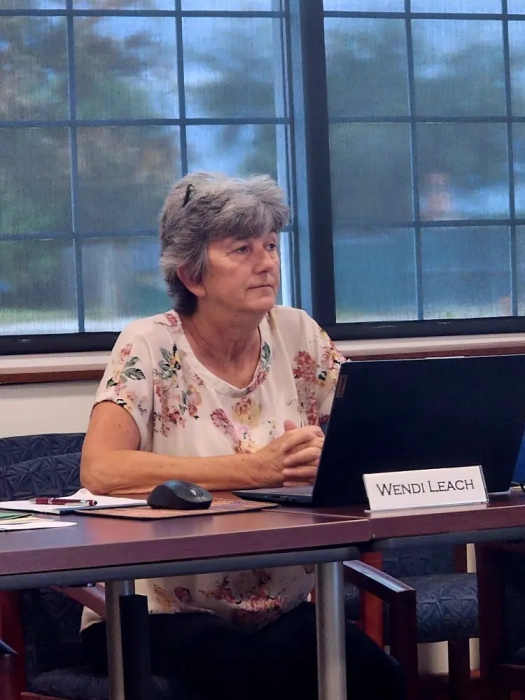
Wendi Leach, current PACE executive director. | Photo by Michael Barfield, Florida Trident
The agreement required Moran to continue performing the executive director’s duties until a successor took over. But PACE operations director Wendi Leach became executive director on Jan. 1 — the same day Moran’s transition agreement began.
Beyond that, Moran was to provide advice, information, support and government-relations consulting “as needed.” The agreement identified no specific tasks, deadlines, deliverables or performance standards.
Two days after signing it, Moran invoiced PACE for the entire $100,767.
Ten days later, the agency paid him in full — more than five months before the agreement ended and six days after he was sworn in as Sarasota County tax collector.
Auditors found that the contract lacked the measurable duties and monitoring mechanisms Florida law requires for public service contracts exceeding $35,000. They also found that paying Moran in full before the service period ended potentially violated the state Constitution’s prohibition against using public credit for private benefit.
And when auditors asked PACE for evidence of the work Moran performed, the agency produced none.
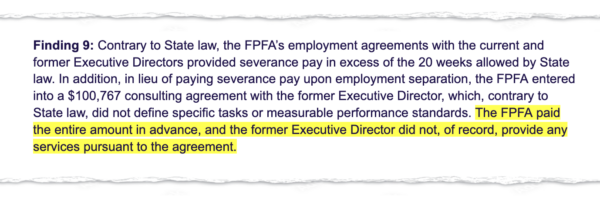
State auditors found that PACE paid former Executive Director Mike Moran $100,767 in advance, but had no record that he provided any services under the agreement. | Image from the Florida Auditor General report
The problem was not confined to Moran. Leach’s Jan. 1 employment agreement also promised 52 weeks of severance. Auditors said PACE was not exempt from the statutory cap and recommended reducing it to 20 weeks.
PACE submitted a 22-page response challenging the auditors’ independence, authority, legal analysis, timing and factual conclusions. It addressed Findings 1 through 8.
PACE provided no response to Finding 9 — about Moran’s $100,767 payment.
The dinners came first
The six-figure exit payment did not emerge from an agency known for tight financial controls.
In July 2024, the Trident reportedthat Moran had spent more than $36,000 in public money during 18 months of PACE travel that included luxury hotel suites, steak dinners and alcohol.
Moran defended the spending at the time, characterizing the reimbursements as coming from “private money” and saying the dinners were necessary to court “highly sophisticated investment bankers in a specialized arena.”
Within weeks of the reporting, Pasco County Tax Collector Mike Fasano terminated his office’s collection agreement with PACE “for cause.”
“He’s taking money from people who can least afford it,” Fasano said at the time, “and spending it in Vegas.”
The state audit now shows the breakdown in financial controls behind that spending.
PACE recorded 163 travel expenses totaling $36,444 from October 2022 through February 2025. Auditors examined 35. Not one contained the certification required by state law attesting that the expense was incurred for official duties and was true and correct in every material respect.
The problems went beyond paperwork.
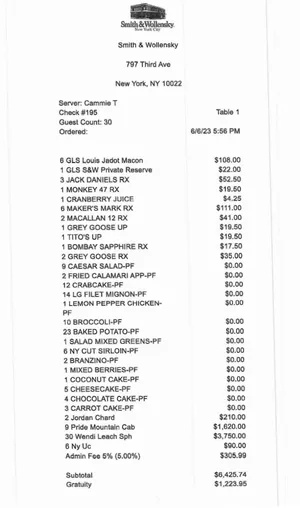
Receipt from Smith & Wollensky steakhouse in New York City. | Image from PACE public records
Auditors identified 13 meal expenses totaling $4,829 that exceeded Florida’s statutory limits, including $374 for multiple meals in Las Vegas and the $622 Tallahassee dinner previously documented by the Trident.
Another receipt, which auditors did not sample, showed an $8,550 private dinner at Smith & Wollensky – a swanky Manhattan steakhouse – where $2,279.75 was spent on 11 bottles of wine.
Special districts may authorize higher meal rates by resolution. PACE’s board has not done so.
Auditors also flagged a $309 seat upgrade on a flight from Sarasota to New York they said violated both the statutory requirement to use the most economical transportation and PACE’s own economy-class policy.
And PACE paid $695 in sales tax on 10 hotel expenses despite being tax exempt. The agency told auditors that obtaining a tax-exempt rate sometimes required booking a more expensive corporate rate. Auditors said PACE provided no rate comparisons or other documentation to support that explanation.
Moran also frequently paid for PACE travel with a credit card issued to Southern Sky Energy, a company he solely owned. PACE reimbursed the company $15,863 and reimbursed Moran another $5,273 for charges made on his personal card.
Fasano, a former state senator, said the spending was indefensible for a government body.
“They were spending taxpayer money like they were drunken sailors,” Fasano said in an interview.
He rejected the argument that the money was private. “If something is put on a tax bill … guess what? Those are taxes.”
“Anywhere else in this state, if a government entity were to use taxpayer money for these travels, expensive liquors, hotels, somebody would be arrested,” Fasano said. “Somebody would be charged with a crime.”
The card approved itself
The travel spending was part of a wider breakdown in PACE’s financial controls.
In 2019, the board authorized Moran to make budgeted expenditures but required that his personal expenses remain subject to “third-party review.”
When auditors asked who performed that review, PACE could not identify anyone.
Moran nevertheless obtained a debit card from the agency’s bank without specific board authorization.
Between October 2022 and February 2025, Moran and his successor, Leach, made 966 debit-card purchases totaling approximately $237,000. Auditors sampled 30 of them. Receipts were the only records available. None showed board approval, and seven did not establish a public purpose.
Those purchases included $1,139 in year-end gifts, including wine, for the board members who supervised Moran, $1,700 in unspecified social-media advertising and $827 in gift cards distributed to customers in exchange for testimonials.
The audit does not say how gifts were divided among board members. The Trident obtained receipts showing board members Ley, Mast, Steigerwald, Grieb and Revels received gifts totaling $1,335 in a one-year period between December 2023 and 2024. The gifts in 2024 exceeded the $100 that triggers disclosure under Florida ethics laws.
Jon Mast acknowledged after the Trident’s inquiry that he had not disclosed a gift of more than $100, saying he would file a belated report with the Florida Ethics Commission. None of the other PACE board members responded to questions of whether they disclosed gifts in financial disclosure forms filed with the Florida Ethics Commission.
Asked by auditors how the debit-card purchases had been approved, PACE offered a simple explanation:
“The use of the debit card itself is proof of approval.”
The Auditor General rejected that logic, citing the sheer volume of transactions and the absence of independent review.
The board that never said no
Moran was not supposed to oversee himself.
PACE’s governing documents placed that responsibility with a five-member board of directors. The agency’s charter states that the executive director and legal counsel “shall each answer directly to the Board of Directors.”
Yet the board itself operated under an unusual arrangement that was supposed to be temporary.
PACE was created in 2011 by an interlocal agreement between the City of Kissimmee and Flagler County, which remain its only two local-government members. Under a 2017 amendment, the board can appoint two of its own five members until at least four local governments join the agency.
That expansion never happened. For nine years, two of the five seats have continued to be filled by the board itself.
The charter also provides that board members “shall receive no compensation for their services” beyond expense reimbursement or a per diem.
Fasano said the board cannot stand behind the executive director it hired.
“If they actually told you that they reviewed everything Mr. Moran did and how his money was spent, then they’re fully responsible,” he said. “Those individuals who are on the board are just as accountable as Mr. Moran is.”
Kissimmee Mayor Jackie Espinosa, who said she was unaware of the audit until contacted by the Trident, recounted fielding complaints from several homeowners about PACE and raised them with Steigerwald, who she said was dismissive.
“I never got straight answers,” Espinosa said. After reading the audit report she said “it’s so disturbing. I have so many questions.”
Homeowners carried the risk
The audit’s most consequential findings extend beyond Moran’s expenses.
PACE administers Property Assessed Clean Energy financing, which allows homeowners to finance improvements through assessments added to their property-tax bills.
Since the agency’s inception, PACE has recorded more than $1 billion in taxpayer assessments, according to statewide assessment data.
During the eight-month period examined by auditors, PACE oversaw 1,849 residential agreements totaling approximately $52.7 million.
Auditors reviewed 60 of those agreements.
They found 157 underwriting deficiencies.
In 30 agreements totaling $713,395, auditors found no documentation showing that the administrator had verified whether the property already had financing agreements or unrecorded qualifying improvements. The auditors warned that failing to perform the required check could render an agreement void — potentially requiring restitution to the homeowner, reversal of liens and removal of assessments from the property-tax bill.
Other agreements ran afoul of protections governing how much homeowners could borrow and for how long.
Eighteen received 30-year financing terms after the Legislature had reduced the maximum to 20 years. One homeowner received an annual assessment of $3,703 — about $600 more than allowed under the statutory income limit.
And 24 homeowners’ financing improvements of $10,000 or more lacked documentation showing they had been advised in writing to seek estimates from more than one contractor.
Auditors also found homeowners were not given disclosures required by state law. In seven agreements, property owners never acknowledged in writing that they could cancel within three business days.
PACE disputed some of the findings based on when an agreement legally takes effect. The agency argued that a financing agreement is not executed until PACE countersigns it after construction is complete.
The Auditor General rejected that interpretation, saying it would “effectively nullify all the property owner protections” enacted in 2024.
Moran’s resistance to consumer protections for PACE predates his time at the agency. In October 2017, as a county commissioner weighing whether to allow PACE to operate in Sarasota, he opposed standard consumer protections, such as requiring borrowers to obtain consent from their mortgage holders before putting a tax lien on their homes. Moran questioned whether the government should have any role in those protections, stating “let the free market rein.”
Auditors found another problem In Orange County: PACE was doing business where it had never been authorized to operate.
One PACE administrator executed 148 agreements in Orange County totaling about $3.7 million. Nine were executed after the administrator said it had discovered the error and stopped the practice.
That expansion has a foundation. The 2011 charter authorized assessments only where the local government had “expressly” authorized them. A 2017 amendment allowed PACE to operate statewide – a move the Legislature invalidated in 2024 by requiring PACE to only operate where formally authorized by local ordinance or resolution.
Fasano criticized PACE’s expansion, noting PACE was going into counties and cities where they had no approval and started “pushing these loans on people who didn’t need them nor could afford them,” Fasano said. “That’s why Tallahassee finally woke up.”
David Zamora presented at the board meeting this week on behalf of one of the financing companies that works with PACE. He spoke to Kissimmee citizens and this reporter after the board meeting Thursday defending the underwriting activities underlying the PACE program.
Zamora did not defend Moran. He acknowledged Moran’s tactics were unpopular with tax collectors across the state and was the driving force behind the legislation in 2024 that imposed significant reforms on the financing program.
“Moran was all about the money,” he said, emphasizing that he was expressing his personal opinion and not that of the company he works for.
“This is what happens when a board treats accountability as an inconvenience instead of a job,” said Kissimmee resident Jon Arguello during public comment at the PACE board meeting.
Next steps
The audit findings warrant more than corrective recommendations, said Ben Wilcox, executive director of Integrity Florida, a nonpartisan research institute that tracks government accountability who read the report. What struck him, he said, was not any single finding but the agency’s response to all of them.
“Their defense was refuted every step of the way through the audit,” Wilcox said. “As you read through the summary of the audit, it’s just one thing after another. They’re just ignoring the law. They’re just not operating legally. This really warrants a criminal investigation.”
Moran built his first months in office as tax collector on the principle that undocumented pay received by public officials demands accountability in the form of a criminal investigation. The findings by the Auditor General now land in his own lap.
Suncoast Searchlight assisted with editing this article.
Suncoast Searchlight and the Florida Trident are collaborative, nonprofit investigative newsrooms focused on accountability journalism in Florida. Learn more at suncoastsearchlight.org and floridatrident.org.