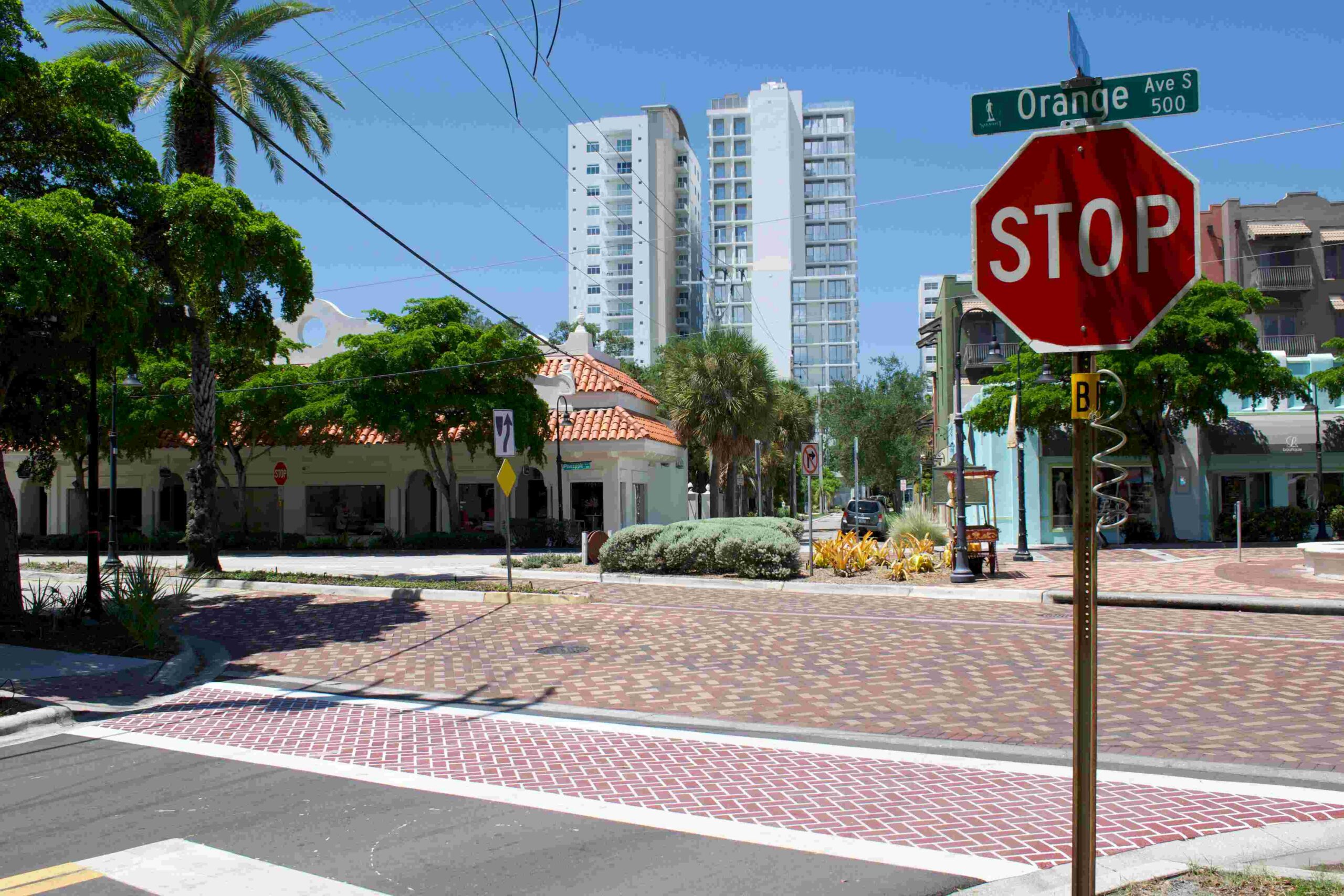
A new faux brick crosswalk at Orange Avenue and Oak Street in downtown Sarasota has raised questions about what designs are allowed nearly a year after the Florida Department of Transportation ordered cities to remove street art from public rights of way. | Photo by Christian Casale | Suncoast Searchlight
FDOT ordered street art removed. Then Sarasota got a faux brick crosswalk
Last summer, city workers erased colorful artwork from streets and sidewalks across Sarasota, including rainbow crosswalks downtown, painted sea creatures near Mote Marine Laboratory on City Island and nearly 300 sidewalk panels created by local artists in Burns Court as part of Sarasota’s Avenue of the Arts initiative.
The artwork disappeared within days as Sarasota raced to comply with a Florida Department of Transportation directive requiring cities to remove nonstandard markings from public rights of way or risk losing state funding. For Sarasota, $67 million was at stake.
Nearly a year later, in late June, the city quietly installed a brick-pattern crosswalk using preformed thermoplastic — an adhesive material used as an alternative to paint — on Orange Avenue and Oak Street.
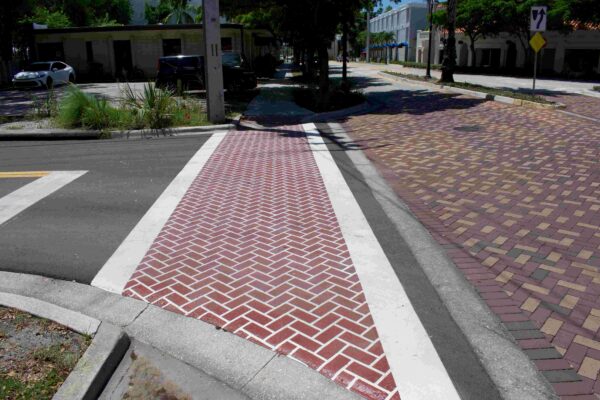
A new crosswalk at Orange Avenue and Oak Street in downtown Sarasota uses brick-pattern thermoplastic designed to resemble brick pavement. | Photo by Christian Casale | Suncoast Searchlight
The new crosswalk raises a basic question: What makes this design different from the artwork Sarasota removed at FDOT’s direction last year?
The answer isn’t clear.
FDOT’s directive requires cities to remove all nonstandard surface markings “not in direct support of traffic control or public safety.” But while FDOT’s design manual prohibits pavement or surface art in crosswalks and other public rights of way, it does allow patterned pavement in crosswalks under certain conditions. The only examples were brick and stone, followed by “etc.”
This has left residents, and especially area artists, wondering where FDOT draws the line. What’s classified as a “standard” pattern? Could other uniform designs by artists be considered acceptable? Why are brick and stone permitted if those designs don’t contribute to traffic control?
Public officials won’t say.
All five city commissioners either didn’t respond to Suncoast Searchlight’s request for comment or directed questions to Public Information Officer Jan Thornburg. Thornburg confirmed that the thermoplastic material used for the brick-pattern crosswalk is on FDOT’s “Approved Products List,” and that the brick pattern was not painted on. She directed questions about the crosswalk’s design to FDOT.
FDOT didn’t return multiple requests for comment.
Wendy Rosen, who helped organize a legal pushback against the 2025 directive, said even a design as simple as brick isn’t too far removed from the art that came before it.
“If crosswalks are now going to get created with decorative elements, then you’re basically doing the same thing that the artists were doing,” Rosen said. “None of these [removed] crosswalks involved text that you had to read to understand. They were not distractions in any way.”
The brick-pattern crosswalk has renewed some of the frustration over how quickly Sarasota removed public artwork last summer instead of challenging FDOT’s directive as other communities had.
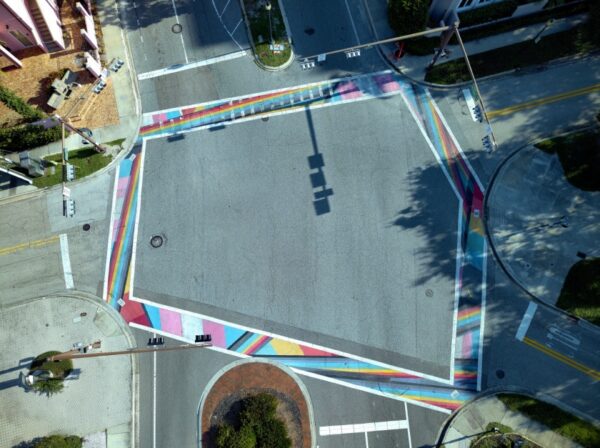
This colorful crosswalk in downtown Sarasota was among the artwork erased in August 2025 to comply with a Florida Department of Transportation directive against painting in public rights of way. | Photo courtesy of the City of Sarasota
Fort Lauderdale, for example, formally challenged the state’s order and kept its street art while its legal challenge proceeded. But those installations — including a colorful crosswalk and a giant pride flag painted on a city street — were quietly removed this July as part of a settlement between Fort Lauderdale and the state to end the lawsuit, according to the South Florida Sun Sentinel.
Those last holdouts joined dozens of street installations removed statewide, including a rainbow crosswalk in Orlando memorializing the 2016 mass shooting at Pulse Nightclub, a crosswalk painted as a checkerboard racing flag outside Daytona International Speedway and a “Back the Blue” mural at the Tampa Police Department headquarters.
In Sarasota, the removals included nearly 300 sidewalk panels created by local artists through the Avenue of the Arts initiative. Several of those artists have since filed claims under the Visual Artists Rights Act, alleging the city violated their rights by removing their art without notifying them.
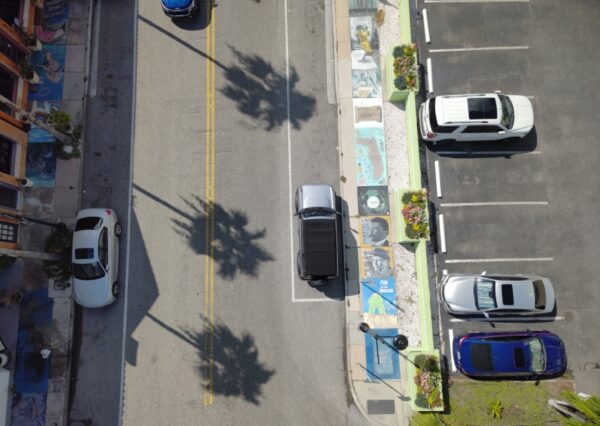
From 2021 to 2025, artists painted nearly 300 sidewalk panels depicting moments, scenes and figures important to Sarasota’s history in Burns Court known as Avenue of Art. All the paintings were destroyed in August to comply with a state order. | Photo courtesy of the City of Sarasota
Virginia Hoffman, who served on Sarasota’s Public Art Advisory Board for 10 years and as a volunteer public art coordinator for three years, said she sees a distinction between the brick pattern and the artwork that was removed.
During her time on the board, Hoffman said, members reviewed artwork and creative designs — not what she described as “expected patterns” like brick.
But she questioned the reasoning behind the broader directive from Gov. Ron DeSantis’ administration.
“I think that DeSantis’ whole agenda was to get all that pesky artwork out of our public right of ways,” Hoffman said. “Quite disgusting, if you ask me.”
The distinction between art and pattern also has become a point of debate on social media.
One Facebook post featuring a picture of the new crosswalk called out the city for installing the brick design after removing other artwork. Some commenters cast the design as “hideous” and called the decision “hypocritical” or “ironic,” while others saw a clear difference.
One user described the brick design as a “surface marking” and “definitely NOT art.” Another said the brick-style crosswalk was “less distracting.”
Regardless of the technicalities, Rosen said the directive has unnecessarily created division in the community over something that previously generated little political controversy.
“We are a creative city full of artists, performers and performing arts, and that is our identity,” Rosen said. “You cannot take away our identity because it impacts our tourism, our sense of safety and our sense of pride in our own town.”
Clinton Engelberger is a contributor for Suncoast Searchlight. Email Clinton at clintonengelberger@gmail.com.