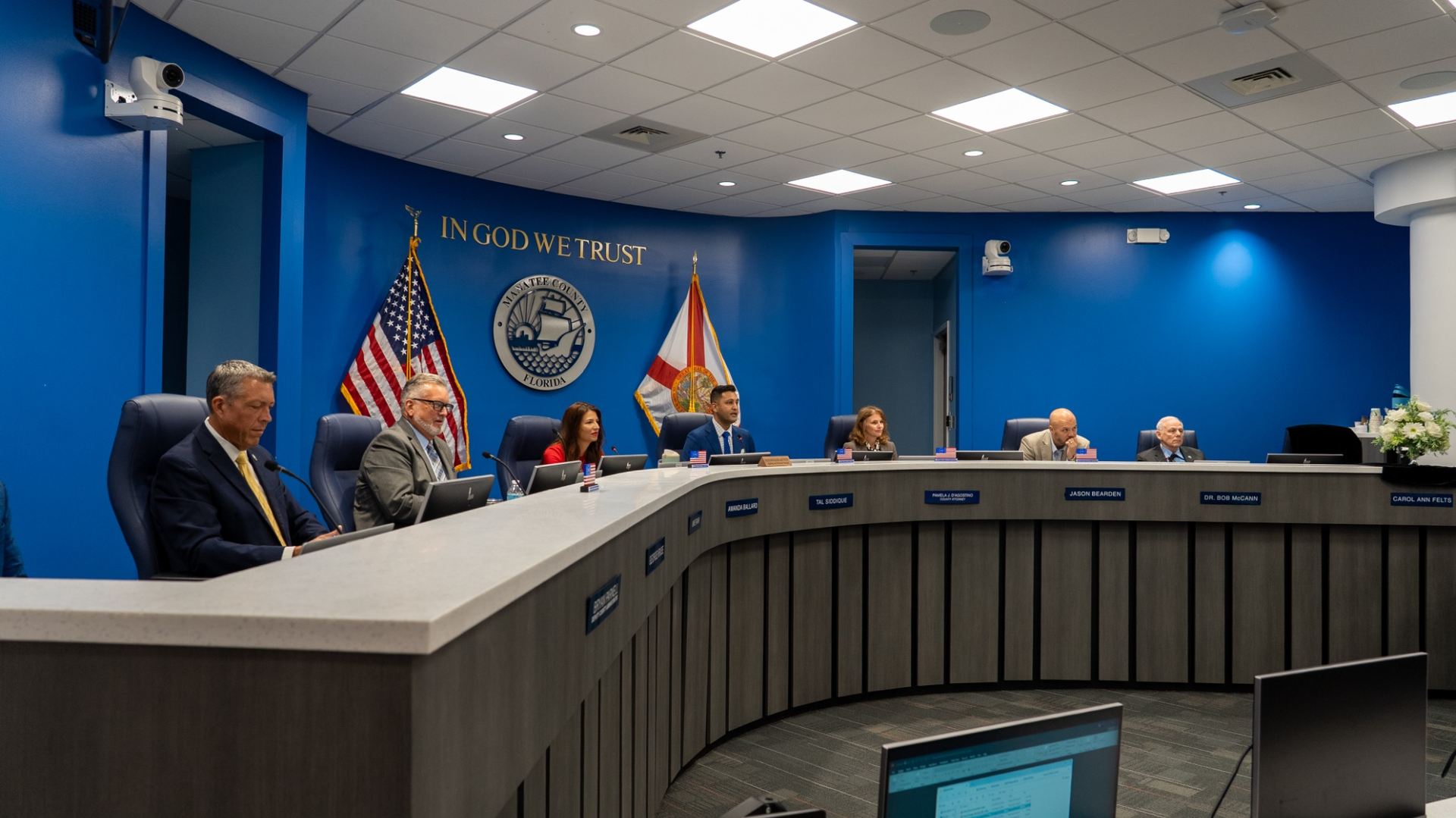
The Manatee County Commission, meeting on July 28. | Courtesy Manatee County
Can Manatee County’s anti-development wave strike again?
Two years ago, Manatee County voters did something rare in modern politics when they rejected the candidates who spent the most money.
That included races for school board, supervisor of elections and most notably county commission, where four grassroots candidates rode a wave of voter dissatisfaction to election night wins.
It didn’t help the big-money candidates that, just two weeks prior, Tropical Storm Debby dumped more than a foot of rain that turned streets into streams in Manatee County neighborhoods that had never flooded.
In some voters’ minds, the flood represented years of poor decisions by leaders who allowed home construction to stretch ever further into floodplains.
Since that election, winning candidates for county commission have struggled to implement the campaign promises they made, constrained by pushback from Gov. Ron DeSantis and state laws preempting their ability to control new development.
Now, this election cycle is once again dominated by anti-establishment candidates running grassroots campaigns, pledging to finish the job. But even longtime Manatee County political observers fear the anti-development movement has lost its momentum from the milestone 2024 victories.
“The people spoke, and that was amazing,” said Ed Ference, a Republican candidate for an at-large county commission seat this year. “I’m hoping they speak here in 2026 and finish what we started.”
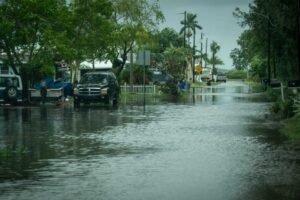
This photo was taken on Aug. 5, just a day after Tropical Storm Debby passed by Manatee County, flooding streets and homes. | Courtesy Manatee County
That will be decided when voters head to the polls for the Aug. 18 primaries.
Nearly 20 people are vying for four county commission seats, and most of the candidates are again running on platforms that promise to manage growth, with challengers claiming the incumbents remain too cozy with developers.
But there are signs that the wave may already have faded. The amount of contributions to candidates has fallen off a cliff, especially among grassroots challengers who now face even greater spending gaps against the more established candidates than they did in 2024.
That comes even as direct contributions from traditional election funders — like developers Pat Neal and Carlos Beruff — have waned.
Suncoast Searchlight spoke with about half of the 19 candidates currently running, as well as longtime local observers, to understand the issues driving people to the polls this year. Some fear the crowded field of grassroots candidates will cannibalize each other for votes.
“You can’t count on a second wave election after the first one,” said Aubrey Jewett, a political science professor at the University of Central Florida. “A wave is usually caused by a particular set of events. What drove people to the polls last time doesn’t necessarily drive them this time around.”
A new reality under SB 180 and DeSantis
For decades, Republican candidates backed by powerful real estate developers were almost assured a seat in office.
In 2024, voters, infuriated by flooding and rapid development, reversed that trend.
A blue-haired puppet that lambasted establishment politicians and local developers in 2024 became a symbol of voter unrest, as foul-mouthed animated videos criticizing the local political order spread across social media. The sentiment gained traction and helped reverse a cycle of developer-backed wins that had dominated local politics.
The victories also ushered in a new political reality for the movement’s supporters, starting with last year’s passage of Senate Bill 180. The controversial law bars local governments from adopting tougher land use regulations for years after a hurricane and effectively blocked Manatee County’s attempts to toughen its own development regulations.
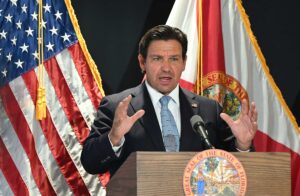
Florida Gov. Ron DeSantis speaks during a visit to Manatee County in July. DeSantis is pushing a proposal that would significantly expand Florida’s homestead property tax exemption, a move that would reduce revenue used to fund county services. | Photo by Tiffany Tompkins, Bradenton Herald
When commissioners in June last year passed an impact fee increase — requiring developers to pay millions of dollars more to support infrastructure needs like roads, sewer and water utilities — the DeSantis administration sent a letter to each one personally threatening “inevitable consequences” if the fee hike proceeded.
The administration followed up with another letter warning against the county’s plans to restore wetland protections and the development boundary.
That same summer, DeSantis and his chief financial officer made Manatee County the first Republican stronghold targeted for an aggressive review by Florida’s newly created Department of Government Efficiency — known as DOGE — a program DeSantis styled after the Elon Musk-backed federal initiative to slash “waste, fraud and abuse.” It was widely viewed as a retaliatory measure against the county’s attempts to manage new growth.
Read the full story here: DOGE audit makes Manatee County a test case for defying DeSantis and developers
Meanwhile, there have been no major storms to bring new development concerns to the forefront.
“I think the urgency has dissipated,” Andra Griffin, a self-described Manatee County activist, told Suncoast Searchlight. “In all fairness, I feel like we had a lot more energy in 2024 than we do in 2026.”
Even Neal, a former state lawmaker and influential real estate developer, says he has backed off from the fight.
“I am trying to stay out as the atmosphere is so negative to homebuilders,” he told Suncoast Searchlight in a statement. “Manatee is a great place and people still want to be here and buy here.”
Across all four county commission seats on the ballot, campaign spending lags behind 2024.
That year, an untested grassroots candidate named Tal Siddique raised $70,000 in direct contributions against April Culbreath, who was then chair of the Manatee County Republican Executive Committee and had raised $106,000.
Siddique defeated her in the primary and went on to win the general election. He now chairs the county commission.
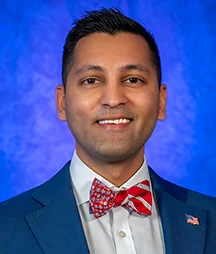
Manatee County Commissioner Tal Siddique | Photo courtesy of Manatee County
By comparison, this year, the Republican grassroots candidate for District 2 — Edward A. Bailey Jr. — has raised just $24,500 compared to incumbent Commissioner Amanda Ballard’s $60,000.
Fourteen candidates in 2024 collectively raised more than $834,000 before the primary. This year, with 19 candidates in the race, the total haul is about half that.
Elizabeth Arnold, who’s running to finish Carol Ann Felts’ term in District 1 after she died in office earlier this year, said it still feels like residents haven’t seen as much success as they would have liked following the movement’s two-year-old victory.
She said that many growth decisions still tilt in favor of development interests despite the current commissioners’ previous campaign promises.
“We tried really hard, we put up a good fight, and even with all that work, it’s still a 4-3 vote for more commercial, more paving over wetlands,” Arnold said. “I think the voters are getting weary.”
Candidates make their case
Many of this year’s candidates insist the grassroots movement is as strong as ever, banking on a repeat groundswell to carry them to victory.
Others were more leery, expecting a low-turnout primary as voters are less alarmed, less engaged and unlikely to show up in large numbers, especially on a ticket without President Donald Trump.
“There’s nothing driving them to go vote except for being my friend because nothing separates the six of us,” said Michael Harrison of Myakka City, who is also running in District 1 as a grassroots candidate. “We are all running on the same thing.”
But not all candidates see the race that way or face a field of opponents with similar views.
Republican Glen Gibellina, seeking to unseat Commissioner Mike Rahn in the primary, said he believes voters are as engaged as they were two years ago, if not more so.
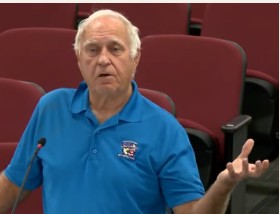
Glen Gibellina is running against current Manatee commissioner, Mike Rahn. | Courtesy Manatee County Supervisor of Elections
“The informed voter is not going to put up with this bullshit anymore,” said Gibellina, whose own campaign has drawn scrutiny as domestic violence arrests from a decade ago surfaced during this election. “The difference between then and now is that the candidates are being vetted more carefully than they were in 2024.”
Incumbents, on the other hand, focused on what they’ve accomplished over their four-year terms. Both commissioners Ballard and Rahn are running in district races located in more urban parts of the county where development concerns may not be as pressing to constituents.
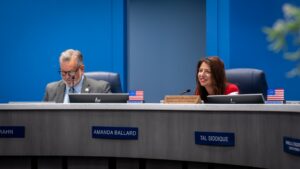
Both Mike Rahn and Amanda Ballard will have to survive a anti-incumbent climate this election season as they battle to keep their seats on the Manatee County Commission. | Courtesy Manatee County
Ballard said she hopes to survive the anti-incumbent climate by running as a results-driven candidate who isn’t afraid to speak her mind on complex topics — like the Bishop Animal Shelter project, which shelter volunteers have said lacks basic shade, among other shortcomings.
At a recent meeting, Ballard unsuccessfully suggested creating a dedicated funding source through a ballot initiative that would see residents tax themselves to fund improvements at the shelter.
She also told the crowd that she thought the current shelter was good, which resulted in boos.
“I’m not always just going to tell people what they want to hear or not take a stand on something I believe could be helpful or solve a problem just because it might be a little politically controversial,” she told Suncoast Searchlight.
Rahn, who has raised the most of any candidate, presented himself as the adult in the room, willing to tell people hard truths.
“I’m not a neighborhood activist,” Rahn said. “I’m a businessman, and you need business people to run a county.”
He also hasn’t backed away from one of his most controversial votes of his first term — a 2023 decision that reduced wetland buffers for development in the face of heavy opposition.
“It’s just a buffer,” he said of that controversy. “It’s not like we killed wetlands, and (if you) talk to the engineers like Representative Bill Conerly, they’ll tell you that if you really want to protect a buffer, build a wall around it.”
Both Rahn and Ballard have been portrayed by their opponents as friendly to developers and the final obstacles preventing the anti-development bloc from gaining a majority on the county commission.
Joe McClash, who served as a county commissioner from 1990 to 2012 and now publishes The Bradenton Times, said there’s still plenty of pent-up anger to drive voters to the polls. He said incumbents likely will take it on the chin once again this year.
“The voters, I believe, will still hold them accountable for choosing developers over the citizens,” McClash said. “From the surface though, you don’t see the energy out there, but it doesn’t mean that people forgot the reason to vote out candidates that are associated with developers.”
Derek Gilliam is a watchdog/investigative reporter for Suncoast Searchlight. Email him at derek@suncoastsearchlight.org.