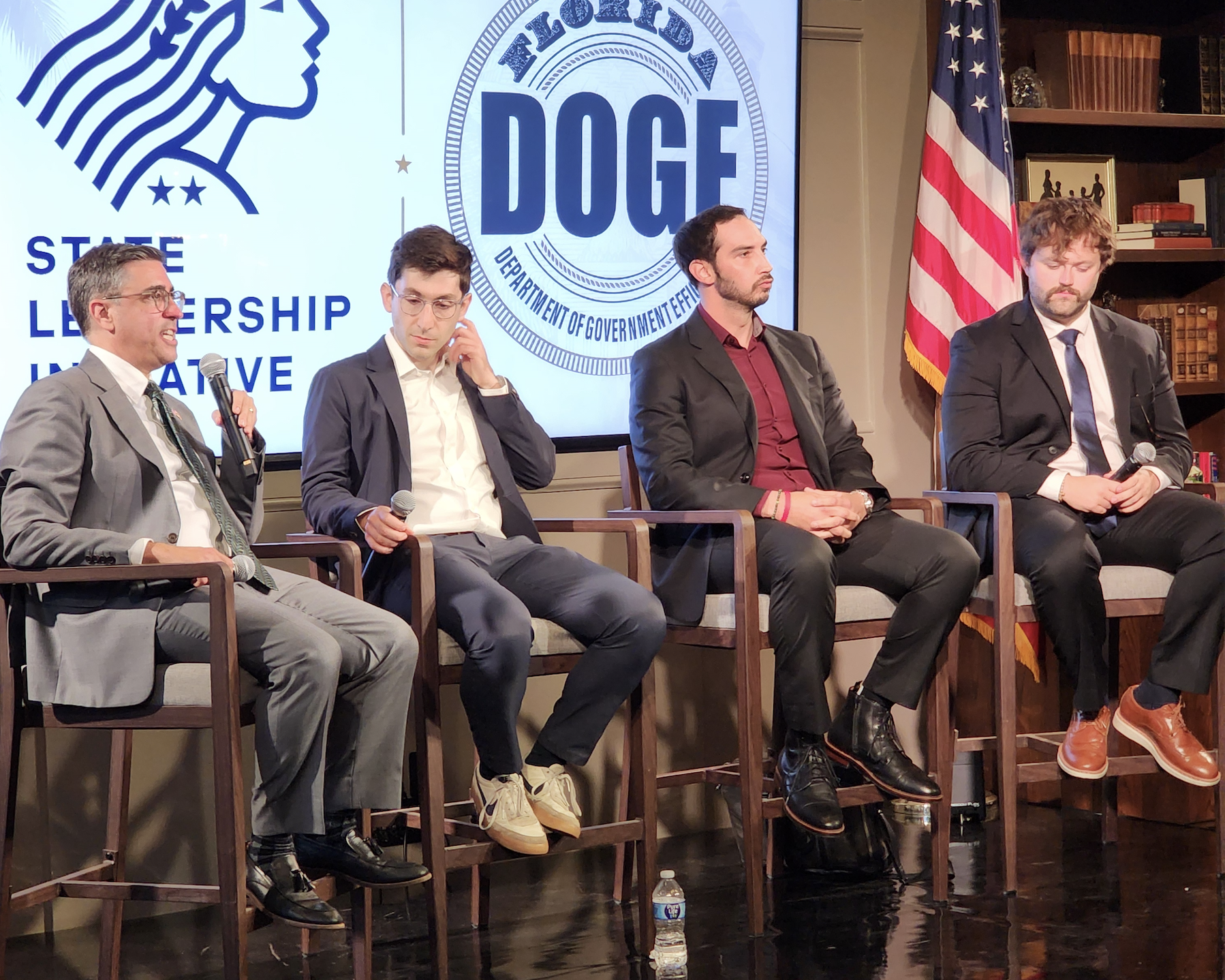
Eric Soskin, director of Florida’s DOGE task force, spoke at the event, which was hosted by State Leadership Initiative | Photo by Michael Barfield, Florida Trident/Florida Center for Government Accountability
D.C. event reveals extremist ties in Florida DOGE’s national push
On a July evening in Washington D.C., right-wing operatives and artificial intelligence enthusiasts gathered in a historic building on Capitol Hill to sip cocktails and hear from Florida officials about their efforts to slash local spending across the Sunshine State.
Standing in front of a pair of American flags, Florida’s Department of Government Efficiency — DOGE — director Eric Soskin and a collection of organizational “partners” offered up a pitch.
What Elon Musk tried and abandoned in Washington, they said, is alive in Tallahassee — and up for franchise.
“It’s very important to Gov. (Ron) DeSantis that the frontier of state DOGE and state conservative governance does not end in Florida,” said Soskin, “but that it is something that can be replicated and continued and made even better all across the 50 states.”
The event, which a reporter attended with a ticket, came a little more than a year after DeSantis launched Florida’s DOGE initiative.
During that time, the task force has facilitated “audits” of cities and counties across the state, criticizing local governments for their spending on things like diversity programming and climate initiatives. It has also taken aim at local officials who fought Tallahassee over other concerns in areas like Manatee, a solidly Republican county where state preemptions stymied local efforts to pass conservation and slow-growth measures last year.
A DOGE report issued in January accused Manatee County of wasteful spending, prompting pushback from local leaders. One prominent conservative activist called DeSantis’ DOGE effort an “imperial threat.”
But DeSantis has been far from the sole force propelling DOGE forward in Florida. The D.C. event on Tuesday revealed how Florida’s DOGE initiative has leaned heavily on rightwing think tanks and AI to audit local governments’ spending — and has ties to figures on the fringes of the far right.
The event offered the first glimpse at the private companies and organizations steering the DOGE push behind the scenes. Event organizers even passed around a printed playbook, and touted plans to duplicate the effort in other states, offering a direct pitch to Wisconsin’s Republican gubernatorial candidate, who was in the room.
The AI firms involved with Florida’s effort were present too, explaining the tool to potential buyers in other Republican states.
Florida DOGE event in D.C. linked to extreme right
DeSantis created the state’s self-styled DOGE team in February 2025, loosely modeling the task force after Elon Musk’s federal DOGE program, which terminated federal contracts and facilitated mass layoffs of the civil service.
Soskin, a Harvard-trained lawyer and the former U.S. Department of Transportation inspector general, jumped onboard as DeSantis’s DOGE adviser after being cut from the federal workforce himself by the Trump administration.
The group’s event in D.C. offered a snapshot of how Florida’s DOGE could soon spread to other states. It also highlighted the group’s ties to far-right organizations.
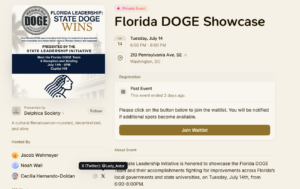
An invitation to the gathering shows Delphica Society as a “presenter” and Cecilia Hernado-Doldan as a host. | Photo by Michael Barfield, Florida Trident/Florida Center for Government Accountability
An official invitation to the function lists Delphica Society, a social club focused on “rebuilding Western culture,” as an event affiliate, and Cecilia Hernando-Doldan, who leads the club, as a host. RSVPs for the event were handled by Delphica, meaning the group could have retained the contact information and identities of the more than 100 people, including journalists, who registered.
Soskin, the director of the project, told a reporter he was unfamiliar with Delphica.
But the group’s role in circulating invitations suggests they travel in the same circles.
Under the username “Lady Astor,” Hernando-Doldan repeatedly posted content showing Nazi imagery and other blatantly racist material on the social media platform X in the days leading up to the event.
She shared World Cup-related memes portraying Black soccer players as monkeys and reposted a doctored image showing a Black player kneeling below an Argentinian player with glowing red eyes in a Nazi armband with a neo-Nazi symbol floating in the background. X appended its own warning to the post: “Visibility limited: this Post may violate X’s rules against hateful conduct.”
Hernando-Doldan has posted other memes celebrating Argentinian star Lionel Messi in Nazi regalia. Yet another meme invoked the 2020 murder of George Floyd, but with soccer players.
“THIS WORLD CUP BELONGS TO THE WHITE MAN,” read a post she shared Wednesday.
Soskin did not respond to additional questions about whether Florida officials had vetted the event’s organizers, or whether he or other state officials would attend gatherings associated with Delphica in the future.
Hernando-Doldan did not return requests for comment.
The group at the heart of Florida’s government efficiency efforts is State Leadership Initiative — an organization that has existed for just over a year.
Launched after President Donald Trump’s second term inauguration, State Leadership Initiative was founded by Noah Wall, a veteran conservative operative, and Nate Fischer — a far-right venture capitalist known in part for his reported role in the secretive anti-government fraternal organization Society for American Civic Renewal.
In an email, Wall wrote that the “extent of the involvement of the Delphica Society was sharing the invite with their email list.” Of Hernando-Doldan’s Nazi-themed and racist posts on X, Wall wrote, “Cicilia is Argentinian, and appears to be a soccer fan, enjoying the World Cup, which is an area outside my expertise.”
Fischer, the co-founder of Wall’s group, did not return requests for comment. He has also posted rhetoric on social media tinged with violence.
“A small segment of the population just needs to be killed,” Fischer wrote on X last month, in a post musing about violent crime. “Execute such people for a few generations, and we could have a civil society against (sic).”
Fischer and Wall embrace a vision of the United States that slashes government regulations and funding, while expelling immigrants through a policy of mass deportation.
The place to start, they argue, is in Republican areas, writing on their website that they seek to“deliver a mandate for Red States to enact inspiring, foundational reforms.”
There, the group seeks to launch a “new manifest destiny,” Fischer and Wall wrote in a February 2025 post on X — nodding to the 19th century doctrine that justified white settlers’ expulsion of Native Americans through western expansion.
The group has promoted projects like Florida DOGE as their first step.
DOGE took aim at local governments
During his year running Florida’s government efficiency program, Soskin has focused his sights on local governments.
DEI programs and climate initiatives have drawn the attention of Florida’s DOGE efforts in particular. At the D.C. event, Soskin claimed those programs had accomplished “almost no good whatsoever.”
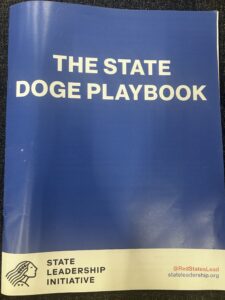
State Leadership Initiative and DeSantis advisor Eric Soskin created a playbook for other Republican states, to help them create their own DOGE initiatives. | Photo by Alice Herman, Suncoast Searchlight
He mused about DOGE’s Florida efforts to root out spending in local communities, noting the task force’s much-publicized DOGE site visits to city halls and county buildings “were not necessarily the most effective or efficient way” to find objectionable spending. Instead, he highlighted the role of artificial intelligence in rooting out government waste.
“The State DOGE Playbook,” a 63-page booklet circulated at the D.C. event, outlines the strategy in depth for others to take back to their home states.
“Local governments present a different challenge than state agencies,” the playbook reads, noting that in some cases, state DOGE teams may lack the authority to make unilateral decisions on behalf of local governments.
For places like Florida, the playbook suggests DOGE teams consider stripping away local “home rule” power to hand over more decision-making to state lawmakers.
“The legislature retains the power to preempt local action on specific subjects even in strong home rule states,” the playbook outlines. An alternative, it says, is the “cooperative path,” in which local governments agree to audit themselves to avoid sanctions — citing Miami-Dade County Commissioner Roberto Gonzalez as a local helper.
State lawmakers have ramped up such preemption laws under the DeSantis administration.
In Manatee County, Republican commissioners— who campaigned on a platform of slowing rapid development — ran headfirst into preemption last year when a law restricting counties from passing building regulations in the wake of major storms blocked them from advancing modest conservation measures and development regulations.
That same preemption law, known as SB 180, generated statewide backlash, underscoring a rift between Tallahassee Republicans and grassroots conservatives.
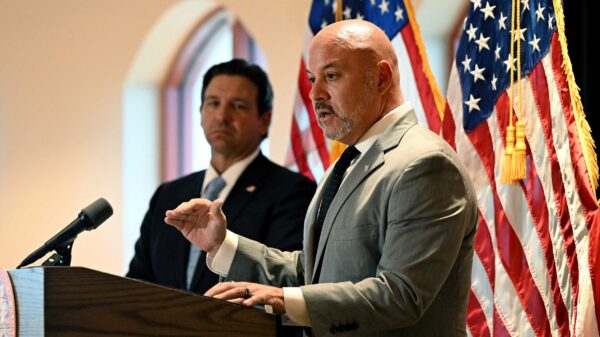
Florida’s chief financial officer, Blaise Ingoglia, appeared with Gov. Ron DeSantis in Bradenton in July 2025 to announce the state’s plans to bring DOGE to Manatee County. | Photo by Tiffany Tompkins, Bradenton Herald
In January, Florida’s DOGE task force released a report alleging that, “in parallel” with Florida Chief Financial Officer Blaise Ingoglio, DOGE had identified nearly $1.9 billion in wasteful spending by local governments across the state.
Some of the counties and municipalities mentioned in the DOGE report, including Manatee, have rejected its conclusions.
Manatee County Administrator Charlie Bishop defended county purchases highlighted in the DOGE report as money appropriately spent. Orange County Mayor Jerry Demings called the project “tainted” and “politically motivated.” Palm Beach County officials, too, rejected the report.
‘Take it national’
During the Tuesday event, though, members of the DOGE team, alongside AI vendors they have worked with and State Leadership Initiative, lauded Florida’s efforts.
“About six months ago, we started working with Florida DOGE and their amazing, visionary team,” said Wall, the president of State Leadership Initiative. “We want to take the work that they’ve done and take it national.”
From the stage, Wall said Florida’s efforts stemmed from the work of a small team, “amplif[ied] with AI” — later giving the floor to a series of startup founders seeking new government contracts outside the Sunshine State.

Attendees watched a Florida DOGE panel in Washington, D.C. | Photo by Michael Barfield, Florida Trident/Florida Center for Government Accountability
Among them was Adam Hoffman, a 25-year old Princeton graduate who left Ken Griffin’s investment firm Citadel to join Musk’s federal DOGE in March 2025. He emerged from the White House with “Echelon,” a startup that “plugs into an organization’s backend enterprise systems.” Hoffman described it as an AI substitute for operations staff. His primary clients, he said, are private equity firms.
But in Florida, Hoffman used his program to audit the Lee County School District.
The DOGE Playbook refers to how Echelon “analyz[ed] the organization’s people and structure to identify…where resources could be realigned, where contracts could be renegotiated, restructured, or eliminated, and where other AI-based tools could be leveraged to improve efficiency.”
Teachers, Soskin said during the presentation, were not a target of the audit.
Other AI firms that Florida DOGE has worked with — companies with names like Vulcan Technologies, DigiBuild, WiseOwl and BrainCo — got a nod from the DOGE team as well.
Alongside companies like these, Wall told the room, Republican state officials could replicate Florida’s work. Without such efforts, he said, red states “are in many cases just blue states with lower taxes,” captured by a “massive shadow government” of non-governmental organizations headquartered in Washington.
Wall said the job is “to expose them and to cut their legs out from under them.”
Wall said that the State Leadership Initiative wanted to provide a roadmap to reproduce Florida’s work in every Republican state.
GOP Congressman Tom Tiffany, now running for governor of Wisconsin, sat in the audience.
Wall thanked him for attending and said he hoped Florida’s model would become “the default expectation for every Republican who decides to run for governor.”
Alice Herman is an investigative/watchdog reporter for Suncoast Searchlight, and Michael Barfield is an investigative reporter for the Florida Trident. Email Alice at alice@suncoastsearchlight.org; email Michael at barfield@flcga.org.