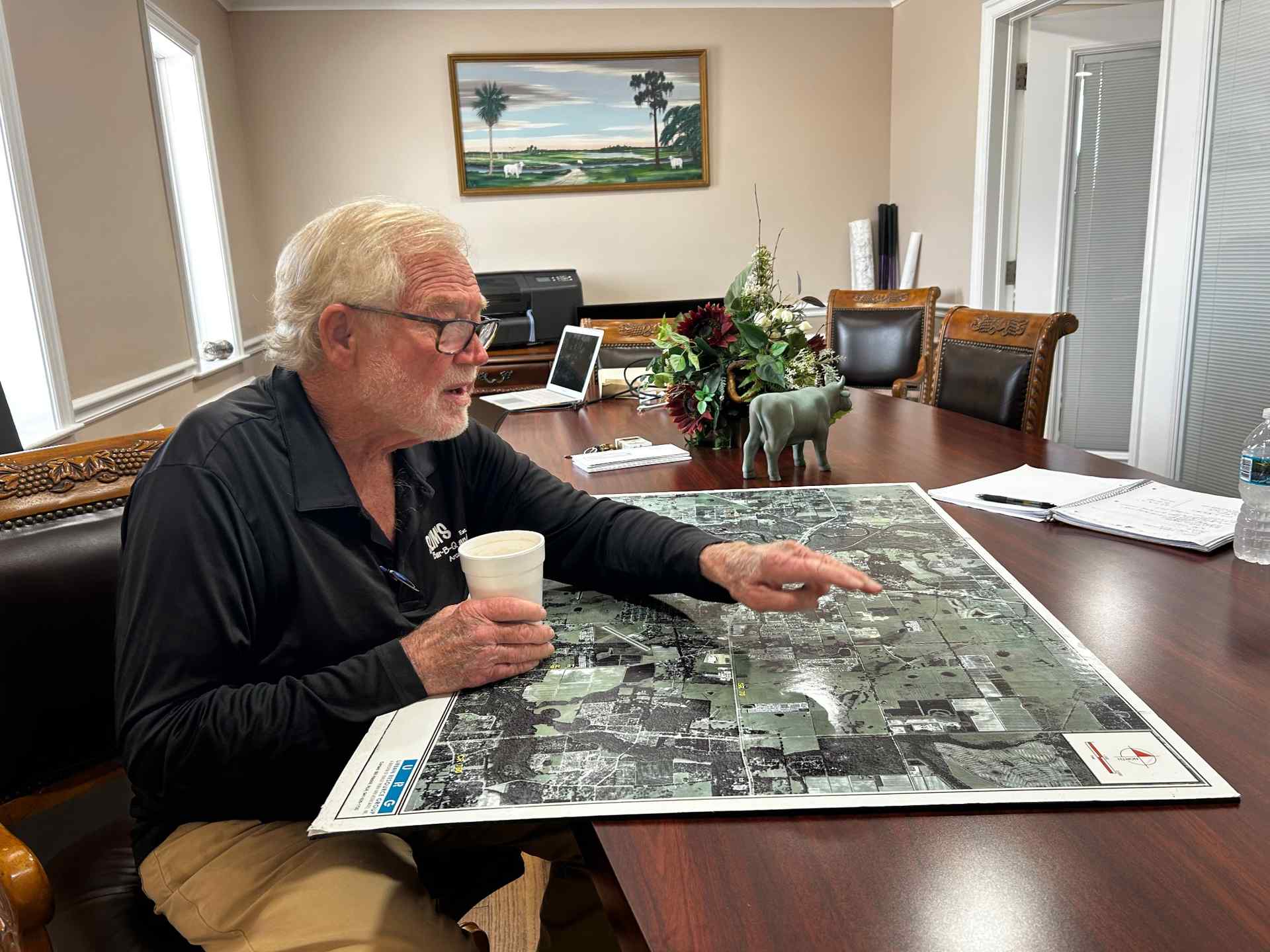
Eugene Turner, a fourth-generation Floridian, vowed not to sell his land to DCIP Group. | Photo by Alice Herman, Suncoast Searchlight
Developers push massive data center complex in DeSoto County amid backlash
On a Wednesday afternoon in May, Eugene Turner sorted through maps of DeSoto County, laying one on a wooden table in his Arcadia real estate office.
Turner scrutinized the map, pointing to properties in the rural county that had grown citrus and raised cattle for decades, some owned by families like his that had passed the land down from one generation to the next.
“We got 5,000 acres of citrus,” said Turner, who describes himself as a fourth-generation Floridian. “I wish we didn’t.”
He lamented how the once-profitable citrus industry that made the orange a symbol of sunny Florida has crumbled as citrus greening — a disease that stunts the growth of oranges — has swept the state.
In DeSoto County, not much has grown in its place.
But snaking under the soil, a natural gas pipeline that stretches from Texas through Louisiana, Mississippi, Alabama and down into Florida could power a tantalizing new economic opportunity — in the form of a sprawling complex of AI data centers.
In March, DeSoto County voted to rezone 34 acres of land on a decommissioned power plant to allow the company DCIP Group to begin the process of constructing its first data center there, using natural gas supplied from the Florida Gas Transmission Pipeline. County commissioners have embraced the proposal, which they herald as financial salvation that could fill the county’s coffers and help the rural community weather budget shortfalls.
Some residents have pushed back, mounting concerns about water use, ambient noise and pollution. And although the developers have promised not to draw from the local power grid, gas-powered data centers like this one pose their own environmental risks — with some reportedly set to emit more greenhouse gases than small nations.
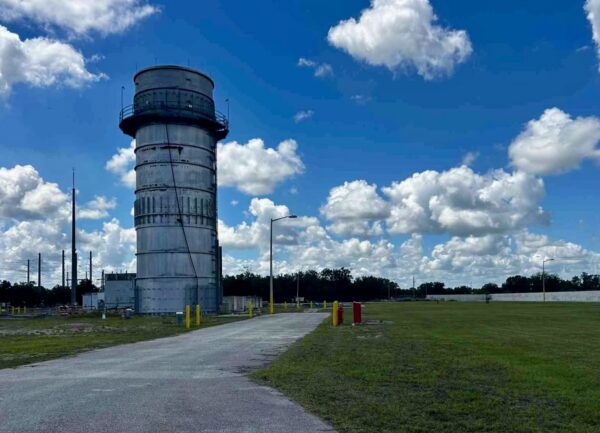
A proposed data center project in DeSoto County would be located on the site of a decommissioned power plant. | Photo by Alice Herman, Suncoast Searchlight
DCIP Group’s proposal mirrors a growing trend in the industry toward hyperscale data centers that require more power to fuel the artificial intelligence boom. The energy-intensive project would pull thousands of megawatts if it reaches the ultimate size the company has advertised to investors.
In an interview with Suncoast Searchlight, DCIP Group CEO Jon Brown and chairman Wilson Trilha said the project would not put pressure on neighbors. They also said they plan to use a closed-loop cooling system that will demand far less water than other large-scale projects.
“Change is hard, and we understand that,” Brown said. “But in the end, I think this project is great for the community. I think it’s going to be good for the county.”
Turner, whose family owns land adjacent to DCIP Group’s first proposed data center, disagrees.
Pointing to little squares on the map in his office — hundreds of acres of ranch land dotted with cattle — he vowed not to give up his own.
“They can’t push me to sell,” Turner said. “My position isn’t ‘no,’ but ‘hell no.’”
‘One of the largest data center projects on Earth’
Turner’s sprawling land isn’t the only space where DCIP Group could seek to expand.
According to public records reviewed by Suncoast Searchlight, the company has already sought to rezone more property adjacent to its initial development — bringing the project’s proposed total footprint to more than 825 acres.
At industry conferences and on social media, the Florida-based company has promoted its early push into DeSoto County as a first step in a dramatic escalation that could eventually make the AI data center one of the largest in the country.
Before a digital infrastructure conference in Fort Lauderdale in February, a DCIP Group adviser announced on LinkedIn that the project was sitting on more than 1,000 acres of developable land — far larger than the initial 34-acre site approved in March.
The adviser, Todd Smith, posted about the project online again before an April conference in Houston, calling it “one of the largest data center projects on Earth.”
In an interview, Brown, the company’s CEO, said the final project — if approved by the county — would span 1,300 acres, a little more than two square miles, consisting of numerous facilities scattered throughout the area.
The largest operating data centers in the United States are currently much smaller than the project proposed in DeSoto — drawing 750 megawatts or less, compared to the 4,000 that DCIP Group says its site could one day demand.
According to Cleanview, which tracks data centers and energy infrastructure, other “hyperscale” data centers like the one in DeSoto are sprouting across the country as the rush for AI data storage stretches into rural America.
The graphics processing units, or GPUs, that run programs like ChatGPT, require more energy than typical microchips. As these kinds of AI services become ubiquitous, they will continue to require more energy to train their models, and hyperscale data centers are popping up to meet that demand.
A pending project in Ohio would draw more than 9,000 megawatts of energy, more than 12 times the energy draw of the nation’s largest currently operating center. In Utah, another planned hyperscale data center would require more than double the amount of energy the entire state currently uses, generating widespread community backlash.
More than 610 data centers are now operating in the United States, according to Cleanview, which had identified 964 facilities in the works as of May 21. Data Center Map, an industry group that tracks existing and new projects, has identified far more. By its count, there are more than 4,200 planned and existing data centers across the U.S., including 109 in Florida alone.
Scrambling for an energy source to propel massive data centers, these companies are turning away from using local power grids — a practice that has jacked up utility rates in their communities — and instead seeking to generate energy from natural gas.
DCIP Group is one of them. The company has made its reliance on natural gas a centerpiece of its public relations campaign.
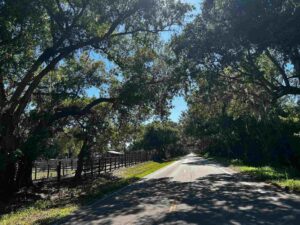
DeSoto County’s first data center would be built on Roan Street, a canopied road lined with cattle ranches. | Photo by Alice Herman, Suncoast Searchlight
In a promotional slideshow the company shared with DeSoto County commissioners, DCIP Group emphasized how it will rely primarily on gas to power its site.
“By generating power on-site,” the slideshow reads, “we remove the primary source of conflict between digital infrastructure development and community interests.”
The slideshow offers other talking points, including the company’s promise to employ “contemporary acoustic design” to keep the project quiet. Trilha, DCIP Group’s chairman, shared the presentation with county officials in mid-January, according to emails obtained by Suncoast Searchlight through a public records request.
By the end of January, the company’s directors had already met individually with DeSoto County commissioners to share their pitch, the emails show.
Project proposal spurs community backlash
During a March county commission meeting, community members voiced worries about the proposed data center, citing fears of pollution, excess water use and noise.
“Besides the power plant, there will be cooling fans for the technology and so forth, and our new high school is less than three miles away,” resident Carol Mahler said. “I also want to ask about greenhouse gas pollution, I know that the plant is going to be fired by natural gas, but it’s still gonna create those greenhouse gases.”
According to an April report in WIRED, air permits tied to 11 data centers serving companies like Meta, OpenAI and Microsoft would have the capacity to create more greenhouse gas emissions than entire nations like Jordan, Croatia, Costa Rica and The Bahamas.
Data centers could also have consequences for the health of nearby communities.
Public health researchers studying the possible health impacts of the Vantage data center in Virginia found it could result in more than $50 million in annual medical costs — largely due to cardiac and respiratory issues associated with the fine particulate matter emitted from the plant.
New research on the impacts of hyperscale data centers also suggests that these facilities can create “heat islands” near the massive plants causing significant temperature increases.
County commissioners have so far welcomed plans to develop data centers in DeSoto County. | Photo by Alice Herman, Suncoast Searchlight
Large-scale data centers can be noisy, too.
Donna Ruby, who lives part-time with her mother in DeSoto County and part-time in Mississippi, said the xAI data center in Southaven, Mississippi has harmed the public with noise and pollution.
During the DeSoto commission meeting in March, Ruby held her cell phone up to the microphone and played a recording of the facility’s droning whine.
“That noise never ends, never, never ends, it is a constant, 24/7 noise,” said Ruby, who made the recording from her Mississippi home. “We can hear this in our houses, [some neighbors] can hear it from miles and miles away.”
During the meeting, Kerri Burns, a consultant for DCIP Group from SWCA Environmental Consultants said it would be different in DeSoto County.
Addressing the near-ubiquitous concerns about water, she said three wells on the property had the capacity to draw 100,000 gallons of water a day, and in an interview with Suncoast Searchlight, Brown, the DCIP Group CEO, said the company would seek to use reclaimed water for its operations. But he was unable to answer more specific questions about the planned facility’s daily water use.
“The technology has advanced to where the water is not the pinch point anymore,” said Brown.
When commissioners voted to rezone the first 34-acre property in March, they imposed a 55 A-weighted decibel noise limit 200 feet from nearby property lines.
An early version of a bill drafted in the Florida House of Representatives this year also sought to address concerns like those raised by DeSoto residents, creating hurdles for companies seeking to develop within five miles of schools or residential properties.
But the legislation that ultimately passed — SB 484 — makes no mention of schools or homes. DCIP Group, whose project is located about 2.5 miles from the county high school, supported the final bill.
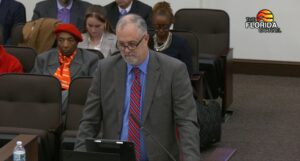
Jon Brown, CEO of DCIP Group, spoke at a senate committee meeting in January about a new bill regulating data centers | Screengrab from the Florida Channel
“I’ve looked [at] videos online from people who live near data centers, or even a distance from them, and it’s this constant hum,” Arcadia resident Sarah Hollenhorst said in an interview with Suncoast Searchlight. “This constant noise is going to cause stress for people’s health.”
But Hollenhorst said she understands why the county may embrace the project despite public anxieties.
“There’s a tax issue, and this county’s in trouble as far as that goes,” she said. “The whole thing makes me kind of sick.”
County commissioners’ support apparently steadfast
In an interview with Suncoast Searchlight, Commissioner Elton Langford, who supports the project, said above all, he was drawn to the possibility of dramatically increasing the county’s tax base.
DCIP Group has suggested that the initial property — once built — could be valued at close to $4 billion.
“It’s a big boost to the economy, to the tax roll for DeSoto County,” said Langford, estimating the first data center could generate $26 million annually in local taxes. That money could be used to lower taxes or fund improvements to the local jail, which Langford said is in dire need of repairs.
“We need a new jail in DeSoto County, and we’ve been needing one for 20 years,” said Langford. “To be honest with you, we’ve just never had the funds to be able to build it.”
With Republicans in Tallahassee toying with the idea of eliminating property taxes for homeowners whose primary residence is in Florida, the commissioners see the need for new tax revenue as particularly urgent.
As DCIP Group seeks to rezone another parcel of land for its expansion, the faster county staff move on any applications, Langdon said, the better.
“It’ll come before the county commissioners for the other two parcels that they’ve got tied up right now,” Langford said. “There’s a very small window of time … and if we miss that window, they’re going to walk away.”
Alice Herman is an investigative watchdog reporter at Suncoast Searchlight. Email Alice at alice@suncoastsearchlight.org.