
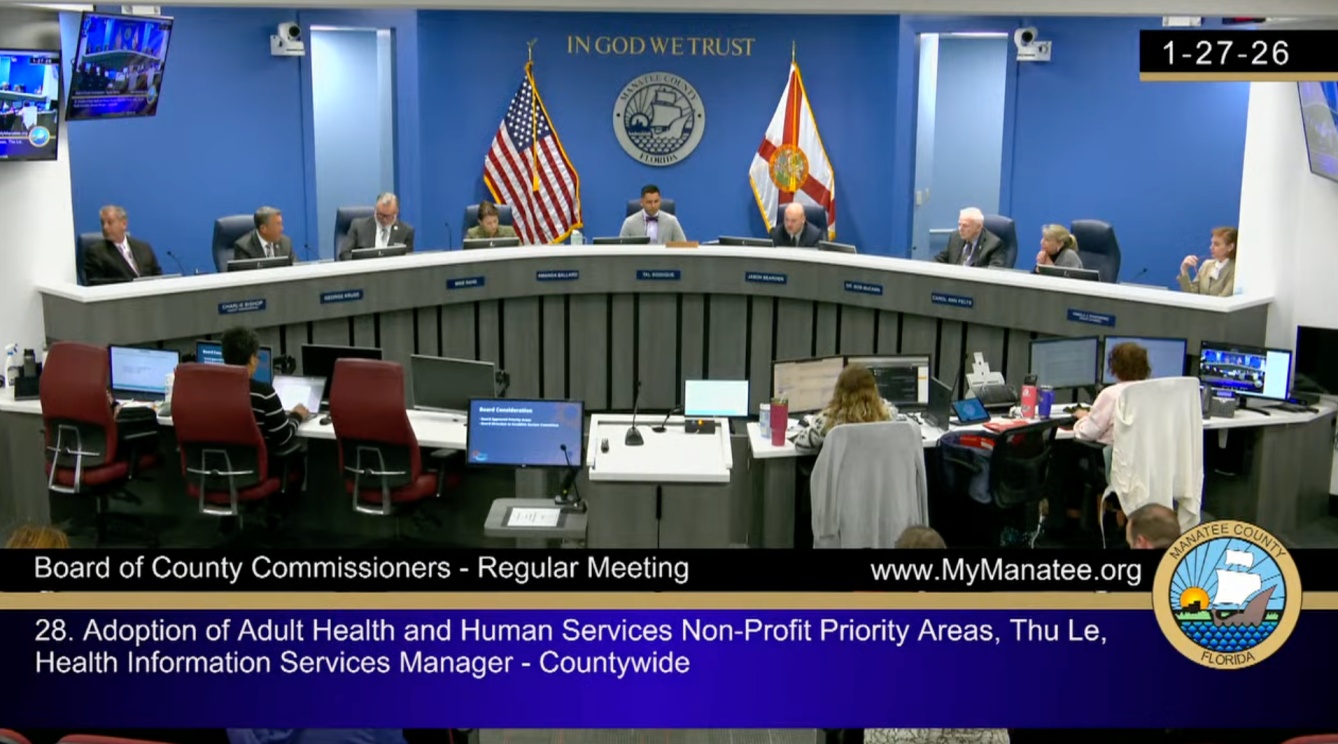
Manatee County Commissioners discuss changes to the county’s nonprofit funding requirements at the Jan. 27 meeting. | Image from Manatee County, via YouTube
Manatee County revisits undocumented immigrant policy amid nonprofit concerns
After weeks of silence that left some nonprofit leaders wondering whether the issue had faded, Manatee County commissioners are set to revisit a controversial proposal requiring nonprofits receiving county funding to verify the legal status of the people they serve.
The proposal, which appears on the commission’s Tuesday agenda, would align the county’s grantmaking with a federal law that restricts certain public benefits for people living in the country without legal authorization.
If approved, the measure would require nonprofits to certify that county funds are not used to serve those individuals, a change that could affect at least 86 organizations receiving more than $26 million annually from Manatee County Government.
Nonprofits that don’t comply could lose that funding, which supports programs such as early childhood development, college readiness, shelters, dental care, sexual assault advocacy and addiction recovery.
Exempt from the restriction are programs that provide immunizations, emergency health care, short-term disaster relief and similar services.
The idea was first raised in September and revived again in January, drawing concern from nonprofits and even community leaders who questioned how immigration status would be defined and verified, and warned the proposal could add costs and bureaucracy while discouraging people from seeking help.
Evelyn Almodóvar, executive director of UnidosNow, a nonprofit whose mission is to elevate the quality of life for Latinos in the region, said her organization does not ask about legal status and would reconsider accepting county funding if required to do so.
“If that’s a requirement, we will forgo the funding,” she said
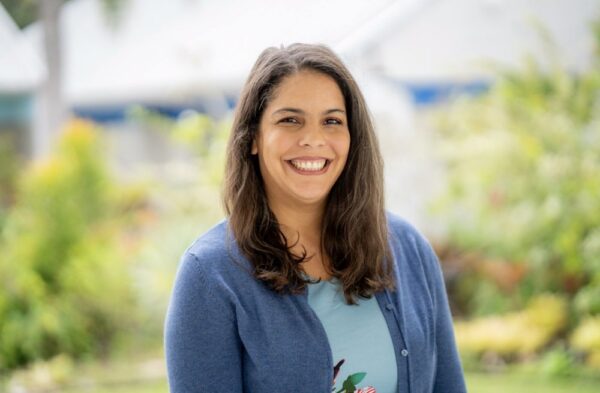
Evelyn Almodóvar, executive director of UnidosNow, said her organization does not ask about legal status and would reconsider accepting county funding if required to do so. | Photo courtesy of UnidosNow
UnidosNow receives about $72,000 in county funding and has an application pending for more than $100,000 to support its Future Leaders Academy, a college and career readiness program for high school students.
Almodóvar said requiring nonprofits to collect immigration information could undermine trust and discourage families from participating, effectively creating what she described as a “registry that could put them in danger.”
Commissioner Amanda Ballard, who brought forward the proposal, said the intent is not to target any one group but to ensure the county is complying with federal law and using taxpayer dollars appropriately. She said the requirement has long existed under federal statute, even if it has not been reflected in the county’s nonprofit contracts.
“Just because we’ve been doing something incorrectly for a long time doesn’t mean we should continue to do it,” she told Suncoast Searchlight.
Ballard acknowledged the proposal could create burdens for nonprofits, but she said many organizations already follow similar rules when they receive federal or state funding and have systems in place to determine eligibility.
“We’ve got a limited pot of funds, and we have a lot of people in this county who are here legally who need help,” Ballard said.
She added that, based on discussions with the county attorney, compliance could be handled through a simple attestation, though commissioners could also direct staff to develop a more detailed process.
The proposal would not prevent nonprofits from serving undocumented residents, but they would need to use other funding sources to do so. How organizations would ensure that separation — including how they determine who qualifies — would largely be left up to the nonprofits.
That’s where some providers say the challenge lies.
Immigration status is often more complicated than a simple yes-or-no distinction, Almodóvar said. She described a family she is working with in which a father had temporary protected status and was working legally, but later lost that status under federal policy changes while still retaining a valid work permit.
“What does documented mean?” Almodóvar said.
She said nonprofits lack the expertise to make those determinations and could be put at risk if they are expected to verify eligibility — a concern echoed by Alice Newlon, a board member with the League of Women Voters of Manatee County.

Commissioner Amanda Ballard, who brought forward the proposal, said the intent is not to target any one group but to ensure the county is complying with federal law and using taxpayer dollars appropriately. | Photo courtesy of Manatee County
“There’s no functional way for them to screen effectively, which is going to set them up for lawsuits. It’s going to open them up for lots of expenses… for denying services.”
Newlon, who opposes the proposal, said it could create confusion and discourage people from seeking aid even when they’re entitled to it, with ripple effects across health, education, safety and other community outcomes.
E-Verify and Social Security are common ways to verify eligibility for certain benefits and employment. However, one nonprofit leader noted that many are in the country legally without a Social Security number, like those who are awaiting asylum hearings.
Newlon also pointed to the fact that other counties in the state have not implemented the same measures.
“Why would we do it? They’re not doing it in Sarasota County, DeSoto County, Pinellas, Hillsborough,” Newlon said. “Why should we be the sacrificial lambs that find out for those around us. That just doesn’t work.”
Commission Chairman Tal Siddique said he has heard similar concerns from nonprofit providers and shares some of their unease.
Asked why other local governments have not taken similar steps, Siddique said it’s likely because “no one enforces it.”
He said the push in Manatee County is being driven by public demand, but that it also raises concerns about potential legal exposure if the county does not comply with federal law.
“I think we have to proceed very cautiously on this,” he said. “I hope we don’t create a situation where too many people will be turned away. We don’t want this to impact kids. It’s the worst thing we can do. They’re already a vulnerable population.”
The discussion comes amid a broader national crackdown on immigration from President Donald Trump’s administration that has involved the mass arrest and deportation of thousands of undocumented immigrants using tactics that have sparked national outcry and protests.
In February 2025, Trump signed an executive order “to ensure taxpayer resources are not used to incentivize or support illegal immigration” and ordered federal departments to “take corrective action” on programs that were using federal funds to provide financial benefits for undocumented immigrants.
The proposal has also drawn the attention of community leaders, some of whom have been working behind the scenes with nonprofits and county officials to address concerns. Veronica Thames, president and CEO of the Manatee Community Foundation said she is helping organize a meeting between nonprofit leaders and Ballard to discuss the proposal and its potential impact.
“I deeply appreciate the commission’s diligence in making sure public dollars are used appropriately and in compliance with the law,” said Veronica Thames, president and CEO of the Manatee Community Foundation. “At the same time, nonprofit partners are concerned that requiring enforcement locally could create new burdens and distract from delivering services.
“I’m grateful that Commissioner Amanda Ballard will be meeting with nonprofit partners to better understand the impact before any process is put in place.”
Manatee County commissioners are expected to discuss Ballard’s proposal during Tuesday’s 9 a.m. public meeting at the Manatee County Administration Building, 1112 Manatee Ave. W., Bradenton.
This story is a collaboration between the Bradenton Herald and Suncoast Searchlight, a nonprofit newsroom of the Community News Collaborative serving Sarasota, Manatee and DeSoto counties. Learn more at suncoastsearchlight.org.