
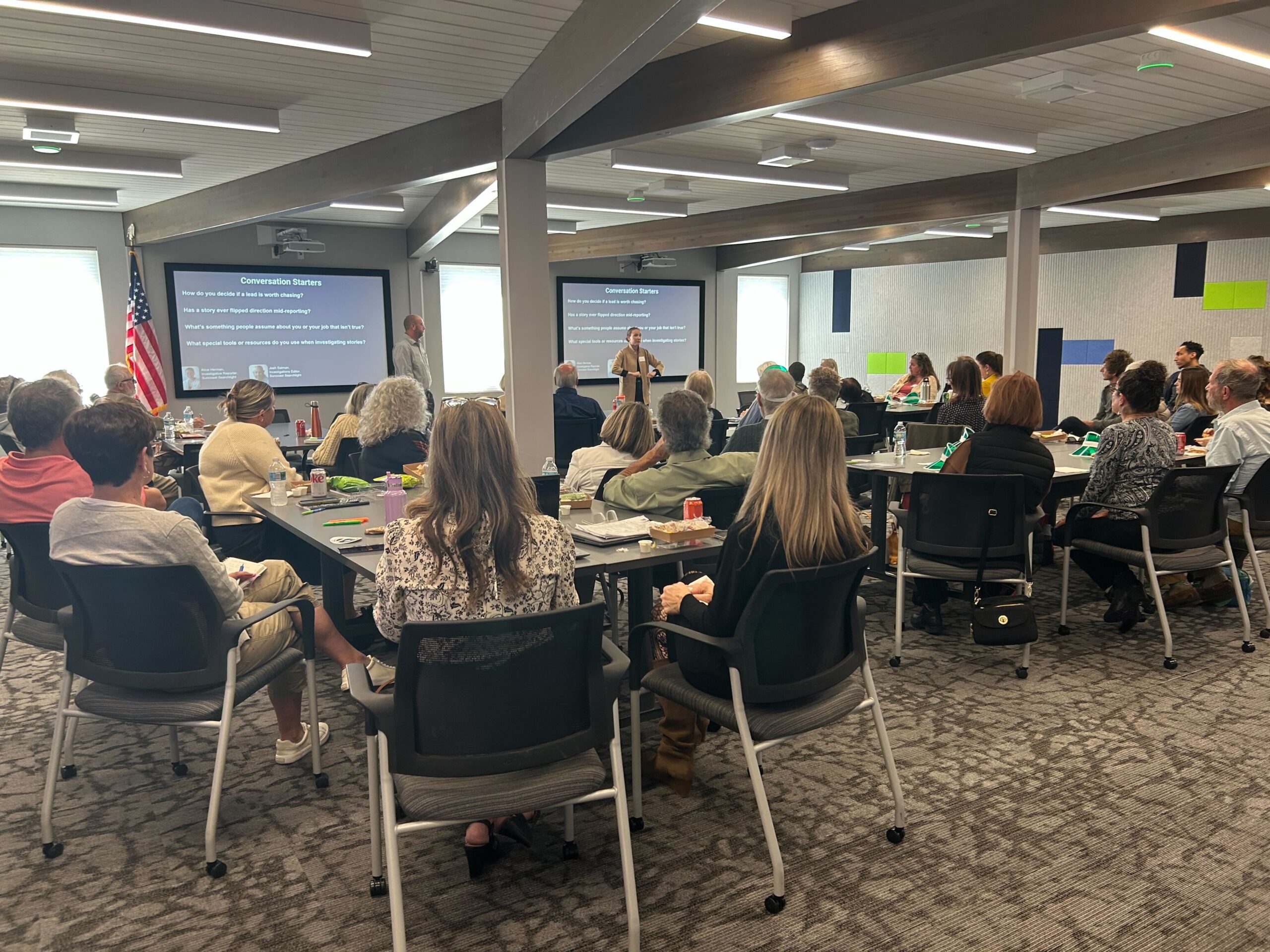
Dozens gathered at Manatee Community Foundation for Suncoast Searchlight’s community engagement event — "From Tip to Truth" — sponsored by Gulf Coast Community Foundation. | Photo by Samantha Ramlall, Suncoast Searchlight
‘From Tip to Truth’ draws crowd for inside look at investigative reporting
How do you decide if a lead is worth chasing?
What special tools or resources do you use when investigating stories?
Can you share a time you got blowback for your reporting and what you did about it?
Suncoast Searchlight journalists answered these and other questions during a one-hour event designed to take readers inside the reporting process, explain how investigative decisions are made and create space for open conversation between journalists and the communities they serve.
“From Tip to Truth: How Investigative Reporting Takes Shape” was the third in Suncoast Searchlight’s ongoing series of community engagement events sponsored by Gulf Coast Community Foundation. The series is built around the idea that accountability journalism is better understood — and trusted — when reporters are visible and transparent about their work.
The event, held at Manatee Community Foundation in Bradenton, drew a crowd of about 40 people. Attendees heard from journalists Josh Salman and Alice Herman, who shared examples from their reporting and walked through how stories evolve.
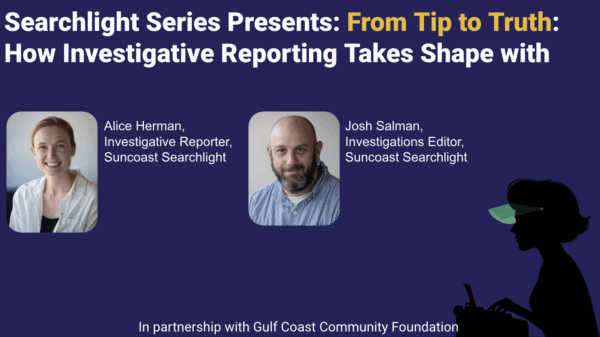
“I think about the stakes and I think about whether the story will be useful to people,” said Herman, an investigative/watchdog reporter in response to the question about deciding whether a lead is worth chasing.
Not all leads or tips pan out, she said. Journalists must evaluate whether a claim can be proved through records, interviews, data or other reporting and whether pursuing it would result in an impactful or meaningful story.
With limited resources, nonprofit newsrooms like Suncoast Searchlight also must consider their ability to chase some leads, especially when doing so would incur significant time or expense.
And among the biggest expenses facing newsrooms these days are public records fees.
Herman said that some government agencies charge exorbitant fees for records — a practice she described as a way to block journalists from accessing information. The Florida Office of the Attorney General, for example, recently charged her more than $7,000 for entries submitted to its “Combat Violent Extremism Portal.” which it launched in September after the murder of conservative activist Charlie Kirk.
Salman, Suncoast Searchlight’s investigations editor, took the question about what tools journalists use to investigate stories.
“Some things have not changed — knocking on doors, picking up the phone, shoe leather reporting,” he said. “But a lot has changed, like data journalism … and AI, which is scary but also great. We can’t run from it. We did that with the Internet, and look where that got us.”
Salman talked about how journalists frequently request and analyze data to inform their stories, using spreadsheets and even coding as a regular part of their jobs. With regards to artificial intelligence, he said, newsrooms are learning how to ethically and responsibly incorporate it into their workflows.
Suncoast Searchlight adopted an AI policy in December that guides the organization’s use of the technology.
Salman also talked about blowback, acknowledging that journalists sometimes face criticism for their reporting, especially when it reveals uncomfortable or unflattering truths about powerful people or institutions.
He recalled the pushback he and his reporting partners at the Sarasota Herald-Tribune faced after publishing Bias on the Bench, a 2016 investigation that found Florida trial judges sentenced Black defendants to harsher sentences than white defendants accused of the same crime under nearly identical circumstances.
Judges did not like the series of stories and some attempted to discredit the report. Despite this, the investigation led to legislative reform in 2018 with the passage of law requiring more transparency and accountability in the justice system.
“We had to stand strong and not let that affect us,” Salman said of the criticism.
Attendee Traci Willingham said she had not thought about the blowback journalists might face for doing their job and that she had a greater respect for the profession after the event.
“This is such an important topic,” she said. “I’m a big supporter of journalism and wanted to learn more about how these decisions are made and what goes into reporting a story, and I feel like I learned a lot today.”
Another attendee, Dan Bradley, a retired broadcast journalist who had participated in community forums himself during his career, said the event gave him a new appreciation for the vulnerability in explaining journalistic work in public.
Rather than defending their reporting, he said, Herman and Salman focused on explaining how and why they do their jobs — a choice that stood out to him.
“One thing that was clear is how deeply personal they take the work,” he said. “When you’ve got journalists willing to stand there and expose that kind of vulnerability to a room full of strangers, to stand up for what they believe in, it will only make your reporting better.”
Get stories like this delivered to your inbox weekly: Sign up for the Suncoast Searchlight newsletter